

The Essential Eight Maturity Model Explained for Australian Businesses
Australian businesses are relying on technology more than ever. Staff need secure access to email, files, cloud apps, customer records and internal systems from different locations and devices. At the same time, cyber criminals are looking for weak passwords, unpatched software, misconfigured cloud services and backups they can delete before asking for a ransom.
That is why the Essential Eight maturity model has become such an important cyber security reference point in Australia. It gives organisations a practical way to assess core security controls, decide what needs to improve, and build a staged uplift plan rather than reacting to every new threat in isolation.
This guide explains what the model is, how the maturity levels work, and how your business can use it to improve security without making technology harder than it needs to be.
What is the Essential Eight maturity model?
The Essential Eight is a set of eight cyber security mitigation strategies developed by the Australian Signals Directorate through the Australian Cyber Security Centre. These strategies are designed to make it harder for attackers to compromise internet-connected IT environments, limit the damage if an incident occurs, and improve the ability to recover.
The Essential Eight maturity model takes those eight strategies and turns them into a graduated roadmap. Instead of simply asking whether a control exists, it helps organisations understand how well that control has been implemented across the environment.
This distinction matters. A business may have multi-factor authentication enabled for some users but not for administrators. It may run backups but never test a restore. It may patch laptops but miss internet-facing systems. The maturity model helps uncover these gaps so leaders can see the difference between having a tool and having a dependable security control.
The model is not a product or one-off certification, and ASD updates it as attacker tradecraft changes. It is a practical baseline that should sit alongside incident response planning, staff awareness and ongoing IT governance.
Why the Essential Eight maturity model matters for Australian businesses
For many small and medium businesses, cyber security can feel overwhelming. There are countless tools, frameworks, alerts and opinions competing for attention. The Essential Eight helps cut through that noise by focusing on controls that address common and damaging attack paths.
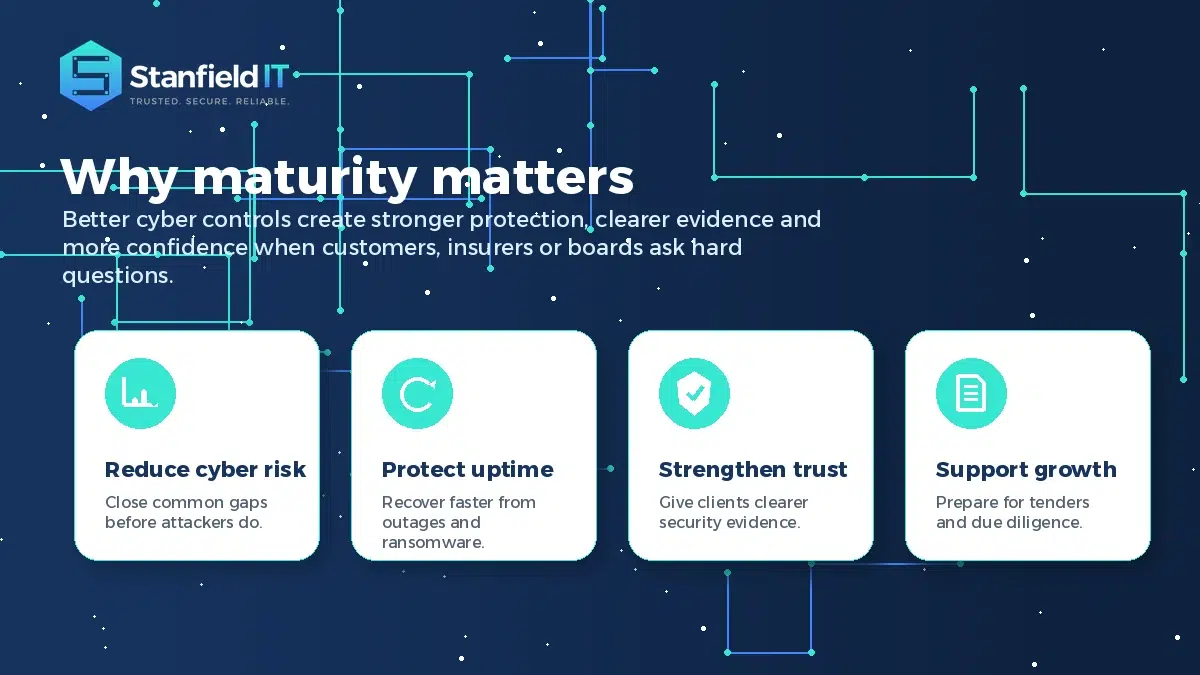
From a business perspective, the value is clarity. A maturity assessment can show where your organisation is exposed, which improvements will reduce the most risk, and what evidence may be needed for customer due diligence, cyber insurance conversations, tenders or board reporting.
It also helps make cyber security more measurable. Instead of saying “we need better security”, leadership can discuss a target maturity level, the gaps between current and target state, the cost and effort involved, and the operational impact of changes. That makes it easier to prioritise budget and avoid scattered, reactive work.
The strongest benefit is resilience: better patching, stronger identity controls, safer applications and tested backups all reduce practical business risk.
The eight strategies that form the Essential Eight
The Essential Eight is built around eight practical strategies. Each one addresses a different part of the attack chain, and they are most effective when implemented together.
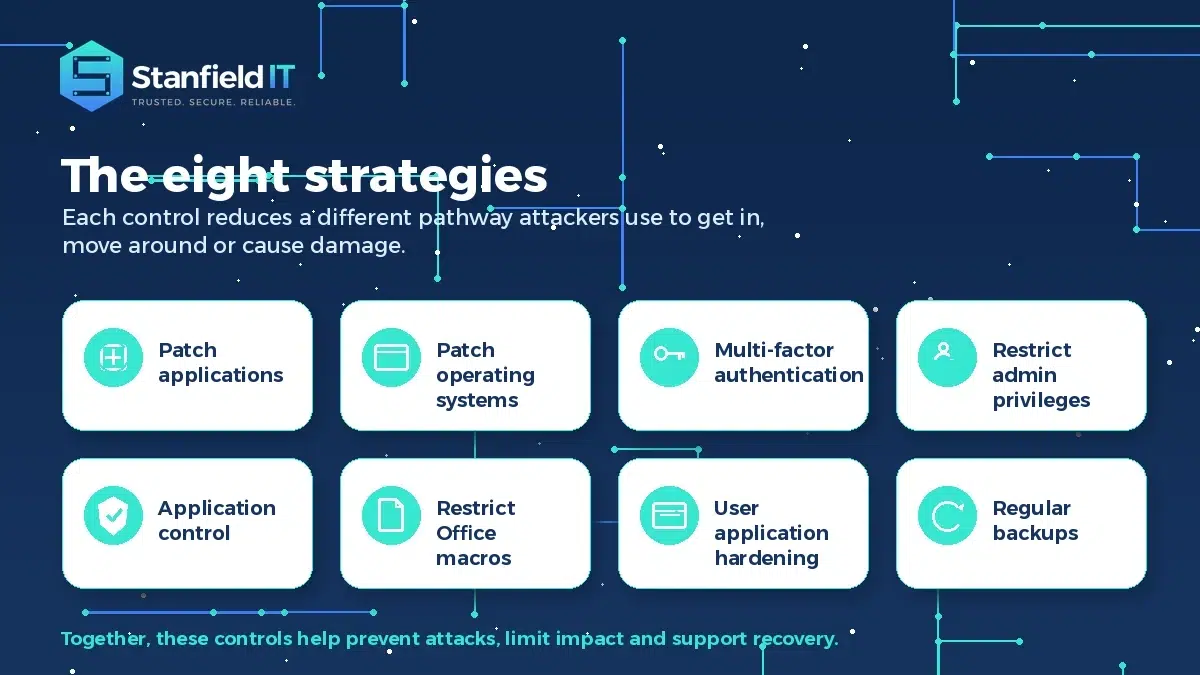
Patch applications keeps software such as browsers, PDF readers, email clients and productivity apps updated so attackers cannot easily exploit known weaknesses.
Patch operating systems applies updates to workstations, servers and network devices so core platforms remain supported and protected.
Multi-factor authentication makes it harder for attackers to use stolen, guessed or reused passwords to access business systems.
Restrict administrative privileges limits who can make high-risk changes, access sensitive systems or move broadly through the environment if an account is compromised.
Application control helps prevent unapproved software, scripts and malicious files from running on systems.
Restrict Microsoft Office macros reduces the risk of malicious documents being used to launch malware or compromise user devices.
User application hardening tightens risky settings in browsers, Office applications and other user-facing software.
Regular backups ensure important data, applications and settings can be restored from a secure and resilient copy when disruption occurs.
The key point is that these strategies work best together. Strong MFA does not remove the need for patching, and good backups do not replace prevention.
The four maturity levels explained
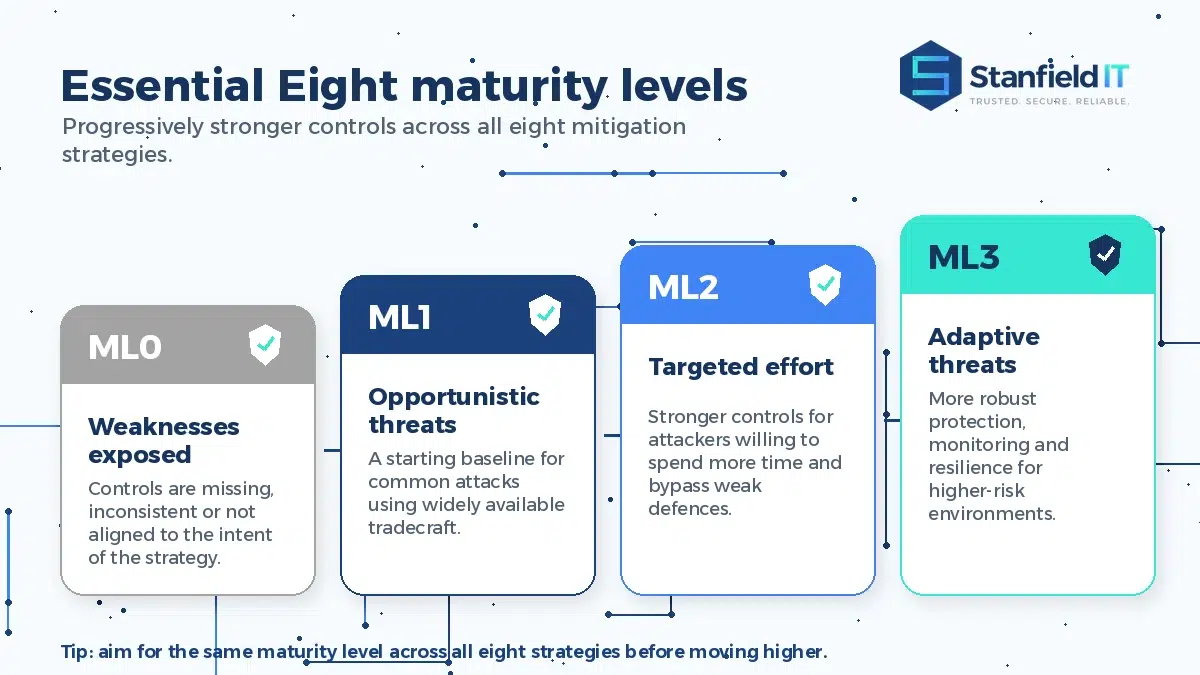
The model uses four levels: Maturity Level Zero through to Maturity Level Three. These levels are not just labels. They represent progressively stronger protection against more capable or persistent attackers.
Maturity Level Zero: weaknesses are exposed
Maturity Level Zero means there are weaknesses in the organisation’s overall cyber security posture. Controls may be missing, informal, inconsistent or only partly aligned with the intent of the mitigation strategy.
Maturity Level One: protection against common attacks
Maturity Level One focuses on attackers using widely available techniques and looking for common weaknesses. This may include exploiting an unpatched online service, using stolen or guessed credentials, or tricking a user into opening a malicious file.
For many smaller organisations, Level One is a sensible first target because it creates structure and reduces obvious exposure.
Maturity Level Two: stronger controls for more targeted threats
Maturity Level Two is designed for attackers who are willing to spend more time on a target and use more effective tools or techniques. They may try to bypass weak controls, target credentials through phishing, or look for ways around basic multi-factor authentication.
At this level, implementation becomes more consistent and harder to bypass, often requiring stronger device management, identity controls, vulnerability management and evidence gathering.
Maturity Level Three: resilience against adaptive attackers
Maturity Level Three is the most advanced level in the model. It focuses on attackers who are more adaptive, less reliant on public tools, and willing to work around the specific controls used by a target.
This level is usually relevant for organisations with higher risk profiles, sensitive data, critical services or government obligations.
How to choose the right target maturity level
Choosing a target level should be based on business risk, not guesswork. A professional services firm with sensitive client records, a healthcare provider, a government supplier and a small office with limited systems may all have different risk profiles.
A practical starting point is to consider what your organisation needs to protect, who may target it, what obligations apply, and what level of downtime or data loss would be acceptable. You should also consider customer expectations, procurement requirements, insurance questions and whether your business handles sensitive or regulated information.
Many small and medium businesses begin by aiming for Maturity Level One, then build towards Level Two where the risk profile justifies it. Larger businesses, regulated organisations and those with more sensitive data may need to target a higher level sooner.
The most important rule is to be realistic and consistent. It is usually better to build a dependable baseline across all eight strategies than to over-invest in one area while leaving obvious gaps elsewhere. For guidance, Stanfield IT’s Essential Eight Services can help assess your current state and define a practical target.
A practical roadmap to improve Essential Eight maturity
Improving maturity works best as a staged uplift program. The goal is to reduce risk in a clear, measurable and sustainable way.
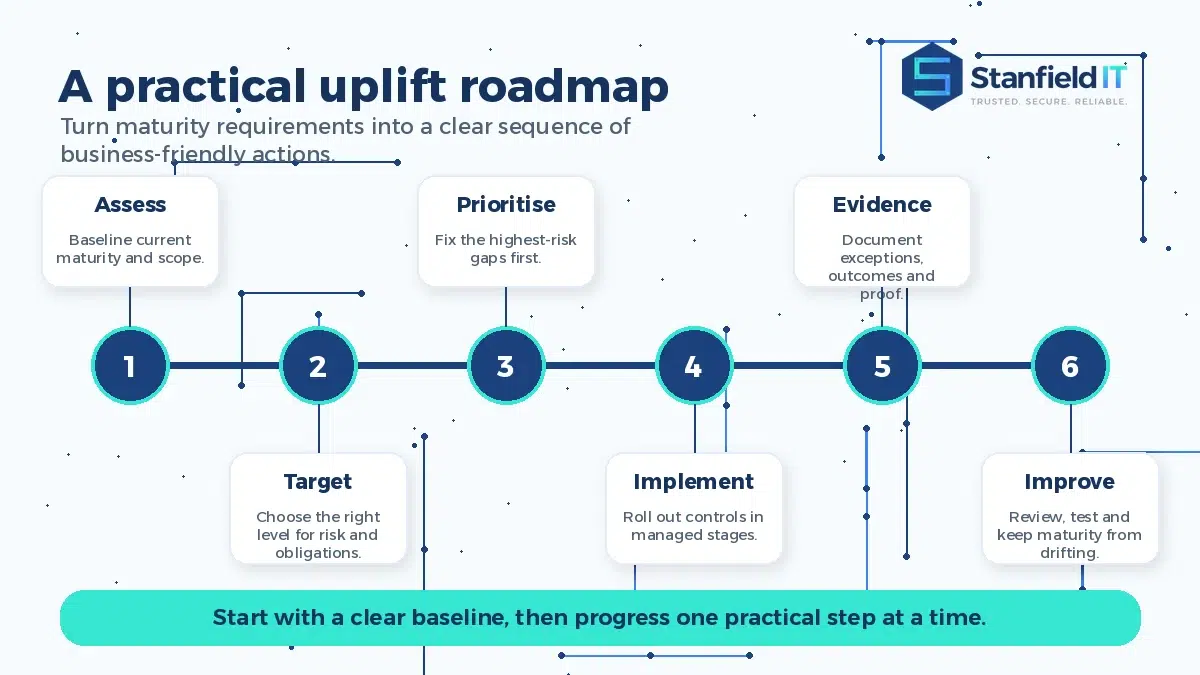
Start with a baseline assessment across users, devices, servers, cloud services, applications, admin accounts, patching, backups and security settings. The outcome should be a plain-English view of current maturity, gaps and priorities.
Next, define scope and target level. Decide which systems are included, what maturity level you are aiming for, and whether any exceptions or compensating controls may be needed. Scope is important because an incomplete view can create false confidence.
Then prioritise the highest-risk gaps. For many businesses, early improvements often include MFA coverage, patching discipline, backup testing, administrator access review and removing unsupported software. These actions can reduce practical risk quickly while the longer-term work is planned.
Implementation should happen in controlled stages. Some controls can affect how staff access systems, run applications or manage files. Good communication, testing and change planning help avoid frustration and keep productivity moving.
Evidence should be collected as you go, including configuration records, exception approvals, backup test results, patch reports and remediation progress.
Finally, review regularly. Your environment changes when new people join, systems are replaced, cloud services are added or threats evolve. Maturity can drift backwards if controls are not monitored, tested and maintained.
Common mistakes that slow down progress
One common mistake is treating the Essential Eight as a checklist. A checklist may help organise work, but maturity depends on whether controls are implemented effectively and consistently across the environment.
Another mistake is jumping straight to a target level without validating the earlier controls. A staged approach helps confirm the foundations are working before more complex requirements are added.
Businesses also underestimate change management. Security controls affect real people doing real work, so communication and testing matter.
Backups are another frequent weak spot. Having backup software is not the same as having recoverable data. A strong approach checks coverage, retention, access controls, monitoring and restore testing. Stanfield IT’s Backup & Disaster Recovery services can support that part of the journey.
Finally, many organisations leave evidence until the end. Good documentation should be part of the uplift process from the start.
How Stanfield IT helps with the Essential Eight maturity model
Stanfield IT helps Australian businesses turn Essential Eight requirements into practical security action. That means giving leaders a clear view of risk, helping technical teams prioritise the right work, and supporting implementation across users, devices, cloud platforms, Microsoft 365, backups and infrastructure.
Our approach starts with clarity. We assess your current maturity, explain gaps in plain English, and build a roadmap that balances risk reduction with business impact. Where controls need to be implemented, we can help plan, configure, test and document the changes.
Because Essential Eight work often overlaps with broader cyber security, we can also connect the uplift plan with vulnerability management, identity and access controls, incident response, backup resilience and ongoing reporting. If you need a wider view of your security posture, our Cyber Security Risk Assessment service can help identify practical priorities beyond the Essential Eight.
The result is a stronger security baseline that is easier to understand, easier to maintain and easier to explain to stakeholders.
Essential Eight maturity model FAQs
Is the Essential Eight mandatory for private businesses?
For many private businesses, it is not automatically mandatory by law. However, it is widely used as a practical baseline for supplier due diligence, tender requirements, insurance and risk management.
Is Maturity Level Three always the goal?
Not always. Maturity Level Three provides the strongest alignment, but the right target depends on your risk profile, obligations, systems and threat environment. Many organisations benefit from first achieving a reliable baseline and then progressing in stages.
How long does Essential Eight implementation take?
Timing depends on current maturity, environment size, legacy systems and target level. Some improvements are quick, while application control, privileged access and backup resilience may need planning.
Can Microsoft 365 help with Essential Eight maturity?
Yes, Microsoft 365 can support several areas, including MFA, conditional access, device compliance, identity protection, endpoint management and security reporting. It still needs to be configured correctly and supported by broader processes.
Is an assessment enough?
An assessment is a valuable starting point, but it does not reduce risk by itself. The real value comes from turning findings into prioritised improvements, then maintaining those controls over time.
What happens after we reach a maturity level?
Maturity needs to be maintained. Systems, users and threats change, so controls should be reviewed, tested and updated regularly.
Build a stronger cyber security baseline
The Essential Eight maturity model gives Australian businesses a practical way to understand cyber security maturity and improve it step by step. It helps move the conversation from vague concern to clear action: what is exposed, what needs to change, what should happen first and how progress will be maintained.
If your business wants to understand its current maturity level, reduce cyber risk and build a realistic uplift roadmap, Stanfield IT can help. Start with an Essential Eight assessment, then move forward with a plan that protects your business without unnecessary complexity.