


If your estate is Microsoft-centric, Microsoft Sentinel is usually the lower-effort, lower-cost choice. If you need maximum on-premises flexibility, deep custom threat hunting across heterogeneous infrastructure, or you carry a long investment in SPL, Splunk Enterprise Security is usually the stronger fit. Neither platform is universally superior — the right answer depends on where your data lives, what your analysts already know, and how much operational overhead your team can absorb.
Here is the one-line verdict for each common scenario:
- Microsoft-centric estate (M365 E5, Azure, Defender XDR): Choose Sentinel. Native connectors, free ingestion of many Microsoft 365 logs, and included SOAR via Logic Apps make it the fastest path to value.
- Heterogeneous multi-vendor or high on-premises footprint: Choose Splunk Enterprise Security. SPL’s flexibility and Splunkbase’s ecosystem breadth handle complex, multi-source environments better than any cloud-native alternative today.
- Strict data sovereignty or air-gapped requirement: Splunk on-premises gives you full control. Sentinel’s Azure-hosted architecture requires careful data-residency planning using Australian Azure regions (Australia East, Australia Southeast).
- Transitional or dual-SIEM strategy: Running both during migration is common, but it doubles licensing and staffing costs. Plan an exit timeline before you start.
The single most important operational recommendation: run a proof of concept (POC) with your real log volumes and representative detections before signing anything. If you would rather outsource the evaluation and ongoing operations entirely, Stanfieldit’s managed IT security services cover the full cycle from POC to production.
Key takeaways
For most Australian enterprises, the decisive variable is where your data lives and what your analysts already know — not which platform has the higher feature count.
| Point | Details |
|---|---|
| Microsoft-centric estates favour Sentinel | M365 E5 free ingestion and native Defender connectors reduce cost and deployment time significantly. |
| Heterogeneous estates favour Splunk | SPL flexibility and Splunkbase ecosystem breadth handle non-Microsoft sources better than Sentinel today. |
| POC with real volumes is non-negotiable | Vendor pricing models diverge sharply at scale; only a POC with your actual logs reveals true TCO. |
| Data residency requires written confirmation | Both platforms have Australian region options, but confirm data residency in writing before signing any contract. |
| Stanfieldit manages the full cycle | Stanfieldit provides managed SIEM services covering POC, integration, detection engineering, and ongoing operations for Australian enterprises. |
Table of Contents
- How do Sentinel and Splunk compare side by side?
- What is Microsoft Sentinel and where does it fit?
- What is Splunk Enterprise Security and where does it fit?
- How do the architectures, analytics, and SOAR capabilities actually differ?
- What does each platform actually cost for Australian enterprises?
- How long does deployment actually take, and what skills do you need?
- How was this comparison compiled?
- How do you choose? A practical decision framework for Australian enterprises
- The case for managed SIEM over self-managed platforms
- Stanfieldit managed SIEM: from POC to production without the staffing risk
- Useful sources and further reading
How do Sentinel and Splunk compare side by side?
The table below maps both platforms across the ten dimensions that matter most for Australian enterprise decisions. Gartner Peer Insights shows Microsoft Sentinel at 4.6 overall (163 reviews) and Splunk Enterprise Security at 4.5 (505 reviews) — a near-even satisfaction score that underlines how much the right choice depends on fit, not raw quality.
| Dimension | Microsoft Sentinel | Splunk Enterprise Security |
|---|---|---|
| Best for | Microsoft-centric SOCs, M365/E5 estates, Azure-first strategy | Heterogeneous estates, deep custom hunting, on-prem/hybrid requirements |
| Deployment model | Cloud-native (Azure only) | On-premises, Splunk Cloud, or hybrid |
| Query language | Kusto Query Language (KQL) | Search Processing Language (SPL) |
| Pricing model | Pay-per-GB analytics tier; commitment discounts; cold data lake tier | Ingest-based, workload/SVC, or entity-based licensing |
| SOAR/automation | Azure Logic Apps playbooks (included) | Splunk SOAR (separate licence) |
| UEBA | Included in analytics tier | Available; licensing varies |
| Integration breadth | Deep Microsoft stack; growing third-party connectors | Thousands of apps via Splunkbase; strong non-Microsoft coverage |
| Operational overhead | Lower for Microsoft shops; KQL learning curve for non-Azure teams | Higher infrastructure management; SPL expertise required |
| Australian data residency | Azure Australia East and Australia Southeast regions available | Splunk Cloud available in Australia; on-prem gives full control |
| Typical TCO drivers | GB ingested, retention period, Logic Apps executions | Ingest volume, licence model chosen, infrastructure staffing |
Where Sentinel wins: Microsoft-centric estates, faster time to value, lower licensing complexity for E5 customers, and tighter integration with Defender XDR and Entra ID.
Where Splunk wins: Heterogeneous or legacy environments, SPL-fluent analyst teams, on-premises data sovereignty requirements, and organisations with deep Splunkbase investments.
What is Microsoft Sentinel and where does it fit?
Microsoft Sentinel is a cloud-native SIEM and SOAR platform built on Azure Log Analytics and Azure Monitor. It was designed from the ground up for cloud-scale telemetry, which means there is no infrastructure to provision, patch, or scale manually. That architecture is its biggest advantage for organisations already running workloads in Azure.
Key strengths at a glance:
- Native Microsoft connectors: — Out-of-the-box connectors for Microsoft 365, Defender XDR, Entra ID, Azure Activity, and Microsoft Defender for Cloud ingest data with minimal configuration.
- M365 E5 ingestion benefit: Certain Microsoft 365 log types ingest at no additional cost for E5 licence holders, which can significantly reduce effective cost for Australian organisations already on E5.
Sentinel fits best when your organisation is already invested in the Microsoft security stack. If you are running Defender for Endpoint, Defender for Identity, and M365 across your fleet, Sentinel becomes a natural aggregation layer with very little parser engineering required.
Pro Tip: The biggest migration pain point when moving to Sentinel is translating existing SPL detection content to KQL. Budget time for a structured content-translation effort — tools like Sigma rules can help bridge the gap, but expect manual review for complex correlation logic.
What is Splunk Enterprise Security and where does it fit?
Splunk Enterprise Security (ES) is the SIEM layer built on top of the Splunk platform. Unlike Sentinel, it supports on-premises, Splunk Cloud, and hybrid deployments, giving security teams genuine flexibility over where data is processed and stored. That flexibility is the core reason Splunk remains the dominant choice for organisations with complex, multi-vendor infrastructure.
Key strengths:
- Deployment flexibility: — On-premises Splunk gives you full control over data residency, retention, and storage costs. Splunk Cloud removes infrastructure management while preserving SPL capability.
- Splunkbase ecosystem: — Thousands of apps and add-ons cover everything from network device parsers to cloud provider integrations, making Splunk the more practical choice for estates with legacy or non-Microsoft infrastructure.
- Cisco integration: Following Cisco’s acquisition of Splunk, the roadmap now incorporates Cisco threat intelligence feeds and network telemetry, which is worth factoring into long-term planning for Splunk’s strategic direction.
“Splunk Enterprise Security provides a flexible platform with many integrations, advanced analytics and structured migration support for organisations considering a move between SIEMs.” — Splunk vendor documentation
Splunk ES suits organisations that have built years of SPL content, maintain on-premises infrastructure, or operate in environments where Microsoft is not the dominant vendor. The deployment flexibility and SPL capability remain genuine differentiators that Sentinel has not yet matched for heterogeneous estates.
How do the architectures, analytics, and SOAR capabilities actually differ?
This is where the Sentinel vs Splunk decision gets technical. The surface-level comparison is straightforward; the operational reality is more nuanced.
KQL vs SPL: analyst productivity and migration friction
KQL is optimised for Azure’s columnar data store. Queries run fast on structured telemetry, and the syntax is clean for analysts who learn it natively. SPL, by contrast, was built for unstructured and semi-structured data from the start, which makes it more flexible for parsing raw log formats and running complex statistical pipelines.
G2’s comparison data shows Splunk scoring higher on log management capability, while Sentinel scores higher on ease of use — a pattern that reflects exactly this trade-off. SPL gives you more power; KQL gives you a faster start.
Migration friction is real. Organisations moving from Splunk to Sentinel need to translate detection content, hunting queries, and dashboards from SPL to KQL. Sigma rules provide a vendor-neutral intermediate format that can reduce this effort, but complex correlation logic almost always requires manual review. The reverse migration (Sentinel to Splunk) carries similar friction.
“Organisations with long SPL investments face significant migration cost and operational disruption if they move to KQL — the language difference is not just syntax, it reflects fundamentally different data models.” — independent analysis
Detection content and threat intelligence
Both platforms ship with out-of-the-box (OOTB) detection rules. Sentinel’s content hub provides Microsoft-curated rules that are tightly integrated with Defender XDR signals. Splunk’s Threat Research team publishes detection content through Splunkbase and the Splunk Security Content repository. For non-Microsoft telemetry sources, Splunk’s community content tends to be broader and more mature.
Threat intelligence integration works differently too. Sentinel connects natively to Microsoft Threat Intelligence and Defender Threat Intelligence. Splunk integrates with a wider range of third-party TI feeds through Splunkbase apps, which matters for organisations running non-Microsoft security tooling alongside their SIEM.
SOAR and automation
Sentinel’s SOAR capability comes through Azure Logic Apps playbooks, included in the analytics tier. Logic Apps is a low-code automation platform with hundreds of connectors, which makes it accessible to analysts without deep development skills. The trade-off is that complex orchestration logic can become difficult to maintain at scale.
Splunk SOAR is a purpose-built security orchestration platform with a more mature playbook engine and stronger support for complex, multi-step incident response workflows. It is licensed separately, which adds cost, but for SOCs running sophisticated response automation across hybrid environments, the capability difference is meaningful. Automated compliance tracking through SOAR playbooks is one area where purpose-built orchestration delivers measurable time savings.
Scalability and indexing behaviour
Sentinel scales automatically as an Azure-native service. You pay for what you ingest, and Microsoft handles the infrastructure. At very high ingest volumes, commitment tier pricing becomes important to manage costs. Splunk on-premises requires capacity planning for indexers and storage, but gives you direct control over retention and archiving costs. Dual-SIEM deployments during migration are common, but they multiply both licensing and staffing costs and require careful orchestration to avoid alert duplication.
What does each platform actually cost for Australian enterprises?
Pricing is where many Australian organisations get surprised. Both vendors have moved away from simple per-seat models, but the cost drivers are different enough that the same data volume can produce very different bills.
Microsoft Sentinel pricing
Sentinel charges on a pay-per-GB basis for the analytics tier, with commitment tiers available that reduce the per-GB rate at higher volumes. A separate data lake tier stores cold data at a lower per-GB cost, useful for long-retention compliance requirements. The most important cost lever for Australian organisations on M365 E5 is the free ingestion of certain Microsoft 365 log types — this can materially reduce the effective cost for estates where Microsoft telemetry makes up the majority of log volume.
Splunk pricing
Splunk has historically used ingest-based licensing, where cost scales directly with daily data volume. This model creates unpredictability risk as log volumes grow. Splunk has introduced workload-based (SVC) and entity-based licensing as alternatives, which can reduce cost volatility for some environments. The right model depends on your data profile, and it is worth modelling all three options against your actual volumes before committing.
| Pricing dimension | Microsoft Sentinel | Splunk Enterprise Security |
|---|---|---|
| Primary billing unit | GB ingested (analytics tier) | GB/day ingested, SVC units, or entity count |
| Commitment discounts | Yes, tiered commitment pricing | Yes, via annual contracts |
| Free ingestion | Selected M365 logs (E5 benefit) | None by default |
| Cold/archive storage | Separate data lake tier (lower cost) | Configurable; on-prem gives full control |
| SOAR licensing | Included (Logic Apps) | Separate licence (Splunk SOAR) |
| UEBA licensing | Included in analytics tier | Varies by licence model |
Practical cost checklist — ask vendors these questions:
- What is the per-GB rate at our projected daily ingest volume, and what commitment tier applies?
- Which log sources qualify for free or reduced-cost ingestion?
- How does retention beyond 90 days affect cost, and what are the archiving options?
- What triggers a licence uplift mid-contract?
- Are Logic Apps executions (Sentinel) or Splunk SOAR playbook runs billed separately?
- What is the data residency configuration for Australian regions, and does it affect pricing?
Azure’s Australian regions (Australia East in New South Wales, Australia Southeast in Victoria) support Sentinel deployments with data residency in Australia. Splunk Cloud also has Australian region availability. On-premises Splunk gives complete data sovereignty by default.
How long does deployment actually take, and what skills do you need?
Deployment timelines vary significantly depending on estate complexity, existing tooling, and whether you are migrating from another SIEM or starting fresh.
Typical deployment milestones
- Pilot (weeks 5–12): — Onboard production log sources, tune detection rules, build initial runbooks, and train analyst staff. Sentinel pilots tend to move faster for Microsoft-centric estates; Splunk pilots for heterogeneous environments often require more parser engineering.
- Phased roll-out (months 3–6): — Migrate remaining data sources, complete playbook library, establish detection engineering cadence, and hand over to run-state operations. Complex on-premises Splunk deployments can extend this phase.
Skills and staffing
- Sentinel: — KQL proficiency, Azure administration, Logic Apps development for SOAR. Microsoft certifications (SC-200 Security Operations Analyst) provide a structured training path.
- Splunk: — SPL proficiency, Splunk administration (indexer management, forwarder configuration, storage planning), and Splunk SOAR engineering for automation. Splunk certifications (Splunk Core Certified Power User, Splunk Enterprise Security Certified Admin) are the relevant credentials.
Both platforms require ongoing detection engineering — someone who writes, tests, and tunes detection rules as the threat environment changes. This role is often underestimated in initial staffing plans.
Pro Tip: If your team has fewer than two dedicated security analysts, a managed SIEM service is almost always the lower-risk path. The operational overhead of maintaining detection content, playbooks, and parser rules across either platform is substantial for a small team. Stanfieldit’s cyber security services include managed SIEM options designed for Australian SMEs and mid-market organisations.
How was this comparison compiled?
This comparison draws on a defined set of sources evaluated for authority, recency, and relevance to Australian enterprise conditions.
- Gartner Peer Insights: — Verified user reviews for both platforms, used for satisfaction ratings and deployment experience signals.
- Vendor documentation: Microsoft Sentinel pricing pages, Azure region documentation, and Splunk’s own comparison material for feature claims and migration guidance.
- Independent technical write-ups: Third-party analysis covering architecture trade-offs, TCO modelling, and buyer guidance for 2026.
“The most reliable evaluation method is a parallel POC using representative log volumes and typical analyst playbooks — this reveals cost, query latency and detection fidelity differences faster than any vendor claim.” — SIEM buyer’s guide 2026
Pricing disclaimer: SIEM pricing changes frequently. Every figure in this article reflects publicly available information at the time of writing. Validate all cost estimates with a vendor quote and a POC against your actual log volumes before making a procurement decision.
How do you choose? A practical decision framework for Australian enterprises
The Splunk vs Sentinel comparison ultimately comes down to four questions about your organisation.
Decision matrix
| Business profile | Recommended platform | Key evaluation metric |
|---|---|---|
| Primarily Microsoft 365 / Azure / Defender | Microsoft Sentinel | Effective cost per GB after M365 E5 benefit |
| Heterogeneous multi-vendor, on-prem heavy | Splunk Enterprise Security | Parser coverage for non-Microsoft sources |
| Air-gapped or strict data sovereignty | Splunk on-premises | Data residency control and retention flexibility |
| Cost-sensitive, small analyst team | Microsoft Sentinel or managed SIEM | Total staffing cost including detection engineering |
| Existing deep SPL investment | Splunk Enterprise Security | Migration cost of existing detection content |
Questions to ask vendors during an RFP or POC
- What is the all-in cost per GB at our projected daily ingest volume, including retention beyond 90 days?
- Which of our specific log sources qualify for free or reduced-cost ingestion?
- How is data residency enforced for Australian regions, and what audit evidence can you provide?
- What is your support SLA for Australian customers, and is local support available?
- How are playbook execution costs calculated, and what triggers additional charges?
- What migration tooling or professional services do you provide for customers moving from another SIEM?
- What is the contract term, and what are the conditions for a licence uplift?
Evaluation metrics to measure during a POC
- Ingestion cost per GB at representative daily volume
- Query latency for typical hunting queries across 30 days of data
- Detection accuracy (true positive rate) for your environment’s specific log sources
- Playbook execution time for a standard incident response workflow
- Analyst time per investigation from alert triage to closure
Red flags to watch for
- Uncapped ingest pricing: — Splunk’s ingest-based model can produce bill shock if log volumes spike. Confirm whether commitment tiers include overage protection.
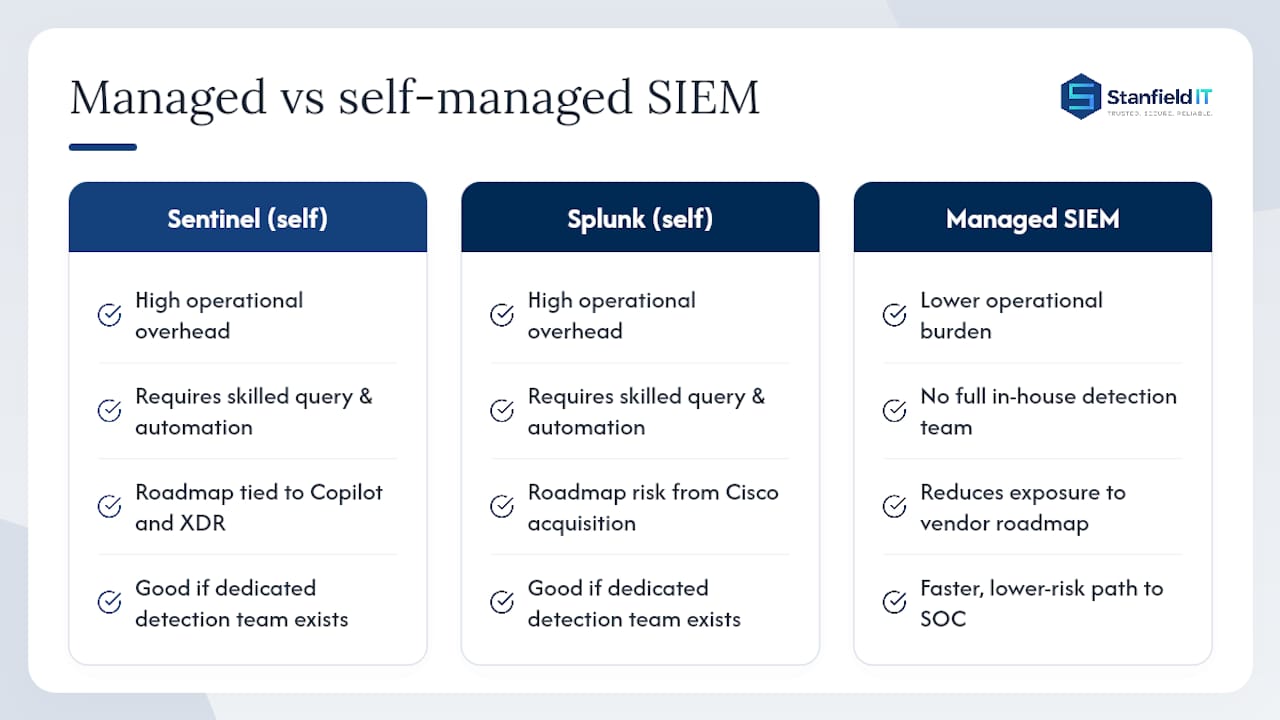
The case for managed SIEM over self-managed platforms
The Sentinel vs Splunk debate often obscures a more fundamental question: should your team be running a SIEM at all, or is a managed service the more practical path?
Most of the Australian organisations we work with at Stanfieldit arrive at this comparison after realising that the operational overhead of either platform exceeds what their internal team can sustain. Detection engineering is a continuous discipline, not a one-time deployment task. Playbooks need maintenance as environments change. Parser rules break when vendors update log formats. Both Sentinel and Splunk require someone who is genuinely skilled in the platform’s query language and automation framework, working on it regularly, not just when incidents occur.
The Cisco acquisition of Splunk adds a layer of strategic uncertainty that is worth factoring into long-term planning. Microsoft’s roadmap, by contrast, ties Sentinel tightly into Security Copilot and Defender XDR — a direction that is clear, if opinionated. Neither roadmap is inherently better; both reward organisations that align their security architecture to the vendor’s direction rather than fighting against it.
My honest view: the organisations that get the most value from either platform are those that treat the SIEM as a living system, not a compliance checkbox. That means dedicated detection engineering, regular playbook reviews, and a clear escalation path when something breaks at 2 AM. If you have that capability in-house, either platform can serve you well. If you do not, a managed engagement is a faster and lower-risk path to a functioning SOC than trying to build that capability while simultaneously running a production SIEM.
Stanfieldit managed SIEM: from POC to production without the staffing risk
Running a SIEM in-house means committing to ongoing detection engineering, playbook maintenance, and 24/7 alert triage — on top of your existing IT workload. For many Australian SMEs and mid-market organisations, that commitment is the real cost, not the licensing.
Stanfieldit takes on that operational burden as part of a managed SIEM engagement. We handle the POC against your real log volumes, configure data connectors and parser rules, build and maintain detection content, and provide incident response support when alerts fire. You get a functioning SOC capability without hiring a dedicated detection engineering team or navigating complex licensing negotiations alone.
Our cyber security services for small business include managed SIEM options aligned to the Australian Essential Eight and Privacy Act requirements, with data residency in Australian Azure regions where applicable. Whether you are evaluating Sentinel for the first time or considering a migration from Splunk, we can run the POC and provide a clear cost model before you commit.
Contact Stanfieldit at stanfieldit.com to request a POC scoping conversation or a cost model review for your environment.
Useful sources and further reading
| Source | What to check there |
|---|---|
| Gartner Peer Insights: Sentinel vs Splunk | Verified user reviews, satisfaction ratings, and deployment experience for both platforms |
| G2: Sentinel vs Splunk comparison | Feature-level scoring across log management, ease of use, and incident response capability |
| Ciphers Security: Sentinel vs Splunk 2026 | Architecture overview, pricing model detail, and M365 E5 ingestion benefit explanation |
| Protego: Sentinel vs Splunk SIEM comparison | Splunk deployment flexibility, SPL capability, and Splunkbase ecosystem analysis |
| Decryption Digest: Splunk vs Sentinel 2026 | Strategic roadmap commentary including Cisco acquisition and Microsoft Copilot integration |
| SIEM buyer’s guide 2026 | POC methodology, pricing model taxonomy, and evaluation checklist |
| Splunk: ES vs Sentinel explainer | Splunk’s own framing of feature differences, migration pathways, and data ownership |
- Microsoft Sentinel vs Splunk Enterprise Security
- Compare Microsoft Sentinel and Splunk Enterprise Security
- Microsoft Sentinel Vs Splunk: 2026 SIEM Comparison
- Microsoft Sentinel vs Splunk: SIEM Comparison | Protego
- Splunk vs Microsoft Sentinel: Cloud‑Native SIEM (2026)
- SIEM platform buyer’s guide 2026: Splunk vs Sentinel
- Splunk Enterprise Security vs. Microsoft Sentinel: An explainer | Splunk
This article provides general information for IT professionals evaluating SIEM platforms. Pricing, feature availability, and compliance applicability vary by configuration and contract. Validate all claims with vendor quotes and consult a qualified security professional for advice specific to your organisation’s requirements.