

Last updated: June 2026
Artificial intelligence is no longer just a future technology. It is already sitting inside the platforms many businesses use every day, from Microsoft 365 and customer relationship management systems to reporting tools, cyber security platforms, chatbots and workflow automation.
That creates a valuable opportunity. Used well, AI can help teams work faster, improve service delivery, analyse information more efficiently and reduce repetitive manual work. Used without proper controls, it can also create serious risks around privacy, cyber security, accuracy, accountability and customer trust.
ISO/IEC 42001 gives businesses a practical structure for managing those risks. It is designed to help organisations put the right governance, policies, responsibilities and improvement processes around the way AI systems are developed, supplied or used.
What is ISO/IEC 42001?
ISO/IEC 42001 is an international management system standard for artificial intelligence. In plain English, it gives organisations a framework for establishing, implementing, maintaining and continually improving an AI management system.
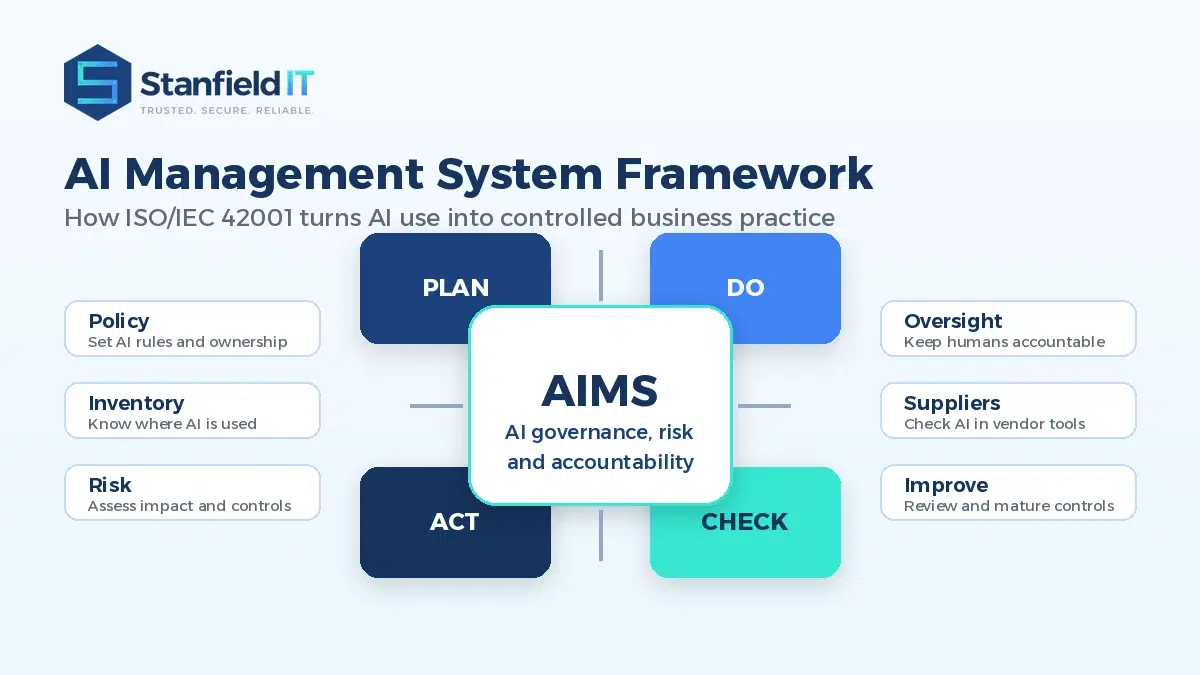
An AI management system is not just a policy document. It is the operating model for how AI is governed across the organisation. It should help answer practical questions such as where AI is being used, who owns each AI use case, what data is involved, what risks exist, how decisions are reviewed and how issues are recorded and improved.
The standard is relevant to organisations that develop AI products, provide AI-enabled services or use AI systems as part of their operations. That makes it broader than many business owners first assume. A company does not need to be an AI software developer to have AI risk. A professional services firm using generative AI to draft reports, a health provider using AI-enabled scheduling, or a manufacturer using AI analytics can all benefit from stronger governance.
Why ISO/IEC 42001 matters for Australian businesses
Australian businesses are under growing pressure to adopt technology quickly, but also responsibly. Customers, boards, insurers, regulators and supply chain partners increasingly want confidence that sensitive data is protected, decisions are explainable and new tools are not being introduced without proper controls.
Standards Australia has adopted the international standard as AS ISO/IEC 42001:2023, highlighting its role in responsible AI, transparency, reliability, internal governance and risk management. That matters because many businesses are moving from informal AI experimentation to wider operational use.
The cyber security context also matters. The Australian Signals Directorate has warned that businesses need a safe and secure approach to the integration of AI technologies. Its 2024–25 Annual Cyber Threat Report also shows the broader cyber risk environment remains costly for organisations, particularly small and medium businesses.
AI can improve productivity, but it also changes how information moves through a business. Staff may paste client information into public tools. Departments may enable AI features inside cloud applications without a central review. A supplier may add AI functionality to a product your team already uses. Without a governance process, these changes can happen quietly and quickly.
This is where ISO 42001 becomes commercially useful. It helps leaders move beyond vague statements such as “we use AI responsibly” and towards a documented system that can be explained to clients, auditors, partners and staff.
What an AI management system should cover
A good AI management system should be practical enough for people to use. It should not sit in a folder and only appear during an audit. The goal is to create clear business habits around AI so that teams can innovate with confidence rather than creating unmanaged risk.
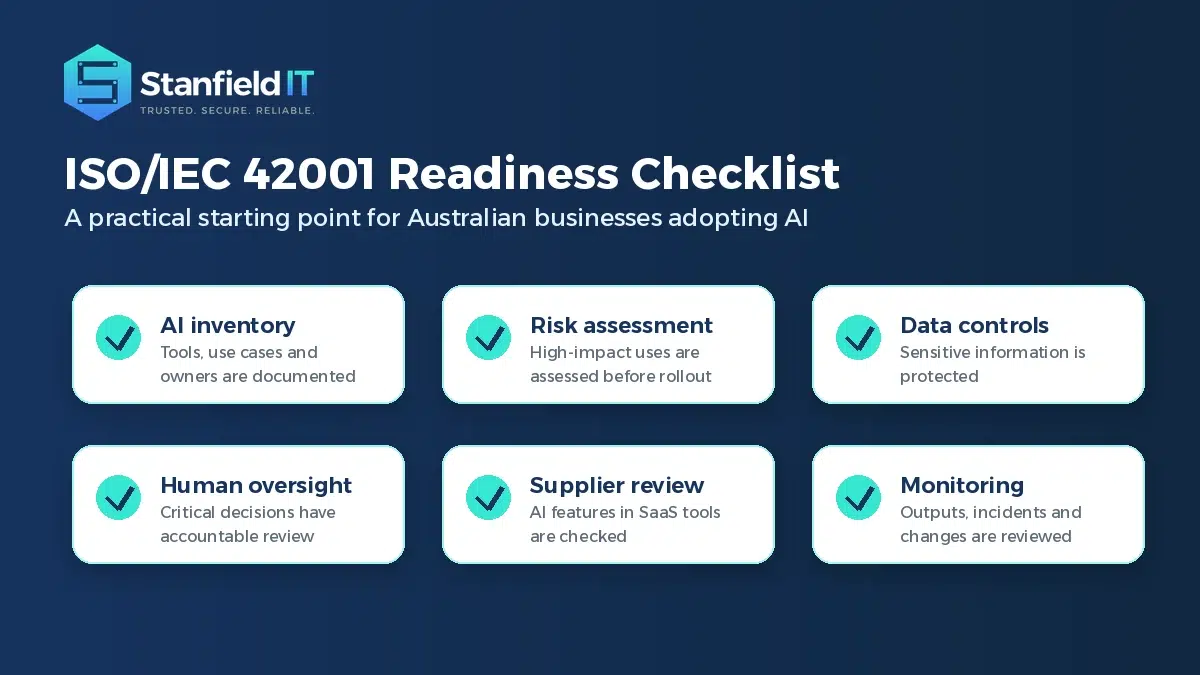
For most small and medium businesses, the first step is visibility. You cannot manage AI tools that nobody has recorded. A simple AI register can document what tools are in use, what they are used for, who owns them, what data they touch, who has access and whether the use case has been approved.
- AI policy: clear rules for acceptable use, approval and escalation.
- AI inventory: a current record of AI systems, features and business owners.
- Risk assessment: a way to assess privacy, security, accuracy, bias, legal and operational impact.
- Data controls: protection for sensitive business, customer and employee information.
- Human oversight: defined review points for important decisions and outputs.
- Supplier governance: review of AI features built into cloud platforms and third-party software.
- Monitoring and improvement: a process for reviewing incidents, changes, performance and lessons learned.
The right level of control should match the risk. Using AI to summarise internal meeting notes is not the same as using AI to assess a customer application, screen job candidates, provide financial advice or handle confidential health information. The standard encourages organisations to think carefully about context, impact and accountability.
The business risks ISO 42001 helps you manage
AI risk is not one single issue. It is a combination of business, technology, legal, operational and reputational risks. Some risks are obvious, such as uploading sensitive customer data into an unauthorised platform. Others are less visible, such as relying on an AI-generated answer that looks convincing but is incomplete or incorrect.
One common problem is shadow AI. This happens when staff use AI tools without central approval because the tools are fast, convenient and often free to start. The intention is usually positive, but the business may have no record of what data was entered, what account was used, whether outputs were checked or whether the supplier’s terms are acceptable.
Another risk is unclear accountability. If an AI tool influences a client recommendation, a hiring decision, a financial forecast or a support response, who is responsible for checking the result? Who approves the use case? Who monitors performance after deployment? Without defined ownership, issues can fall between IT, operations, legal, compliance and individual departments.
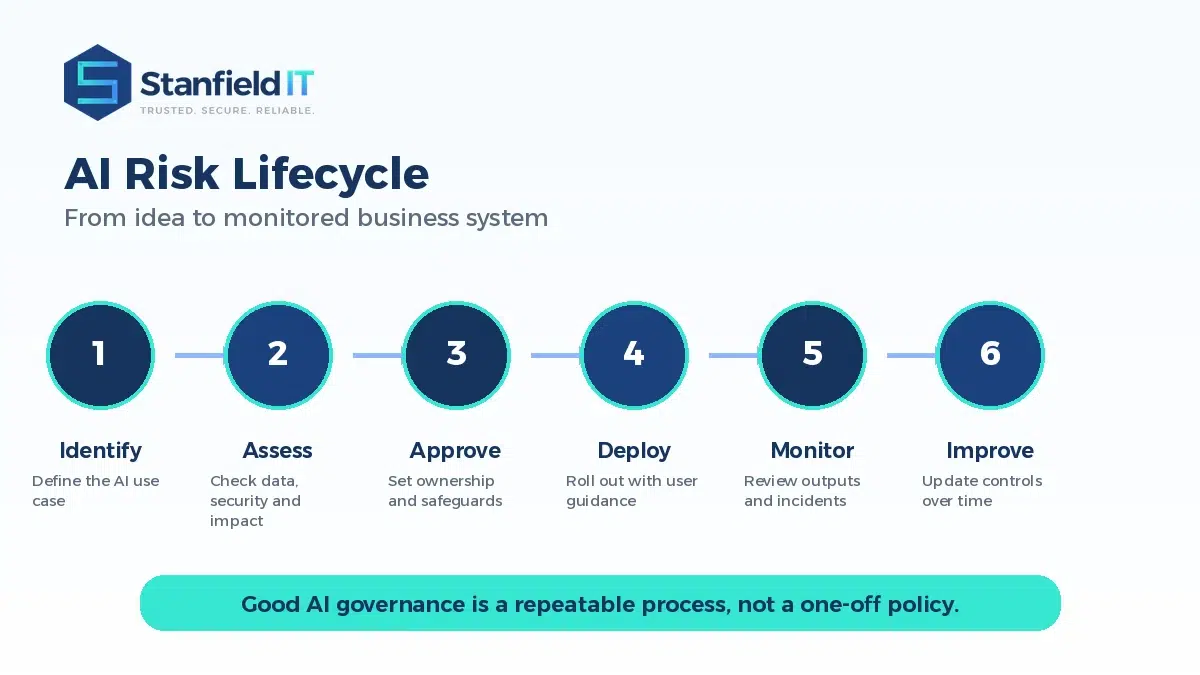
ISO 42001 helps by encouraging a repeatable approach. Assess the use case. Identify the risks. Apply appropriate controls. Keep records. Monitor what happens. Improve the system as technology, suppliers and business needs change.
How ISO/IEC 42001 fits with cyber security and ISO 27001
AI governance is broader than cyber security, but it depends heavily on strong cyber security foundations. Most AI systems touch identity, access control, cloud services, business data, third-party suppliers, device security, logging and incident response. Weaknesses in any of these areas can quickly become AI governance problems.
Businesses that already have mature cyber security controls, documented policies and structured risk management will usually find it easier to prepare for the AI management standard. Existing work around information classification, supplier review, access management, incident handling and audit evidence can often support AI governance as well.
This is also where ISO 27001 and ISO 42001 can complement each other. ISO 27001 focuses on information security management. ISO 42001 focuses on AI management. A business using both can build a stronger overall approach to secure, responsible and accountable technology adoption.
For example, an AI use case may need identity controls to limit who can access it, data loss prevention to reduce leakage risk, logging to support investigation, supplier due diligence to check contractual and security commitments, and staff training so people understand when human review is required. These are practical technology controls, not just compliance paperwork.
Practical steps to prepare for AI governance
Preparing for the standard does not mean every business needs to build a large compliance programme on day one. The better approach is to start with a practical readiness review and build a roadmap that matches the organisation’s size, risk profile and AI maturity.
Start by finding out where AI is already being used. This includes obvious tools such as ChatGPT, Microsoft Copilot or AI writing assistants, but also AI features embedded in CRM, accounting, HR, marketing, service desk, security and analytics platforms. Many businesses discover they are already using more AI than they realised.
Next, decide who owns AI governance. This should not sit entirely with IT, because AI affects operations, compliance, legal risk, people, customer service and strategy. A practical governance group may include leadership, IT, operations, risk, HR and key department managers, depending on the business.
The Australian Government’s Guidance for AI Adoption is also a useful reference point because it encourages organisations to strengthen governance, manage risk and maintain human oversight in practical stages.
A simple preparation roadmap may include:
- Build an AI inventory and identify current business use cases.
- Create an AI policy that staff can understand and follow.
- Define ownership, approval pathways and escalation points.
- Assess AI risks against data, cyber security, privacy, bias, accuracy and operational impact.
- Review supplier terms, security controls and data handling for AI-enabled platforms.
- Train staff on safe AI use, especially around confidential information and human review.
- Monitor AI systems, record incidents and improve controls over time.
Common mistakes to avoid
The first mistake is treating AI governance as a document exercise. A policy is important, but it does not create control by itself. The policy needs to be supported by tool reviews, staff training, access controls, supplier checks and a process for monitoring what is actually happening.
The second mistake is assuming AI is only an IT issue. IT plays a critical role, especially around security, data and systems integration, but AI governance also requires business ownership. Department leaders need to understand the risks created by their own use cases and accept responsibility for how AI is used in their workflows.
The third mistake is waiting until a client or regulator asks for evidence. By then, the organisation may need to scramble to identify tools, document controls and explain decisions. Starting early gives the business more time to create sensible processes and avoid rushed, reactive changes.
Where Stanfield IT can help with AI governance readiness
The AI management standard depends on reliable IT, strong cyber security and well-managed cloud platforms. That is where Stanfield IT can help.
We help businesses take a practical approach to AI governance, secure adoption and cyber risk. That may include reviewing current AI tools, improving Microsoft 365 security settings, strengthening identity and access controls, documenting approved use cases, checking supplier risks, improving data protection and helping leadership understand where the biggest risks sit.
Stanfield IT is not a certification body, and certification decisions should always be handled through an appropriate accredited provider. Our role is to help build the technology, security and governance foundations that make responsible AI adoption easier to manage and easier to evidence.
If your business is starting to use AI, planning wider Microsoft Copilot adoption, responding to client due diligence, or preparing for stronger governance expectations, our AI governance and secure adoption support can help you move forward with confidence. We can also assist with related cyber security consulting and practical ISO 27001 alignment.
ISO 42001 frequently asked questions
Is ISO/IEC 42001 mandatory in Australia?
For most businesses, the standard is not mandatory. It is voluntary, but it can help organisations demonstrate responsible AI governance as customer, board, insurer and regulatory expectations continue to grow.
Who should consider ISO 42001?
Any organisation that develops, supplies or uses AI systems should consider whether the standard is relevant. It is especially useful for businesses using AI with sensitive data, customer-facing processes, regulated activities or important operational decisions.
How is ISO 42001 different from ISO 27001?
ISO 27001 focuses on information security management. ISO 42001 focuses on AI management. They complement each other because responsible AI adoption relies on strong security, data protection, supplier governance and incident management.
Can a small business use ISO 42001?
Yes. The approach should be scaled to the business and the level of risk. A small business can start with an AI inventory, a clear policy, basic risk assessments, supplier checks, staff guidance and stronger data controls.
Does Stanfield IT provide ISO 42001 certification?
No. Certification must be handled by an appropriate certification provider. Stanfield IT can help prepare the IT, cyber security, cloud, data and governance foundations that support ISO 42001 readiness.
How long does ISO 42001 preparation take?
It depends on the size of the organisation, the number of AI use cases and existing governance maturity. A readiness review is usually the best first step because it identifies gaps and creates a practical roadmap.
Build AI confidence before risk becomes a problem
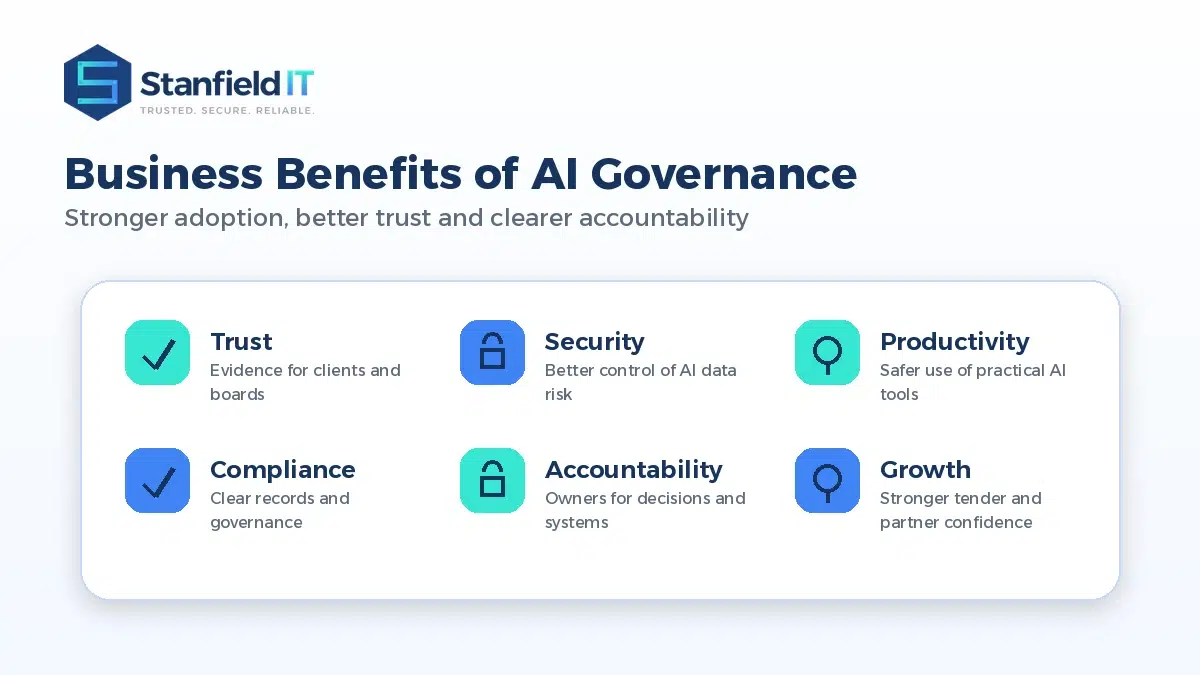
AI can be a genuine advantage for businesses, but only when it is introduced with the right controls. The AI management standard gives organisations a useful framework for managing AI responsibly, protecting information, improving accountability and building trust with clients and stakeholders.
The businesses that benefit most from AI will not simply be the ones that adopt tools the fastest. They will be the ones that adopt AI in a way that is secure, governed, explainable and aligned with real business outcomes.
If your business is looking for practical support with AI governance, cyber security or secure technology adoption, contact Stanfield IT to discuss the right next step.