


The advantages of using a 100% Australian-based MSP
Choosing who manages your IT is now a security, compliance and trust decision. Here is why Australian businesses in regulated industries are keeping their data, support and accountability onshore in 2026.
Key takeaways
- A 100% Australian-based MSP keeps your data, your support and your accountability onshore — under Australian law, in your time zone, with a team you can verify.
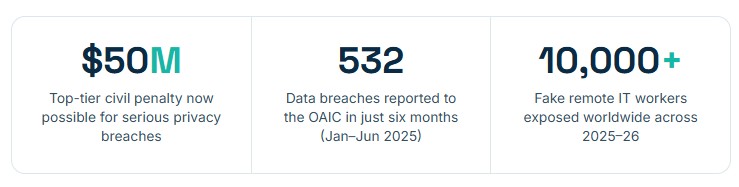
- Australia’s privacy regime tightened sharply in 2024–26: civil penalties now reach $50 million, individuals can sue directly, and the OAIC began proactive compliance sweeps in January 2026.
- Where your data physically lives (data sovereignty) carries real legal weight — offshore hosting can complicate your obligations under the Australian Privacy Principles.
- Authorities exposed more than 10,000 fake remote “IT workers” using stolen identities across 2025–26, making it critical to know exactly who can access your systems.
- Onshore support means same-time-zone response, engineers who can attend in person, and partners fluent in the Essential Eight and the Notifiable Data Breaches scheme.
Your managed service provider looks after the technology your business runs on — networks, devices, cloud, cyber security and the day-to-day support that keeps your people working. It is one of the most trusted relationships in your business. The question worth asking is where, and by whom, that work actually gets done.
For Australian businesses in regulated industries — financial services, aged care, legal practices and the not-for-profit sector — the answer increasingly points onshore. A 100% Australian-based MSP keeps your data, your support and your accountability inside Australian borders and under Australian law. Below is why that matters more in 2026 than it ever has, grounded in the regulatory and threat landscape as it stands today.
What is a 100% Australian-based MSP?
A 100% Australian-based MSP is a managed service provider whose people, support operations and data storage are all located in Australia, rather than offshored to overseas call centres or data centres. In practice that means the engineer who answers your call is local, your data is held under Australian jurisdiction, and the company answering for your systems is accountable under Australian law and consumer protections.
It is a meaningful distinction. Plenty of providers brand themselves as “Australian” while routing support through offshore teams and hosting data in foreign data centres. Being genuinely onshore is about where the work happens and where the data sits — not just where the logo is registered.
Why does onshore IT support matter in 2026?
Onshore IT support matters in 2026 because Australia’s privacy and security obligations have tightened dramatically, and because the people with access to your systems have themselves become a frontline security risk. Two shifts drive this: a reformed privacy and compliance regime with penalties measured in the tens of millions, and a global wave of fraudulent remote workers infiltrating organisations through outsourced and remote roles.
Both shifts reward businesses that can answer a simple question with confidence: who, exactly, is on the keyboard, and which laws govern your data? An onshore partner makes that answer straightforward.
Six reasons Australian businesses choose a local MSP
The case for a local MSP comes down to six practical advantages: real conversations, faster onsite support, data sovereignty, built-in compliance knowledge, a verifiable team, and clear local accountability.

- Real conversations, not scripts. You speak with vetted local engineers who understand your environment and can make decisions, rather than reading from a distant call-centre script.
- Faster, onsite help. Support happens in your time zone, and when a problem cannot be fixed remotely, a technician can physically attend your site — something no overseas provider can offer.
- Data sovereignty. Your data stays in Australia, under Australian law, which keeps your privacy obligations clear and avoids the legal grey areas of foreign jurisdictions.
- Compliance built in. A local partner is fluent in the Essential Eight, the Australian Privacy Principles and the Notifiable Data Breaches scheme, rather than applying generic overseas frameworks.
- A team you can verify. You know who manages your systems and can confirm their identity and background — a direct defence against the infiltration tactics now in circulation.
- Local accountability. One Australian partner owns the outcome, so there is clear responsibility and no finger-pointing across borders when something goes wrong.
What is data sovereignty, and why does it matter under the new Privacy Act?
Data sovereignty is the principle that data is subject to the laws of the country in which it is physically stored. It matters because Australia’s privacy regime has been substantially reformed, and where your data lives now has direct legal consequences for how you must protect it and what happens if it is exposed.
The Office of the Australian Information Commissioner (OAIC) reports that organisations notified 532 data breaches in the first half of 2025, with malicious or criminal attacks the single largest cause at around three in five incidents. The health and finance sectors were the most affected. When data sits offshore, demonstrating that you have met your obligations — and responding quickly when something goes wrong — becomes considerably harder.
The legal stakes have risen in step. The Privacy and Other Legislation Amendment Act 2024 introduced a tiered penalty regime, a new right for individuals to sue directly, and proactive enforcement by the regulator. The timeline below shows how quickly the compliance clock has been ticking.

Two further changes are worth watching closely. From 10 December 2026, businesses must disclose in their privacy policy where automated decision-making significantly affects individuals. And the long-standing small-business exemption — which has historically excluded most businesses under $3 million in annual turnover — has been earmarked for removal, which would bring a large share of Australian SMBs squarely into scope for the first time. Onshore data handling and a compliance-literate partner make adapting to all of this far simpler.
Do you actually know who manages your IT?
You may not — and in 2025–26 that became a serious problem. Western authorities, including the US Department of Justice and FBI, alongside Microsoft, exposed a large-scale scheme in which fraudulent remote “IT workers” used stolen and fabricated identities to gain employment and access to organisations’ systems.
Microsoft has estimated that more than 10,000 such operatives have been active worldwide. Their methods are sophisticated: stolen identities, AI-generated headshots, real-time deepfakes and voice-changing tools in interviews, and networks of intermediaries used to disguise their true location. The threat has broadened well beyond the technology sector and beyond any single country.
The defence is not complicated, but it depends on knowing who you are dealing with: rigorous pre-employment vetting, verification of a candidate’s digital footprint, tight control over remote-access tooling, and identity and access management extended to every contractor and vendor. A 100% Australian-based MSP — with a known, locally vetted team — closes the door that this scheme relies on being open. You can meet the people who manage your systems.
Onshore vs offshore: what actually differs?
The difference is not about talent — there are capable engineers everywhere. It is about jurisdiction, proximity, accountability and verifiability: the four things that determine how well your IT partner can protect you and respond when it counts.


Supporting local — and building a partnership that lasts
Choosing a local MSP keeps your investment in the Australian economy and builds a relationship with a partner who shares your context. Beyond the compliance and security case, working with an onshore provider means your IT spend supports local jobs and expertise, and your provider understands the Australian business environment first-hand — from regulatory expectations to the practical realities of operating here.
That shared context compounds over time. A partner who knows your systems, your people and your obligations can act faster, advise better, and grow with you — whether you are tightening cyber maturity, adopting managed AI, or expanding to new offices.
Key terms, defined
A quick reference for the terms used throughout this article.
Frequently asked questions
Is a 100% Australian-based MSP more expensive than offshore IT support?
An Australian-based MSP can carry a higher hourly rate than offshore support, but the total cost of ownership is usually lower once you account for faster resolution, fewer repeat issues, reduced compliance and breach risk, and the absence of communication delays. For regulated businesses, the cost of a single notifiable data breach or privacy penalty far outweighs the difference in support rates.
Does using an Australian MSP help with Privacy Act compliance?
Yes. An Australian-based MSP works under the same Privacy Act 1988 and Australian Privacy Principles your business must comply with, can keep your data onshore to simplify data-sovereignty obligations, and is familiar with the Notifiable Data Breaches scheme and the reforms introduced by the Privacy and Other Legislation Amendment Act 2024.
What is the Essential Eight and does my business need it?
The Essential Eight is a set of eight baseline cyber security mitigation strategies defined by the Australian Cyber Security Centre. It is mandatory for many Australian government entities and is widely adopted by private businesses, insurers and regulators as a benchmark for cyber maturity, so most organisations handling sensitive data benefit from implementing it.
Can an Australian MSP support multiple offices across different states?
Yes. A national MSP such as Stanfield IT supports clients across multiple states with remote monitoring and management plus local engineers for onsite work, so a business with offices in Sydney, Melbourne, Brisbane and Perth receives consistent support in the same time zone.
How do I verify that an MSP’s team is genuinely Australian-based?
Ask where support staff and data are physically located, request details of identity and background checks for anyone with administrative access, confirm which remote-access tools are used, and ask to meet the engineers who will manage your environment. A genuinely onshore provider will answer all of these openly.
What is the difference between an MSP and an MSSP?
An MSP (managed service provider) manages your overall IT, including networks, devices, cloud and support, while an MSSP (managed security service provider) focuses specifically on cyber security services such as managed detection and response, threat monitoring and incident response. Many Australian providers, including Stanfield IT, deliver both under one accountable partnership.
Sources
Regulatory and threat figures in this article are drawn from the Office of the Australian Information Commissioner (Notifiable Data Breaches Report, January–June 2025), the Privacy and Other Legislation Amendment Act 2024 (Cth), and public reporting from the US Department of Justice, the FBI and Microsoft on fraudulent remote IT-worker schemes (2025–26). Figures are current as at June 2026 and are provided for general information only.
Security-first IT, made in Australia
See where your business stands
Book a free IT and cyber security assessment with our Australian team. We will show you exactly where your data lives, where your risks are, and what to fix first.