


Cyber security is the combination of leadership, people, processes and technology used to protect business systems, accounts, data and operations from unauthorised access, disruption, manipulation and loss. For an Australian business, a practical security program should reduce the likelihood of an incident, detect problems early, limit damage and support a controlled recovery.
Most organisations now depend on email, cloud applications, online banking, customer records, mobile devices, suppliers and remote access simply to operate. A stolen account can therefore become a payment fraud, privacy breach, customer issue and operational outage within hours. Cyber risk is no longer a specialist topic that sits entirely with the IT team; it is part of business continuity, financial control, privacy, supplier management and executive governance.
This cyber security guide for Australian businesses is written for owners, directors, operational leaders and internal IT teams. It explains the threats that matter in 2026, the controls that make the greatest practical difference, the Essential Eight, NIST Cybersecurity Framework 2.0, ISO/IEC 27001, secure use of artificial intelligence, incident response, Australian reporting considerations, measurement and a realistic 30–60–90 day improvement plan.
What is cyber security?
Cyber security is the practice of protecting digital systems, identities, devices, networks, applications and information from unauthorised access, misuse, disruption, alteration and loss. In a business, it also includes governance, staff behaviour, supplier risk, incident response and recovery.
Security is commonly described through three core outcomes:
Confidentiality
Information is available only to authorised people and systems. This applies to customer records, employee information, commercial documents, passwords, intellectual property and sensitive communications.
Integrity
Information and systems remain accurate, complete and trustworthy. A changed supplier bank account, manipulated invoice or altered backup can be as damaging as stolen data.
Availability
People can access the systems and information needed to operate. Ransomware, denial-of-service attacks, failed updates and provider outages can all become availability incidents.
A mature program adds accountability—being able to show who performed an action, approved a change and owns a risk—and resilience, which is the ability to maintain critical outcomes during disruption and restore services within an acceptable time.
Key takeaways for business leaders
- Cyber security is an operational and financial risk, not only an IT issue.
- Identity, exposed software, social engineering, suppliers, cloud services and unmanaged AI use are common pathways into a business.
- The best program is risk-based and protects the systems and information that would cause the greatest harm if unavailable, altered or disclosed.
- The Essential Eight is a strong Australian technical baseline, but it is not a complete security program on its own.
- Backups reduce risk only when they are protected, monitored and successfully restored in testing.
- Leadership should measure coverage, response and recovery outcomes rather than collecting a long list of tool alerts.
Why cyber security matters to Australian businesses in 2026
The current threat environment makes complacency expensive. The latest available ASD Annual Cyber Threat Report 2024–25 states that ASD’s Australian Cyber Security Centre received more than 84,700 cybercrime reports during the financial year—an average of one every six minutes. The average self-reported cost per cybercrime report for businesses rose to approximately $80,850, including about $56,600 for small businesses, $97,200 for medium businesses and $202,700 for large businesses.
Those figures represent reported financial loss, not the complete business impact. An incident can also cause staff downtime, missed sales, emergency consulting costs, customer notifications, legal work, insurer involvement, compromised negotiations and weeks of management distraction. A business may restore its technology and still need to rebuild confidence with customers, staff and suppliers.
Privacy exposure is equally important. The Office of the Australian Information Commissioner reported 532 Notifiable Data Breaches notifications for January to June 2025. Malicious or criminal attacks accounted for 59% of notifications, while cyber incidents affected just over 10,000 people on average during that reporting period.
Global evidence points to a broader attack surface. Verizon’s 2026 Data Breach Investigations Report says 31% of breaches in its dataset began with exploitation of software vulnerabilities and that generative AI is bolstering a growing range of attack techniques. These are global findings rather than a precise forecast for an individual Australian business, but they reinforce the importance of patching, identity controls, supplier governance and visibility over AI adoption.

What has changed in the cyber threat landscape?
Several shifts are making familiar risks harder to manage.
Attack speed has increased
Criminal groups can scan large numbers of internet-facing systems, reuse stolen credentials and automate parts of reconnaissance. Artificial intelligence can help attackers draft convincing messages, localise language and adapt pretexts more quickly. This makes consistent fundamentals more important, not less.
Identity is now a primary perimeter
Business data often sits in cloud services that can be reached from anywhere. A stolen password, session token or approval can let an attacker sign in, create inbox rules, register an application, change payment details or download files without “hacking the network” in the traditional sense.
Supply-chain exposure is broader
Organisations depend on payroll platforms, accounting systems, managed service providers, legal portals, building systems and industry-specific applications. A supplier may hold data or trusted access. The business still needs to understand and manage that dependency.
Operational concentration is higher
A small number of platforms may support nearly every employee. An outage or compromised administrator account in Microsoft 365, a line-of-business application or an identity provider can affect the whole organisation at once.
AI can combine data and action
An AI assistant that can read files, send email, update customer records or trigger workflows has more potential impact than a simple chatbot. The risk comes from the full system: model, data, identity, tools, suppliers, instructions and human approvals.
Recovery expectations are rising
Customers, insurers and leadership increasingly expect proof that the organisation can identify an incident, contain it, communicate and restore critical services. A backup status icon is not the same as demonstrated recovery capability.
The most common cyber threats to business
Threat names can become confusing, particularly when one incident uses several techniques. The useful questions are: How could this reach us? What would it affect? Which controls would interrupt it? The following threats deserve attention in most Australian small and medium businesses.
Phishing and business email compromise
Phishing uses a deceptive email, text message, phone call, QR code or website to persuade someone to reveal information, approve access, open a file or perform an action. Business email compromise, often shortened to BEC, focuses on trusted business conversations and payments. An attacker may impersonate an executive, supplier, employee or customer—or operate from a genuinely compromised mailbox.
The most damaging messages are often not obviously malicious. A criminal with mailbox access can study invoice timing, language and relationships, then wait for a genuine payment conversation and insert different bank details. They may create forwarding rules or delete warnings to remain unnoticed.
Defence requires more than telling staff not to click links. Strong controls include phishing-resistant multi-factor authentication where practical, secure email configuration, domain protection, restrictions on automatic forwarding, monitoring for suspicious mailbox rules, independent verification of payment changes and a culture where staff can pause a transaction without being criticised for delay.
Payment verification should be designed as a business control. New bank details should be confirmed through a trusted phone number already on record—not a number supplied in the email requesting the change. High-value payments should have appropriate separation of duties. The process should cover suppliers, payroll, refunds and executive requests.
Short, regular, role-specific learning is more useful than relying on a yearly presentation. Stanfield IT’s Security Awareness Training can support practical training, phishing simulations and reporting improvement.
Credential theft and account takeover
Passwords are stolen through phishing, malware, credential stuffing, insecure storage, fake sign-in pages, compromised devices and breaches at unrelated services. Attackers also target session tokens and MFA processes because these can provide access even where the password is protected.
MFA significantly reduces risk, but not every method offers the same resistance to phishing. SMS codes and push approvals are generally stronger than password-only access, while suitable passkeys and FIDO2 security keys can offer stronger resistance to fake sign-in pages. The appropriate method depends on the system, user group and business risk.
Coverage matters first. Email, remote access, cloud administration, finance platforms and applications holding sensitive information should not remain on password-only access. Administrator accounts should be separate from everyday accounts, used only for administration and protected with stronger controls.
Account lifecycle is equally important. Joiner, mover and leaver processes should create only the access needed for a role, adjust it when responsibilities change and remove it promptly when a person leaves. Shared accounts should be eliminated or tightly controlled, while access reviews should include third parties, dormant accounts, service accounts, emergency accounts and application permissions. Identity and Access Management connects these business processes with technical controls.
Ransomware and cyber extortion
Ransomware is malware or attacker activity that denies access to systems or data, usually through encryption or destructive changes. Modern incidents often include data theft and extortion. An attacker may threaten to publish information, contact customers or disrupt services even when the organisation can restore from backup.
Ransomware commonly follows an earlier compromise. Initial access may come through an exposed vulnerability, stolen account, remote access tool, supplier connection or phishing message. Attackers can then obtain higher privileges, disable security controls and locate backups before causing widespread disruption.
Prevention therefore depends on layers: timely patching, secure remote access, MFA, restricted administrator privileges, endpoint detection, application control, network segmentation, protected backups and monitoring for suspicious behaviour. Recovery depends on knowing which services are critical, how they depend on one another and how long the business can operate without them.
The Australian Government advises organisations not to pay a ransom because payment does not guarantee recovery or deletion of data and can encourage further targeting. Certain ransomware and cyber extortion payments are subject to mandatory reporting under Australian law. Obtain current legal, insurance and specialist advice during an incident rather than relying on a general guide.
Exploitation of software vulnerabilities
A vulnerability is a weakness in software, hardware or configuration that can be exploited. Internet-facing systems are especially important because attackers can reach them without first entering the internal network. Firewalls, VPN appliances, web applications, remote management tools, cloud services and forgotten test systems all require visibility and maintenance.
Traditional vulnerability tools can produce thousands of findings. Treating every finding as equally urgent creates noise and delay. Prioritisation should consider whether exploitation is known, whether the system is exposed to the internet, the value of the affected asset, available compensating controls and the business consequence of compromise.
A vulnerability scan is not the same as a penetration test. Scanning identifies known weaknesses at scale. Penetration testing uses authorised, controlled techniques to validate whether weaknesses can be combined to achieve a meaningful objective. Stanfield IT provides both Vulnerability Management and Penetration Testing.
Cloud and software-as-a-service misconfiguration
Cloud platforms can be highly secure, but the customer remains responsible for how identities, permissions, sharing, retention and integrations are configured. Common problems include excessive administrator access, public links, unmanaged guest users, weak conditional access, old application permissions, unmonitored forwarding and inconsistent retention settings.
Microsoft 365 deserves particular attention because it often contains email, files, chat, meetings, identities and workflows. Security should cover tenant configuration, privileged roles, MFA, conditional access, device compliance, external sharing, audit logging, email protection and data lifecycle settings.
Configuration should be documented and reviewed as platforms change. Secure configuration also needs change control so that a rushed exception does not become a permanent gap. Cloud Security is an ongoing management discipline rather than a one-time hardening exercise.
Third-party and supply-chain compromise
A supplier may process sensitive data, host an application, maintain a system, provide remote support or connect through an integration. The business may have limited visibility into the supplier’s internal controls, yet an incident can still affect operations and customers.
Supplier security should begin before the contract is signed. Due diligence should be proportionate to the service. A payroll provider, managed service provider or core platform deserves deeper review than a low-risk marketing tool. Questions should cover data location, access controls, incident notification, subcontractors, recovery capability, independent assurance and the process for returning or deleting data at the end of the relationship.
Technical controls also matter. Supplier accounts should use MFA and least privilege. Remote access should be restricted and monitored where practical. Integrations should use scoped permissions rather than broad administrator rights. Trusted access should be reviewed after projects and staff changes.
Mistakes, insider risk and unsafe workarounds
Not every incident is caused by an external attacker. Employees and contractors can expose information accidentally, bypass controls to finish work more quickly or misuse access deliberately. Examples include emailing information to a personal account, sharing a file publicly, retaining access after changing roles, using an unapproved application or sending information to the wrong recipient.
Insider risk should not be framed as automatic distrust of staff. It is a design issue involving access, workflow, supervision, culture and monitoring. People are more likely to use unsafe workarounds when approved processes are slow or unclear. Least privilege, data classification, separation of duties, logging, secure offboarding and manager-led access reviews reduce risk.
A supportive reporting culture is one of the strongest controls. An employee who immediately reports a mistaken email or suspicious MFA prompt gives the organisation time to act. Fear of blame causes delay, and delay increases impact.
Shadow IT and shadow AI
Shadow IT refers to applications, devices or services used without approval or visibility. Shadow AI is the same problem applied to generative AI and agentic tools. Staff may paste customer information into a public assistant, connect an AI product to cloud storage or create an automated workflow using a personal account.
Prohibition alone rarely solves the problem because people adopt tools that help them work. A practical program provides approved options, explains which information can be used, defines acceptable use, reviews high-risk integrations and makes it easy to ask for guidance. The business should maintain an inventory of approved AI use cases and suppliers, with an owner, purpose, data classification, access model, human oversight, retention position and fallback for each material use case.
How to assess cyber risk before buying more tools
Security spending is most effective when it follows a clear view of risk. Without that view, organisations tend to react to the latest headline, renew products because they have always had them or work through a technical checklist without knowing which business problem it solves.
A cyber security risk assessment connects threats and weaknesses to business consequences. It should answer five questions:
- What matters? Which services, systems, data, suppliers and relationships are most important to the business?
- What could happen? Which credible events could affect confidentiality, integrity, availability, safety, finances or trust?
- What already reduces the risk? Which technical, operational and governance controls are in place, and how well do they operate?
- What remains? What residual risk is left after existing controls are considered?
- What should be done? Which treatment will reduce the most meaningful risk for a reasonable cost and effort?
Start with critical business services
Begin with the services the business must deliver, not a list of devices. Examples include processing customer orders, paying staff, accessing clinical information, completing settlements, operating a production line or responding to clients. For each service, identify the people, applications, information, devices, facilities, suppliers and connectivity it depends on.
This service view often reveals hidden concentration. Several critical processes may depend on one identity platform, one internet connection, one administrator, one spreadsheet or one vendor. That dependency deserves attention even when it has never caused an incident.
Business impact analysis can help define tolerances. Recovery Time Objective (RTO) describes how quickly a service needs to be restored. Recovery Point Objective (RPO) describes how much data loss the business can accept, measured in time. These are business decisions. Technology teams can explain options and cost, but leadership must decide what interruption is tolerable.
Build an accurate asset and data picture
You cannot protect what you do not know exists. A practical asset register should cover endpoints, servers, network devices, cloud subscriptions, key applications, domains, websites, service accounts, integrations and important suppliers. It should record ownership, purpose, support status, location, sensitivity and business criticality.
Data discovery should focus on where sensitive information is created, stored, shared and retained. Avoid trying to classify every file on the first attempt. Begin with a few useful categories—such as public, internal, confidential and highly restricted—then apply handling rules employees can understand.
Retention matters because old data creates risk without always creating value. Keep information for as long as required by operational, contractual and legal needs, then dispose of it securely. Formal retention decisions may require legal, privacy and records-management advice.
Use realistic threat scenarios
A scenario turns an abstract risk into a sequence the business can assess. For example: “A finance employee’s Microsoft 365 account is compromised through phishing. The attacker monitors invoices, changes supplier banking details and downloads customer correspondence.”
Another scenario might be: “An unpatched internet-facing appliance is exploited. The attacker obtains administrator access, disables endpoint protection and encrypts core file services and accessible backups.”
Scenarios should be credible for the organisation’s industry, systems and operating model. They should identify the affected service, likely path, existing controls and consequences. This produces a better discussion than arguing over whether a generic risk is “medium” or “high”.
Score consistently and convert findings into a roadmap
Many businesses use a likelihood-and-impact matrix. It can help when definitions are clear. Likelihood should consider exposure, attacker capability, known activity and control effectiveness. Impact should consider financial loss, downtime, safety, privacy, legal obligations, customer harm and reputation.
The score is a decision aid, not a scientific measurement. It is usually more useful to explain why a risk matters, what assumptions were made and what would change the decision. Each material risk needs an owner with authority to accept, reduce, transfer or avoid it. Accepted risks should have an expiry or review date.
A useful roadmap separates urgent exposure from longer-term maturity. Immediate work may include closing a known exploited vulnerability, protecting privileged accounts, fixing an unusable backup or removing access for former staff. Foundational work may include asset management, policies, supplier governance, centralised logging and incident exercises.
Choosing a cyber security framework
Frameworks help organisations structure decisions, communicate expectations and avoid missing important areas. They are not competing products, and adopting one does not automatically make a business secure. The right approach depends on what the organisation needs to achieve.
An Australian SME may use the Essential Eight as a technical baseline, NIST Cybersecurity Framework 2.0 as an overall risk-management structure and ISO/IEC 27001 principles to formalise governance and evidence. A regulated or enterprise-facing organisation may also need certification, sector requirements or contractual controls.
The Essential Eight
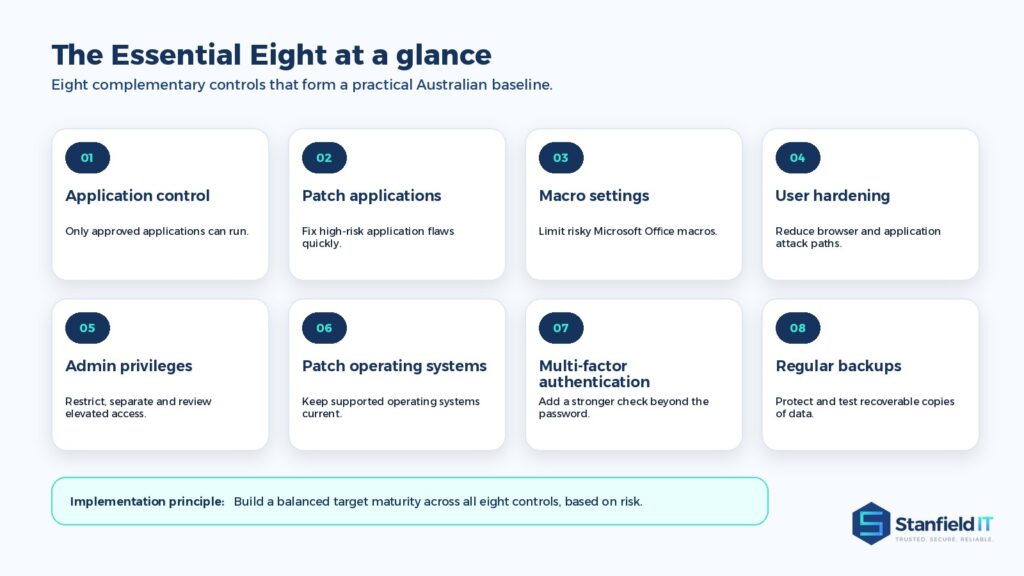
The Essential Eight is a set of prioritised mitigation strategies developed by the Australian Signals Directorate. It is intended to make it harder for attackers to compromise internet-connected information technology environments and to limit the impact of incidents.
1. Application control
Permit approved software, scripts and code to run while restricting unauthorised items.
2. Patch applications
Identify and remediate application vulnerabilities within timeframes appropriate to exposure and risk.
3. Microsoft Office macro settings
Restrict macros from untrusted sources and permit only justified, controlled use.
4. User application hardening
Reduce risky features and behaviours in browsers, PDF readers, email clients and other user applications.
5. Restrict administrative privileges
Separate privileged access from ordinary work, minimise standing rights and review high-risk accounts.
6. Patch operating systems
Keep supported operating systems current and manage exceptions or legacy systems explicitly.
7. Multi-factor authentication
Require more than one factor for important access, with stronger methods for higher-risk users and systems.
8. Regular backups
Protect recoverable copies, monitor backup activity and prove restoration through testing.
The Essential Eight Maturity Model includes Maturity Level Zero and three target maturity levels. ASD recommends selecting a target suitable for the environment and implementing the same maturity level across all eight strategies before moving individual controls further ahead.
Stanfield IT can help assess current implementation, select a proportionate target and build a staged uplift through its Essential Eight services.
NIST Cybersecurity Framework 2.0
The NIST Cybersecurity Framework 2.0 organises cyber risk around six functions:
- Govern: establish context, roles, policy, oversight, supply-chain expectations and risk appetite.
- Identify: understand assets, information, dependencies, threats and current risk.
- Protect: apply safeguards that reduce the likelihood and impact of compromise.
- Detect: find suspicious activity, anomalies and control failures.
- Respond: contain incidents, coordinate decisions and communicate.
- Recover: restore operations, manage consequences and improve from lessons learned.
NIST CSF 2.0 is useful as an operating model because it connects leadership and risk management with technical safeguards, detection, response and recovery. It can be used by organisations of different sizes without requiring certification.

ISO/IEC 27001 and an ISMS
ISO/IEC 27001:2022 defines requirements for an Information Security Management System (ISMS). An ISMS is the structured way an organisation governs information security risk, including scope, leadership, risk assessment, treatment, competence, operational control, internal review and continual improvement.
Certification is not simply a technical test. The organisation needs to show that its management system is designed, implemented, reviewed and improved. Evidence should arise from normal operations: access reviews, patch reports, backup tests, training records, supplier reviews, incident exercises and management meetings.
Stanfield IT provides ISO 27001 services and ISMS management support. Certification itself must be performed by an appropriate independent certification body.
How the frameworks fit together
| Business need | Useful approach | What it contributes |
|---|---|---|
| Practical technical baseline for an Australian IT environment | Essential Eight | Eight complementary mitigation strategies and a maturity model |
| Whole-of-business cyber risk structure | NIST CSF 2.0 | Govern, Identify, Protect, Detect, Respond and Recover outcomes |
| Formal management system and independent certification | ISO/IEC 27001 | Risk-based ISMS requirements, governance, evidence and continual improvement |
| Detailed government-aligned security controls | ASD Information Security Manual | Broader technical and governance controls for higher-assurance environments |
The right starting point is the business objective. A company answering enterprise procurement questionnaires may prioritise an ISO 27001 roadmap. A growing SME with inconsistent technical controls may begin with an Essential Eight assessment. An executive team seeking a coherent program may use NIST CSF 2.0 to organise priorities and reporting.
How to build a practical cyber security program
A security program is more than a collection of products. It is the way the organisation makes decisions, applies controls, checks whether they work and improves over time. Its design should reflect business size, sector, data, threat exposure and tolerance for disruption.
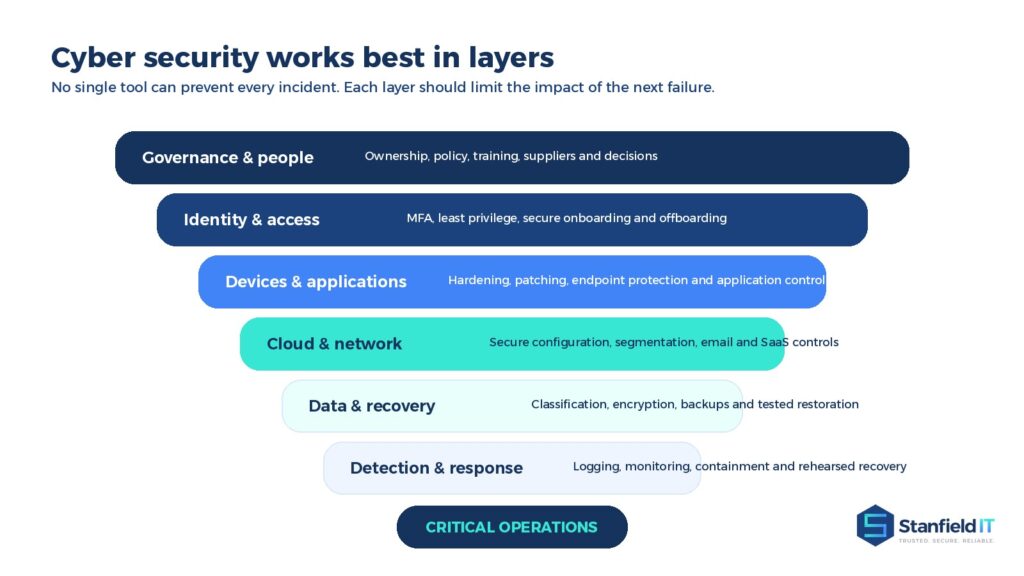
The strongest programs use defence in depth. An attacker must overcome several independent layers, and a failure in one layer does not automatically become a major incident. A phishing message may reach an inbox, but secure identity controls can stop account access. A device may be compromised, but least privilege and segmentation can limit movement. An incident may disrupt a system, but tested recovery arrangements can restore the service.
Leadership, ownership and governance
Every material security program needs a named executive owner. This person does not need to be the most technical leader. They need enough authority to resolve priorities, accept residual risk, sponsor change and keep the issue visible.
Responsibilities should be clear across leadership, IT, finance, HR, legal, privacy, operations and external providers. IT may configure access, but managers approve role requirements and HR triggers onboarding and offboarding. Finance owns payment controls. Legal and privacy advisers support breach assessment and notification. Communications manages consistent messages to staff, customers and media.
Policies should describe real expectations in language people can use. A smaller organisation may begin with an information security policy supported by access control, acceptable use, remote work, backup, incident response, supplier security and AI use policies. Avoid copying generic templates that do not match actual systems and roles.
A practical governance rhythm can include monthly operational review, quarterly executive reporting, an annual risk assessment and periodic exercises. Significant changes—such as acquisitions, office moves, cloud migrations, new critical suppliers or AI deployments—should trigger additional review.
Asset management and secure configuration
Asset management underpins patching, monitoring, cyber insurance responses, incident investigation and software licensing. The organisation should be able to answer which devices and systems are active, who owns them, what software runs, whether they are supported and whether they are monitored.
Standard builds reduce variation. Workstations, mobile devices, servers, network devices and cloud tenants should follow approved configuration baselines. Security settings should be centrally managed where practical, with changes tested and exceptions documented.
Configuration drift occurs when systems gradually move away from the standard. Temporary settings become permanent, local administrator rights accumulate and new cloud features arrive with broad defaults. Regular comparison against the baseline helps find drift before it becomes an incident path.
Identity and access controls
Identity has become the main security perimeter for many organisations. A strong identity program starts with a reliable source of truth for people and roles. Access should be created through approved processes, limited to the role and removed promptly when no longer needed.
MFA should be enforced broadly, with stronger methods for administrators, executives, finance staff and high-risk systems. Conditional access can consider device compliance, location, risk signals and application sensitivity. Rules need testing, monitoring and emergency access arrangements so that a configuration mistake does not lock out the business.
Least privilege means people and systems receive only the access needed for authorised tasks. It is not a one-time cleanup. Access grows through projects, temporary coverage and role changes, so reviews should occur regularly. Managers and system owners should confirm access because they understand business need better than IT alone.
Privileged access needs separate controls. Administrator identities should not be used for everyday email and browsing. High-risk changes should be logged, and particularly sensitive actions may require approval or time-limited access. Service accounts, application identities and API keys should have an owner, purpose, scoped permissions and protected credentials.
Endpoint and mobile device security
Endpoints include laptops, desktops, servers, phones and tablets. They are where users open content and where attackers often gain an operational foothold. A device program should combine supported operating systems, secure configuration, patching, encryption, endpoint protection and management visibility.
Modern endpoint detection and response can identify suspicious behaviour and support containment, but it is not a substitute for hardening. Devices should restrict local administrator rights, limit risky scripts or applications where practical, enforce screen locking and protect storage with encryption.
Mobile devices require clear rules. The organisation should define whether personal devices can access business information, what management is required, how data is separated and what happens when a device is lost. Lost or stolen devices should be reported immediately; remote lock or wipe can help, but encryption and strong authentication reduce exposure before the business acts.
Patching and vulnerability management
Patching is an operating process, not a monthly button. It requires complete asset visibility, trusted update sources, testing, deployment, verification and exception management. Different systems need different timeframes based on exposure and criticality.
Known exploited vulnerabilities and internet-facing weaknesses deserve urgent attention. Where a patch cannot be applied immediately, consider temporary controls such as disabling a feature, restricting access, segmenting the system or increasing monitoring. Every exception needs an owner, reason, compensating controls and an expiry or review date.
Vulnerability management adds discovery, risk-based prioritisation, remediation tracking and verification. It should show whether the most dangerous exposures are closing—not merely how many findings a scanner produced.
Email and collaboration security
Email remains a major route for fraud, account compromise and malware. Protection should include secure configuration, anti-phishing controls, domain authentication, restrictions on forwarding, suspicious sign-in detection, safe-link and attachment controls where suitable, and monitoring of high-risk mailbox changes.
Technology cannot replace financial procedure. Payment-detail changes, payroll updates, refunds and urgent executive requests should be independently verified through a trusted channel. The control must still work when an attacker has access to a genuine mailbox.
Collaboration platforms also need governance. External sharing, guest access, public links, retention and application integrations should match the sensitivity of the information. Business owners should understand who can share information outside the organisation and how that activity is monitored.
Network and remote-access security
Networks connect users, devices, cloud platforms, offices and suppliers. A practical design limits unnecessary exposure, separates higher-risk or sensitive systems and provides visibility into important traffic. Firewalls and remote-access systems should be supported, patched, securely configured and included in monitoring.
Remote access should use strong authentication, managed devices and least privilege. Old accounts, shared credentials and permanent vendor access are common sources of risk. Supplier access should be approved, time-limited where practical and reviewed when projects or contracts finish.
Network segmentation can limit movement after compromise. It is particularly important where the environment includes servers, backups, operational technology, building systems, guest networks or unmanaged devices. Segmentation needs testing; a diagram alone does not prove that traffic is actually restricted.
Cloud, data and application security
Cloud applications should be approved through a repeatable process that considers data, identity, integration permissions, supplier security, recovery, contract terms and exit arrangements. Single sign-on can improve user experience and centralise control, while automated provisioning reduces orphaned access.
Important cloud logs need adequate retention and monitoring. Default retention may be shorter than the period needed to investigate a slow compromise. Identity, administrator, sharing and application-consent events should feed an appropriate monitoring process.
Data protection begins with knowing what information exists and why it is retained. Classification and ownership make technical controls more targeted. Highly restricted data may need tighter sharing, stronger authentication, encryption, additional logging or approval before export.
Data loss prevention can detect or restrict sensitive information leaving through email, cloud sharing, endpoints or applications. Poorly tuned rules create noise and frustration, so begin with a small number of high-confidence data types and business scenarios, then expand.
Backups, disaster recovery and business continuity
Backups protect data, disaster recovery restores technology and business continuity keeps critical operations functioning. They are connected but not interchangeable.
A backup strategy should cover critical data, system configuration, cloud services and dependencies. The familiar 3-2-1 principle—multiple copies, different media or platforms and one protected offsite copy—remains a useful starting point, but modern environments also need immutability or equivalent protection, separate administrative control and monitoring for deletion attempts.
Restoration tests should be scheduled and recorded. Test sample files regularly, then run complete application or service recovery exercises according to risk. The test should confirm data integrity, identity dependencies, network access, licences, credentials and the correct order of restoration.
Business continuity plans should identify manual workarounds, alternative communications, priority customers, supplier dependencies and decision thresholds. A plan stored only on the unavailable network is not useful. Stanfield IT provides Backup and Disaster Recovery and Business Continuity Planning support.
Logging, monitoring and managed detection and response
Prevention will not stop every event. Monitoring helps the organisation find suspicious activity before it becomes a larger incident. Useful logs often come from identity platforms, email, endpoints, firewalls, servers, cloud applications, privileged access and backup systems.
A logging strategy should answer what is collected, how long it is retained, who can access it, which alerts are monitored and what happens when a signal appears. Time synchronisation matters because investigators need to reconstruct events across systems.
Alerting should focus on behaviours that matter: unusual sign-ins, new administrator accounts, disabled protection, suspicious application consent, mass file changes, mailbox forwarding, unexpected downloads, backup deletion and malicious process execution.
Managed Detection and Response combines technology with analysts who investigate and escalate alerts. It works best when the provider and customer agree who may isolate a device, disable an account, contact leadership and act outside business hours.
Security awareness and a healthy reporting culture
People are part of the control environment, not “the weakest link” by default. Training should help staff make safer decisions in their actual work. Topics may include phishing, payment verification, password managers, MFA prompts, data sharing, remote work, AI use and incident reporting.
New starters need guidance before they receive broad access. Role-based training should cover finance, executives, administrators, customer service and developers because their risks differ. Short refreshers and timely messages about emerging campaigns keep security relevant.
Phishing simulations should be used carefully. The goal is to measure and improve reporting, not shame individuals. Metrics should include how quickly suspicious messages are reported and whether the organisation responds effectively—not only click rate.
Supplier security and contract controls
A supplier register should connect each service with its business owner, data, criticality, access method, contract renewal and latest risk review. Without that visibility, third-party risk becomes a pile of questionnaires rather than a managed program.
Contracts should make responsibilities clear: incident notification timeframes, investigation support, evidence, subcontractors, data location, continuity, recovery, liability, insurance and the return or deletion of data. Contracts cannot eliminate risk, but they can prevent confusion during an incident.
Managed service providers and other technical suppliers often have privileged access. Ask how their staff are screened, how access is approved, recorded and removed, whether MFA is enforced, how customer environments are separated and what happens when the provider itself experiences an incident.
How to adopt AI securely
Artificial intelligence should be governed as part of the existing security environment—not treated as a separate experiment. The risk depends on the full system: the model, prompts, connected data, tools, permissions, supplier, users, monitoring and business decisions made from its output.
ASD’s 2026 guidance on the careful adoption of agentic AI services recommends applying established practices such as Secure by Design, defence in depth, identity and access management, continuous monitoring and incident response across the complete AI system lifecycle.
A practical AI governance process should answer:
- What approved business purpose does the AI use case serve?
- Which data can it read, create, retain or send elsewhere?
- Which actions and external tools can it invoke?
- Which identity does it use, and are permissions limited to the minimum required?
- Which decisions require human review or explicit approval?
- How are prompts, actions, exceptions and security events logged?
- How can the workflow be stopped, rolled back or operated manually?
- How will supplier, ownership, model and integration changes be reassessed?
Higher-risk systems need testing for prompt injection, data leakage, incorrect output, unintended actions and loss of control over connected tools. Sensitive actions—such as payments, account changes, legal commitments, employee decisions or customer communications—should not be delegated without appropriate human accountability.

Stanfield IT’s AI Governance and Secure Adoption service helps businesses introduce approved tools, access controls, data-handling rules, oversight and review without blocking useful innovation.
How to prepare for and respond to a cyber incident
An incident response plan explains how the organisation identifies, assesses, contains, investigates, communicates and recovers from cyber events. It should be usable under pressure, available outside normal systems and understood by both technical and business decision-makers.
Prepare
Set roles, contacts, decision authority, alternate communications, insurer instructions, external support and scenario playbooks.
Detect
Validate the signal, assess impact, classify severity and begin a reliable incident record.
Contain
Limit spread and ongoing harm without destroying useful evidence or creating avoidable disruption.
Eradicate
Remove attacker access, persistence and root cause across the full affected scope.
Recover
Restore from trusted sources, monitor closely, support users and return services in the correct order.
Learn
Review decisions, detection, containment, communications and recovery, then track improvements to completion.

Prepare the response team before an incident
Identify the incident lead, technical lead, executive decision-maker and contacts for legal, privacy, communications, HR, insurance and critical suppliers. Smaller organisations may rely on external specialists for several roles, but internal authority still needs to be clear.
Keep contact details and engagement instructions available outside normal systems. Confirm how the team will communicate if email or collaboration tools are compromised. Review cyber insurance requirements because some policies require the insured to contact an approved breach coach, forensic firm or hotline before engaging other providers.
External incident support should be arranged in advance when the organisation lacks specialist depth. Procurement and legal approval during a live incident creates delay. Pre-agreed terms, an incident response retainer or at least a documented engagement path can shorten the route to help.
The first hour of a cyber incident
The first hour is about control, not perfect diagnosis. Protect people and safety first. Confirm who is leading. Preserve relevant logs and evidence. Isolate affected accounts or devices carefully. Avoid broad actions that may destroy evidence or unnecessarily alert an attacker unless immediate harm requires them.
For an account compromise, actions may include revoking sessions, resetting credentials through a trusted process, reviewing MFA methods, disabling malicious inbox rules, checking application consent and investigating activity across related accounts. For malware, safe isolation may be more appropriate than simply switching a device off.
Do not use potentially compromised channels to discuss the response. Do not contact an extortionist, publish a statement or wipe systems without coordination. These actions can affect safety, recovery, legal privilege, insurance and investigation.
Australian organisations can report a cyber security incident through ReportCyber or contact the Australian Cyber Security Hotline on 1300 CYBER1 (1300 292 371). The organisation should also decide promptly whether it needs specialist forensics, legal advice, privacy assessment, insurer engagement or law-enforcement support.
Containment, eradication and recovery
Containment limits spread and ongoing harm. It may involve disabling accounts, blocking malicious infrastructure, isolating devices, restricting remote access or segmenting systems. The response team should consider business impact and attacker behaviour before taking broad action.
Eradication removes the attacker’s access and the cause of compromise. Resetting one password may not be enough if the attacker created another account, registered a new MFA method, installed persistence, obtained an API key or compromised an administrator. The investigation should define the affected scope and trusted point of recovery.
Recovery should be staged. Systems need to be restored from known-good sources, patched, reconfigured and monitored. Backups should not be connected blindly to a compromised environment. Validate that recovery infrastructure, administrator accounts and backup copies are trustworthy, then restore critical business services in the agreed order.
Communications and post-incident review
Incident communications should be accurate, timely and appropriate to the audience. Staff need practical instructions. Customers and suppliers may need to know what happened, what information was involved, what the organisation is doing and what they should do. Regulators and government agencies may require specific information and timeframes.
Avoid speculation. Facts change during an investigation. Use an approved source of truth and record material statements. Legal and privacy advice can help balance transparency, accuracy, privilege and reporting obligations.
A post-incident review should examine the initial path, time to detection, escalation, containment, communication, recovery, supplier performance and control gaps. Actions need owners, dates and executive oversight. Stanfield IT’s Incident Response service can support triage, containment, recovery planning and post-incident improvement.
Australian privacy, breach and ransomware reporting considerations
Privacy Act and Notifiable Data Breaches scheme
The Privacy Act 1988 generally applies to Australian Government agencies and many private-sector organisations, including certain organisations covered regardless of turnover. Applicability can be complex, so a business should not assume it is exempt without checking.
Under the Notifiable Data Breaches scheme, an eligible data breach generally arises where personal information is subject to unauthorised access or disclosure, or is lost, and serious harm is likely unless remedial action prevents that likely harm. Covered entities must notify affected individuals and the OAIC when the legal criteria are met.
Assessment should begin promptly. The organisation needs to determine what information was involved, who was affected, whether it was protected, who may have obtained it and what harm could result. A response plan should connect technical investigation with privacy and legal assessment. Stanfield IT’s Notifiable Data Breaches Readiness service helps organisations prepare roles, evidence and response processes.
Ransomware payment reporting
The Cyber Security Act 2024 introduced mandatory reporting for certain ransomware and cyber extortion payments. The ransomware payment reporting rules commenced on 30 May 2025 and specify the applicable annual-turnover threshold and information that a report must contain.
Reporting requirements do not make payment advisable. Payment may not restore access or ensure deletion of stolen information, and it can create legal, sanctions, insurance and repeat-targeting risk. A covered organisation considering or making a payment should obtain urgent legal, insurer, law-enforcement and specialist incident-response advice.
Contracts, sectors and cyber insurance
Many security requirements arise through customer contracts, tenders, cyber insurance, professional obligations or sector-specific regulation rather than one general Australian cyber security law. Businesses should maintain a register of relevant obligations and map each requirement to an owner, control and source of evidence.
Questionnaires should not be answered from assumption. Claims about MFA, encryption, monitoring, backups, incident response or framework maturity should be supported by current evidence. Inaccurate answers can create contractual and insurance risk even when the underlying security issue appears minor.
A 30–60–90 day cyber security roadmap
A practical roadmap should address urgent exposure without losing sight of sustainable operating practices. The sequence below is designed for a typical Australian small or medium business and should be adjusted for industry, risk, scale and current maturity.

Days 0–30: stabilise
- Name the executive owner and confirm incident contacts.
- Identify the critical services, systems, data and suppliers the business depends on.
- Review administrator, former-user and third-party access.
- Enforce MFA across email, cloud, remote and privileged access, with documented exceptions.
- Check exposed systems and urgent vulnerabilities.
- Confirm endpoint protection is active and centrally managed.
- Validate that critical backups are protected and can be restored.
- Define payment-verification and staff incident-reporting processes.
Output: a concise risk snapshot, urgent actions, accountable owners and dates.
Days 31–60: standardise
- Set configuration baselines for endpoints, cloud services, network devices and remote access.
- Define patching and vulnerability service levels based on exposure and criticality.
- Document joiner, mover and leaver processes and begin access reviews.
- Centralise priority logs and agree alert escalation.
- Write a practical incident response plan and scenario playbooks.
- Confirm insurer, legal, privacy and alternate-communication arrangements.
- Review high-risk supplier access and contract requirements.
- Provide targeted training for finance, executives, administrators and general staff.
Output: consistent control standards, response arrangements and a manageable operational cadence.
Days 61–90: prove and improve
- Run a backup restoration test against agreed RTO and RPO.
- Conduct an incident tabletop exercise with leadership and operations.
- Measure MFA, managed-device, patch, logging and recovery coverage.
- Investigate exceptions rather than presenting only averages.
- Review approved and unapproved cloud and AI applications.
- Prioritise vulnerabilities by exploitability and business impact.
- Complete a 12-month roadmap with costs, owners, milestones and residual risk.
- Decide which outcomes stay internal and which require specialist or managed support.
Output: tested controls, management evidence and a funded improvement plan.
The 12-month operating rhythm
After the first 90 days, cyber security should become part of normal management. A useful rhythm may include:
- Daily or continuous: priority alert monitoring, backup-failure review and active incident response.
- Weekly: urgent vulnerability review, privileged changes and significant exceptions.
- Monthly: patching, security performance, unresolved risks and supplier issues.
- Quarterly: executive reporting, access reviews, roadmap governance and high-risk supplier review.
- Six-monthly: incident exercises, recovery testing and policy review for higher-risk areas.
- Annually: risk assessment, strategy refresh, cyber insurance review and penetration testing where appropriate.
Frequency should remain risk-based. Internet-facing systems and known exploited vulnerabilities may need action much faster than a standard cycle. Critical backups may require more frequent restoration testing. The value lies in a repeatable cadence that creates evidence and catches drift.
How to measure cyber security without drowning in metrics
Metrics should support decisions. A board dashboard with 40 technical numbers can hide the few issues that matter. Combine leading indicators—which show whether controls are in place—with outcome indicators that show whether incidents are being detected, contained and recovered.
Coverage
- Active users protected by MFA
- Managed devices reporting to endpoint protection
- Critical assets included in vulnerability scanning
- Important logs reaching the monitoring service
- Critical services covered by tested recovery plans
Timeliness
- Age of known exploited vulnerabilities
- Time to remove leaver access
- Time to triage high-severity alerts
- Time to contain validated incidents
- Time to restore critical services in testing
Effectiveness
- Restoration tests completed successfully
- Tabletop actions closed by due date
- High-risk vulnerabilities verified as remediated
- Suspicious messages reported promptly
- Access reviews completed by business owners
Residual risk
- Material risks awaiting leadership decision
- Unsupported or exposed systems
- Permanent security exceptions
- Critical suppliers without current review
- Unfunded actions past their target date
Context matters more than a single percentage. “98% patched” may conceal one unpatched internet-facing system that represents most of the risk. Executive reporting should identify important exceptions, ownership, overdue decisions and whether the risk is improving.
How to plan a cyber security budget
There is no dependable universal percentage that suits every business. Budget should follow risk, required outcomes, customer obligations, regulatory expectations, existing capability and the cost of sustaining controls—not only the purchase price of software.
Separate the program into sensible categories:
- Foundational operations: identity, endpoint management, patching, email, backup and secure administration.
- Monitoring and response: logging, MDR, incident support, exercises and specialist retainers.
- Assurance: risk assessments, vulnerability management, penetration testing, audits and certification support.
- People and governance: awareness, policies, supplier reviews, reporting and leadership oversight.
- Improvement projects: legacy-system replacement, segmentation, cloud remediation, data protection and AI governance.
Compare cost with plausible business impact: downtime, payment fraud, privacy response, emergency recovery, contractual loss and management distraction. Avoid using fear as the only justification. Connect investment to measurable risk reduction, customer assurance and resilience.
For practical Australian scope examples, read the guide to cyber security services costs in Australia.
In-house, co-managed or managed cyber security?
An in-house model offers direct control and business knowledge but requires sufficient people, specialist depth and coverage. A fully managed model can provide scale and continuous capability, but responsibilities and integration must be clear. Co-managed security combines internal ownership with external specialists.
| Model | Best suited to | Strengths | Points to clarify |
|---|---|---|---|
| In-house | Organisations with enough scale, specialist staff and coverage requirements | Direct control, deep business context and close operational integration | Recruitment, separation of duties, after-hours coverage and specialist depth |
| Co-managed | Businesses with internal IT that need additional security capacity or specialist capability | Internal ownership with external assessment, MDR, testing, compliance or incident support | Boundaries, escalation, tool ownership, evidence and shared procedures |
| Managed | Businesses that want ongoing operational support without building a complete internal security function | Broader capability, recurring processes and defined reporting | Included scope, response authority, coverage hours, exclusions and customer responsibilities |
When evaluating a provider, ask who performs the work, where the team is located, how staff are screened, what happens after hours, which actions they may take, how evidence is retained, how incidents are escalated and how the provider secures its own privileged access.
Request sample reporting. It should explain business risk, trends, exceptions and actions—not merely list alerts. Confirm what is included, what is excluded and which responsibilities remain with the customer. A provider should be willing to work with internal IT, insurers, legal advisers, auditors and other suppliers because security often fails at organisational boundaries.
Common cyber security mistakes
Treating security as a one-off project
Threats, systems, employees and suppliers change. A successful uplift becomes stale without ownership, monitoring and review. Build a recurring operating rhythm and budget.
Buying tools before understanding risk
More products can create more consoles, alerts and gaps between responsibilities. Define the outcome and owner first, then use existing capability properly before adding platforms.
Assuming MFA solves identity risk
MFA is essential, but enrolment, reset, session theft, legacy authentication, application consent and excessive privilege can still create exposure.
Ignoring cloud and SaaS settings
A secure provider cannot compensate for public sharing, unmanaged guests, broad administrator access or risky integrations. Review customer-side configuration and logs.
Backing up without testing recovery
A green backup status does not prove that the business can restore. Test data, applications, identities and dependencies against agreed recovery objectives.
Relying on annual awareness training
People need timely, role-specific guidance and a safe reporting culture. Finance, executives and administrators face different scenarios from general staff.
Letting exceptions become permanent
Temporary administrator rights, unsupported systems and disabled controls often remain after the original need disappears. Give every exception an owner and expiry.
Waiting for an incident to make a plan
Contact details, insurance instructions, decision authority and alternate communications should exist before a crisis. Exercises are cheaper than improvisation.
Frequently asked questions about cyber security
What is cyber security in simple terms?
Cyber security protects systems, accounts, devices, networks and information from unauthorised access, disruption, alteration and loss. For a business, it also includes governance, employee behaviour, supplier risk, incident response and recovery.
Why is cyber security important for a small business?
Small businesses process payments, hold personal information and depend on cloud systems, but may have limited internal security resources. A compromised account, fraudulent payment or unavailable system can therefore cause disproportionate financial and operational harm.
Which cyber security controls should a business implement first?
Start with broad MFA coverage, prompt patching, restricted administrator access, managed endpoint protection, secure email and cloud settings, protected backups with restoration testing, a simple staff reporting process and an incident response plan.
Is the Essential Eight mandatory for every Australian business?
No. It is official ASD guidance and may become a requirement through government, customer, sector or contractual arrangements. Even where it is not mandatory, it is a strong technical baseline. Confirm your specific obligations before making compliance claims.
Which Essential Eight maturity level should we target?
The target should reflect threat exposure, information sensitivity, business impact and stakeholder expectations. ASD recommends a risk-based approach and balanced implementation across all eight strategies. An assessment should establish the current state and a practical target.
Is ISO 27001 the same as the Essential Eight?
No. ISO/IEC 27001 defines requirements for an Information Security Management System and can support independent certification. The Essential Eight is a set of technical mitigation strategies. They can complement one another within the same security program.
Is multi-factor authentication enough to stop account compromise?
MFA greatly reduces risk but does not eliminate it. Attackers may use phishing proxies, session theft, approval fatigue, help-desk manipulation or malicious application consent. Use stronger methods for high-risk access and monitor identity events.
How quickly should systems be patched?
Patching timeframes should reflect exposure and risk. Known exploited or internet-facing vulnerabilities may require urgent action, while routine updates can follow tested cycles. Maintain service levels, verify completion and manage every exception.
How often should backups be tested?
Test sample restoration regularly and complete service recovery exercises according to criticality and recovery objectives. High-impact systems may need more frequent testing. Record actual recovery time, data integrity and any gaps discovered.
What is managed detection and response?
Managed Detection and Response combines monitoring technology with security analysts who investigate suspicious activity, escalate confirmed threats and may assist with containment under agreed authority. It can extend capability beyond standard business hours.
What should an employee do after clicking a suspicious link?
Report it immediately through the approved channel, even when nothing appears to happen. The response team can assess the message, account, device and active sessions. Early reporting is far more valuable than hiding a mistake.
Should a business pay a ransomware demand?
The Australian Government advises against paying. Payment does not guarantee recovery or deletion of stolen data and can create further risk. Obtain urgent legal, insurer, law-enforcement and incident-response advice. Mandatory payment reporting may apply.
How do we know whether a data breach must be reported?
Covered entities need to assess whether personal information was accessed, disclosed or lost, whether serious harm is likely and whether remedial action prevents that harm. The facts and law can be complex, so involve privacy and legal advisers promptly.
How can a business use AI securely?
Use approved tools, define permitted data, restrict access and actions, assess suppliers, require human oversight for material decisions, monitor activity and include AI in incident response. Higher-risk integrations need deeper testing and stronger approval.
How much should a business spend on cyber security?
There is no reliable universal percentage. Budget from business risk, required outcomes, customer and regulatory obligations and internal capability. Include ongoing operation, awareness, monitoring, testing and incident readiness—not only software licences.
How often should we run a cyber security risk assessment?
Annual review is a reasonable minimum for many organisations, with additional assessment after acquisitions, cloud migrations, new critical applications, significant supplier changes, regulatory shifts or material incidents. Higher-risk environments may need more frequent review.
Can Stanfield IT work alongside an internal IT team?
Yes. Stanfield IT can provide assessments, monitoring, penetration testing, vulnerability management, compliance support, incident response and strategic guidance alongside an internal IT team or existing provider under a clearly defined co-managed model.
Cyber security glossary
- Application control
- A control that permits approved software and code to run while restricting unauthorised items.
- Attack surface
- The systems, accounts, interfaces, people and suppliers through which an attacker could attempt access or cause harm.
- Business email compromise
- Fraud using impersonated or compromised business communications to redirect payments or obtain information.
- Conditional access
- Rules that consider user, device, location, application and risk before allowing access.
- Cyber resilience
- The ability to prepare for, withstand, respond to and recover from cyber incidents while maintaining critical outcomes.
- Defence in depth
- Multiple preventive, detective, responsive and recovery layers so one control failure does not determine the whole outcome.
- Endpoint detection and response
- Technology that monitors devices for suspicious behaviour and supports investigation and containment.
- Information Security Management System
- A structured, risk-based management system for governing and continually improving information security.
- Least privilege
- Giving a person or system only the access needed for its authorised purpose and no more.
- Multi-factor authentication
- Authentication using two or more factors, such as something known, possessed or inherent to the user.
- Penetration testing
- Authorised testing that validates whether weaknesses can be combined to achieve a defined objective.
- Phishing-resistant MFA
- Authentication designed to resist fake sign-in pages and credential relay, such as suitable passkeys or FIDO2 security keys.
- Recovery Point Objective
- The maximum acceptable amount of data loss measured in time.
- Recovery Time Objective
- The target time for restoring a service after disruption.
- Residual risk
- The risk that remains after existing controls and planned treatment are considered.
- Shadow AI
- AI tools or use cases adopted without organisational approval, governance or adequate visibility.
- SIEM
- Security Information and Event Management technology that centralises security data for monitoring and investigation.
- Zero trust
- An approach that verifies access continually instead of assuming a user, device or network location is automatically trusted.
A practical conclusion
Effective cyber security is not about predicting every attack or eliminating all risk. It is about understanding what the business depends on, making compromise harder, detecting problems early, limiting their spread and recovering in a controlled way.
For most Australian businesses, the strongest starting point is a clear risk assessment followed by disciplined fundamentals: identity protection, patching, secure configuration, restricted privilege, protected backups, monitoring, employee readiness and a rehearsed response plan. Frameworks such as the Essential Eight, NIST CSF 2.0 and ISO/IEC 27001 can organise the work and provide evidence, but ownership and consistent operation are what create resilience.
The program should remain practical. Controls need to support how people work, suppliers need to be included, AI needs guardrails and leadership needs a concise view of residual risk. Progress should be measured through coverage, timeliness, testing and outcomes—not simply through the number of products installed.
Authoritative sources and further reading
- ASD Annual Cyber Threat Report 2024–25
- ASD Essential Eight
- ASD Essential Eight Maturity Model
- ASD consultation on the evolution of the Essential Eight
- ASD Information Security Manual
- ASD Careful Adoption of Agentic AI Services
- OAIC Notifiable Data Breaches statistics, January to June 2025
- OAIC About the Notifiable Data Breaches scheme
- Department of Home Affairs: Cyber Security Act and ransomware payment reporting
- NIST Cybersecurity Framework 2.0
- NIST Cybersecurity Framework 2.0 Small Business Quick-Start Guide
- NIST Incident Response Recommendations and Considerations
- ISO/IEC 27001 information
- Verizon 2026 Data Breach Investigations Report