


Few industries hold information as sensitive as healthcare. Patient records bring together medical histories, Medicare numbers, contact details and payment information in one place, which is exactly the combination criminals find most valuable. As practices have moved to electronic records, telehealth and connected medical devices, the digital front door to that information has grown wider. That is why cyber security for healthcare has shifted from a back-office IT concern to something that sits much closer to patient care itself.
For most Australian practices, the question is no longer whether they will be targeted, but how well they will cope when they are. The encouraging news is that meaningful protection does not require an enterprise budget or a room full of specialists. It takes the right priorities, a handful of well-chosen controls and a proactive mindset. This guide walks through the threats facing healthcare providers, the obligations that apply in Australia, and the practical steps that make the biggest difference.
Why cyber security for healthcare is now a patient-safety issue
When people picture a cyber attack, they usually think of stolen data. In healthcare, the stakes go further. A ransomware attack that locks clinical systems can delay appointments, block access to medication records and force staff back to paper at the worst possible moment. The harm is not only financial or reputational; it can affect the care a patient receives that day.
Patient trust sits at the centre of it too. People share deeply personal information with their GP, specialist or allied health provider on the understanding that it will be kept private. A single breach can undo years of that trust, and word travels quickly in local communities. Strong cyber security for healthcare protects both the practice and the relationship it depends on.
The shift to digital tools has only raised the stakes. Electronic health records, online bookings, telehealth and networked devices all make practices more efficient, but they also create more ways in for an attacker. Protecting patient data now means protecting the systems that clinical care runs on.
The state of cyber security in Australian healthcare
The scale of the problem is well documented. The Office of the Australian Information Commissioner (OAIC) consistently finds that the health sector lodges more data-breach notifications than any other part of the economy. In the first half of 2025, health accounted for the largest share of all reported breaches, ahead of finance and government, and 2024 saw the highest annual total since mandatory reporting began.
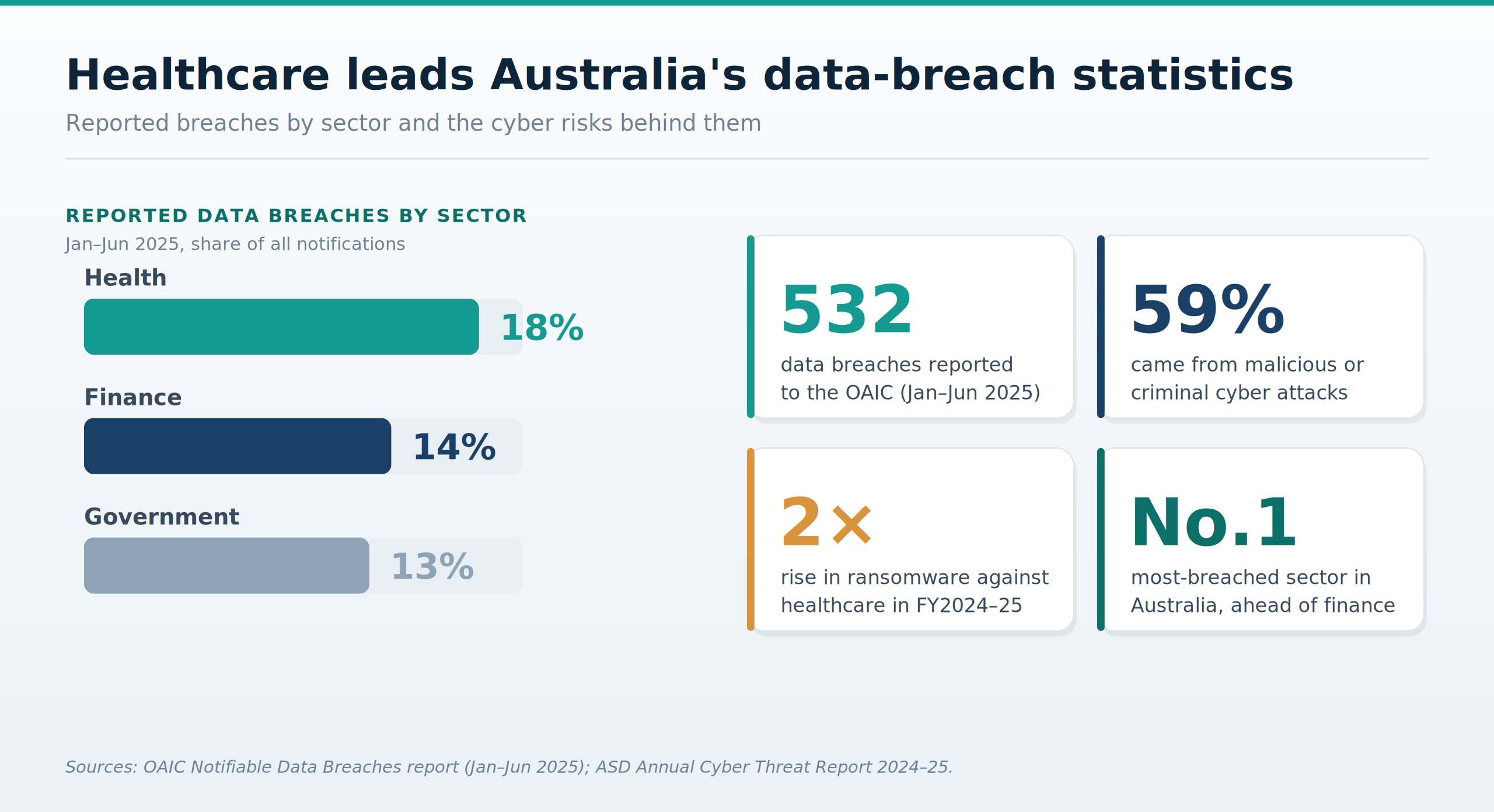
Australian health providers report more data breaches than any other sector.
The way attacks happen matters as much as how often. Most breaches are deliberate, with malicious or criminal attacks behind roughly three in five notifications, and the Australian Signals Directorate has reported that ransomware incidents against the healthcare sector doubled in 2024–25. At the same time, everyday human error, such as a record emailed to the wrong person, remains a leading cause of breaches in health specifically. Practices therefore face pressure from both determined attackers and simple mistakes.
The cost is real, and it is not only measured in dollars. Industry research puts the average cost of a data breach in the millions, but that figure does not capture the disruption, regulatory attention and lost confidence that follow. For a small practice, even a modest incident can mean days of downtime and a long, anxious clean-up.
Common cyber security threats facing healthcare practices
Effective cyber security for healthcare starts with understanding where attacks come from, because a small number of threats account for the majority of incidents. Knowing the usual suspects makes them far easier to prevent.
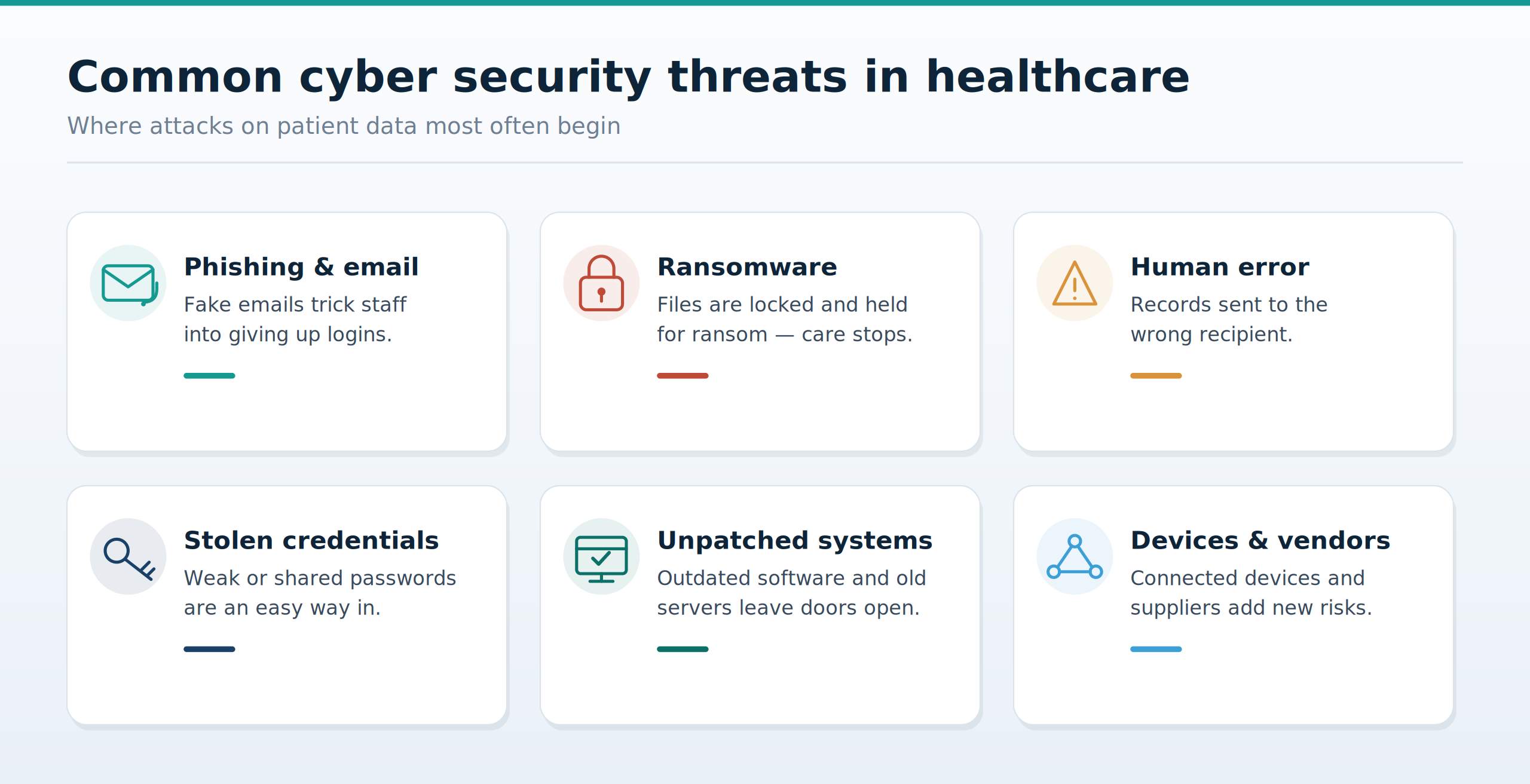
Most incidents trace back to a handful of recurring threats.
Phishing is the most common entry point. A convincing email, perhaps posing as Medicare, a software vendor or a colleague, persuades a staff member to click a link or hand over a password. From there, attackers can move into mailboxes, patient systems and billing. Closely related is ransomware, where criminals encrypt a practice’s files and demand payment to release them. For a clinic that depends on its booking and records systems, the operational impact is immediate and the recovery can be slow.
Not every breach involves a hacker. Human error is one of the leading causes of incidents in the health sector, often as simple as a patient’s results being sent to the wrong recipient. Weak or shared passwords create another easy opening, allowing a single stolen login to unlock far more than it should. Many practices also run ageing servers or unsupported software that no longer receives security updates, leaving known gaps for attackers to walk straight through.
Finally, the modern practice is highly connected. Networked medical devices, cloud platforms and third-party suppliers all touch patient information, and each connection is a potential weak point. A breach at a supplier or an unsecured device can quickly become your problem.
Privacy and compliance obligations for Australian healthcare providers
Beyond the practical risks, healthcare providers carry clear legal duties. Under the Privacy Act 1988 and the Australian Privacy Principles, organisations must take reasonable steps to protect the personal information they hold, and health information is treated as sensitive information that attracts a higher level of protection. Importantly, these obligations apply to health service providers regardless of their size or turnover, so the usual small-business exemption does not apply when you handle health data.
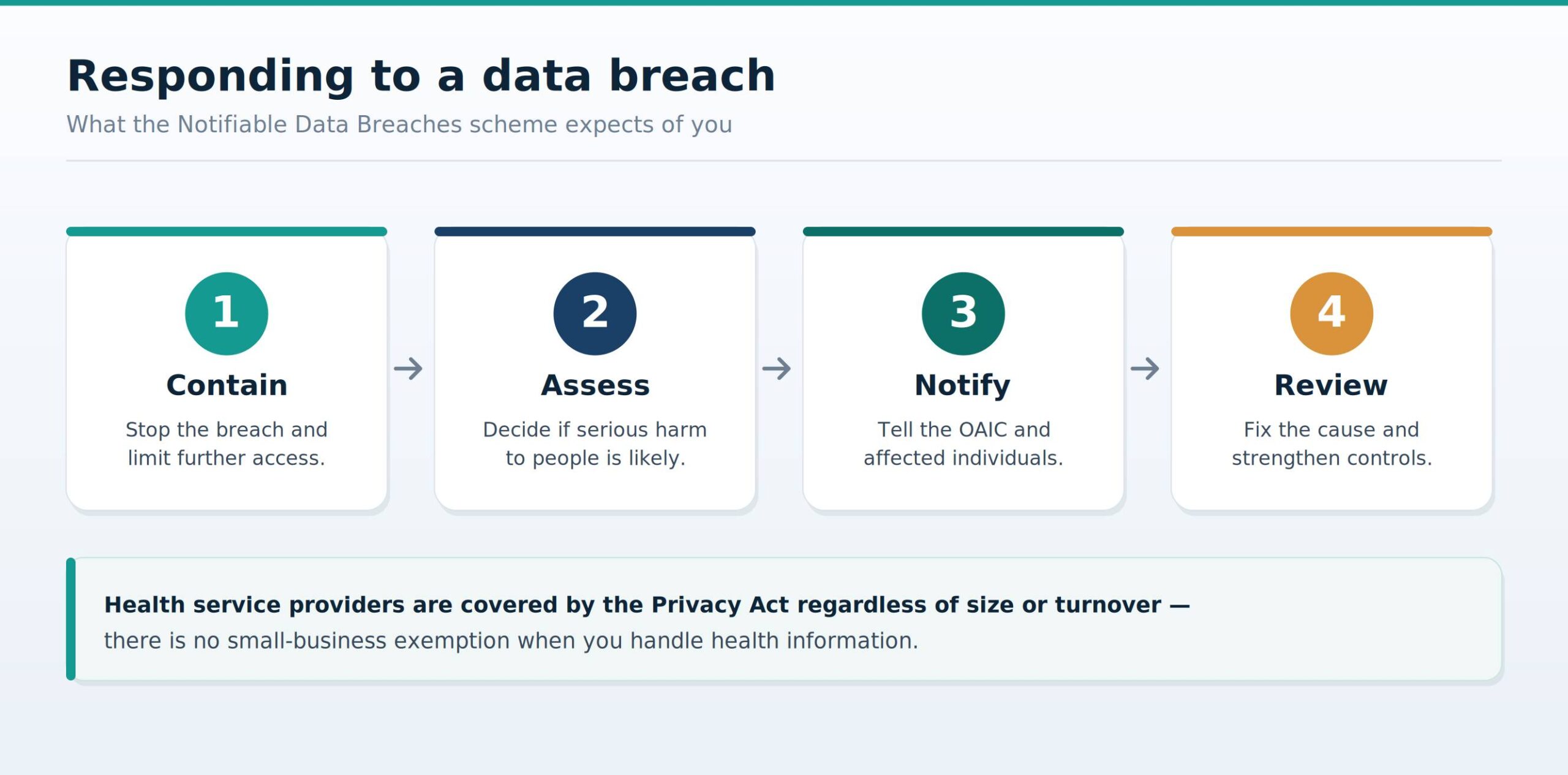
Knowing the steps in advance makes a breach far easier to manage.
If a breach is likely to result in serious harm, the Notifiable Data Breaches scheme requires you to assess the incident and notify both the OAIC and the affected individuals. Handling that process well, quickly, honestly and with a clear plan in place, makes a significant difference to the outcome for patients and for the practice.
The rules are also tightening. The Privacy and Other Legislation Amendment Act 2024 introduced a new statutory tort for serious invasions of privacy, which from June 2025 allows individuals to take direct legal action, and it added a tiered penalty regime for less serious breaches. The reforms also expect organisations to put appropriate technical and organisational measures in place, which in plain terms means actually securing the data you hold rather than simply promising to. For general practices, the RACGP’s information security guidance and the Australian Signals Directorate’s Essential Eight offer a practical roadmap for meeting these expectations.
Practical steps to strengthen cyber security for healthcare
The reassuring reality is that a small number of well-implemented controls prevent the large majority of attacks. The most effective starting point in Australia is the Essential Eight, a set of baseline strategies developed by the Australian Signals Directorate and recommended for organisations of every size.
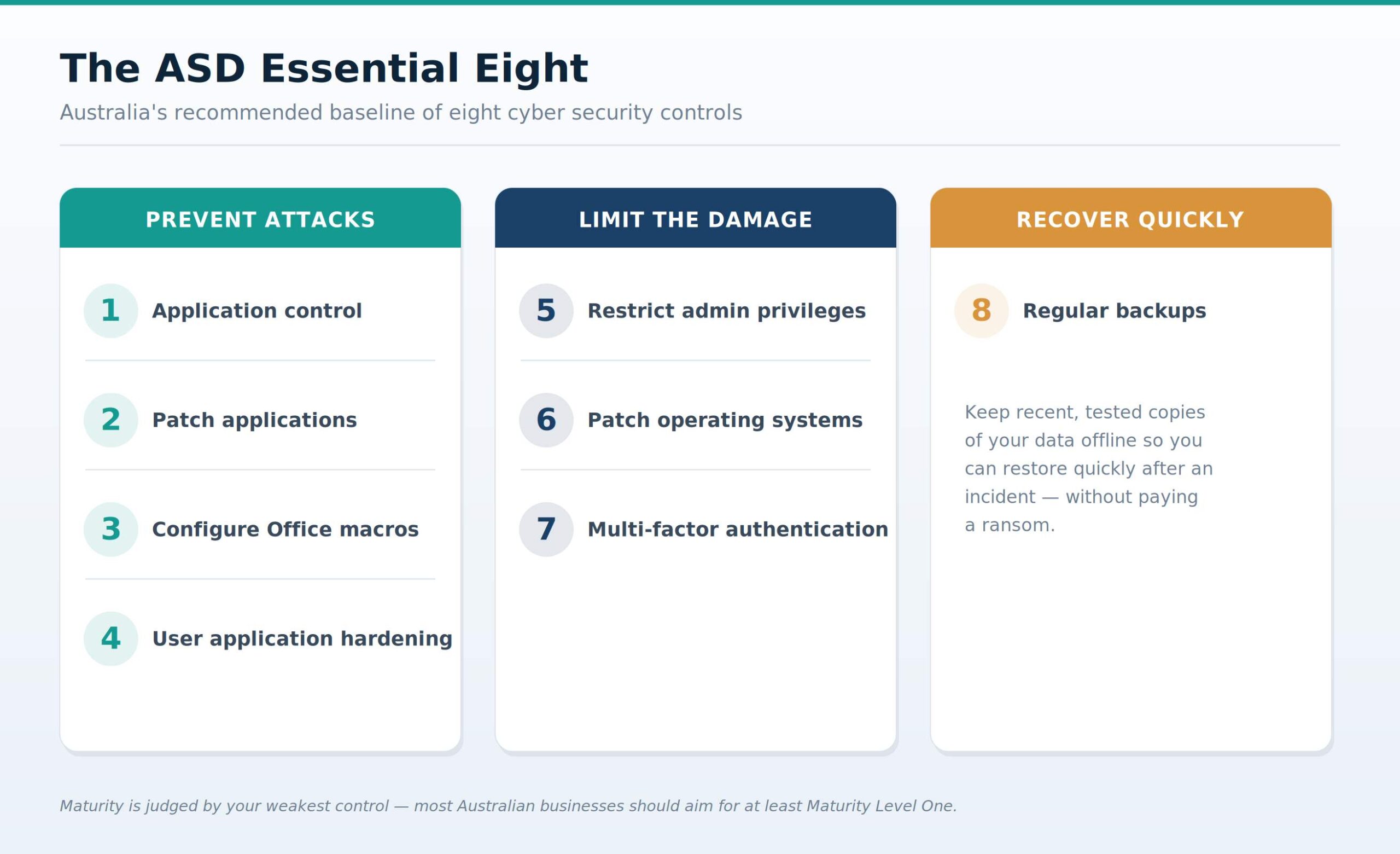
The Essential Eight is a practical baseline for any Australian practice.
The Essential Eight groups neatly into three goals: stopping attacks from succeeding, limiting the damage if one does, and recovering quickly afterwards. You do not need to implement everything overnight. The aim is steady, measurable progress, and it is worth remembering that maturity is judged by your weakest control rather than your strongest, so consistency matters.
Start with the highest-impact controls
If you do nothing else this quarter, a few measures deliver outsized protection:
Turn on multi-factor authentication (MFA) for email, clinical systems and remote access, so a stolen password alone is not enough to get in.
Keep software and operating systems patched, closing the known gaps that attackers rely on.
Maintain regular, tested backups stored separately from your main systems, so you can recover without paying a ransom.
Restrict administrator access to the few people who genuinely need it.
These four steps form the backbone of practical cyber security for healthcare: they are inexpensive, well within reach of a small practice, and they block the most common attacks seen in healthcare today.
Don’t overlook your people
Technology alone will not protect a practice whose team has not been shown what a phishing email looks like. Brief, regular training and clear procedures for verifying unusual requests go a long way. Many of the most damaging breaches begin with a single click, so an informed team is one of your strongest defences, not a box to tick once a year.
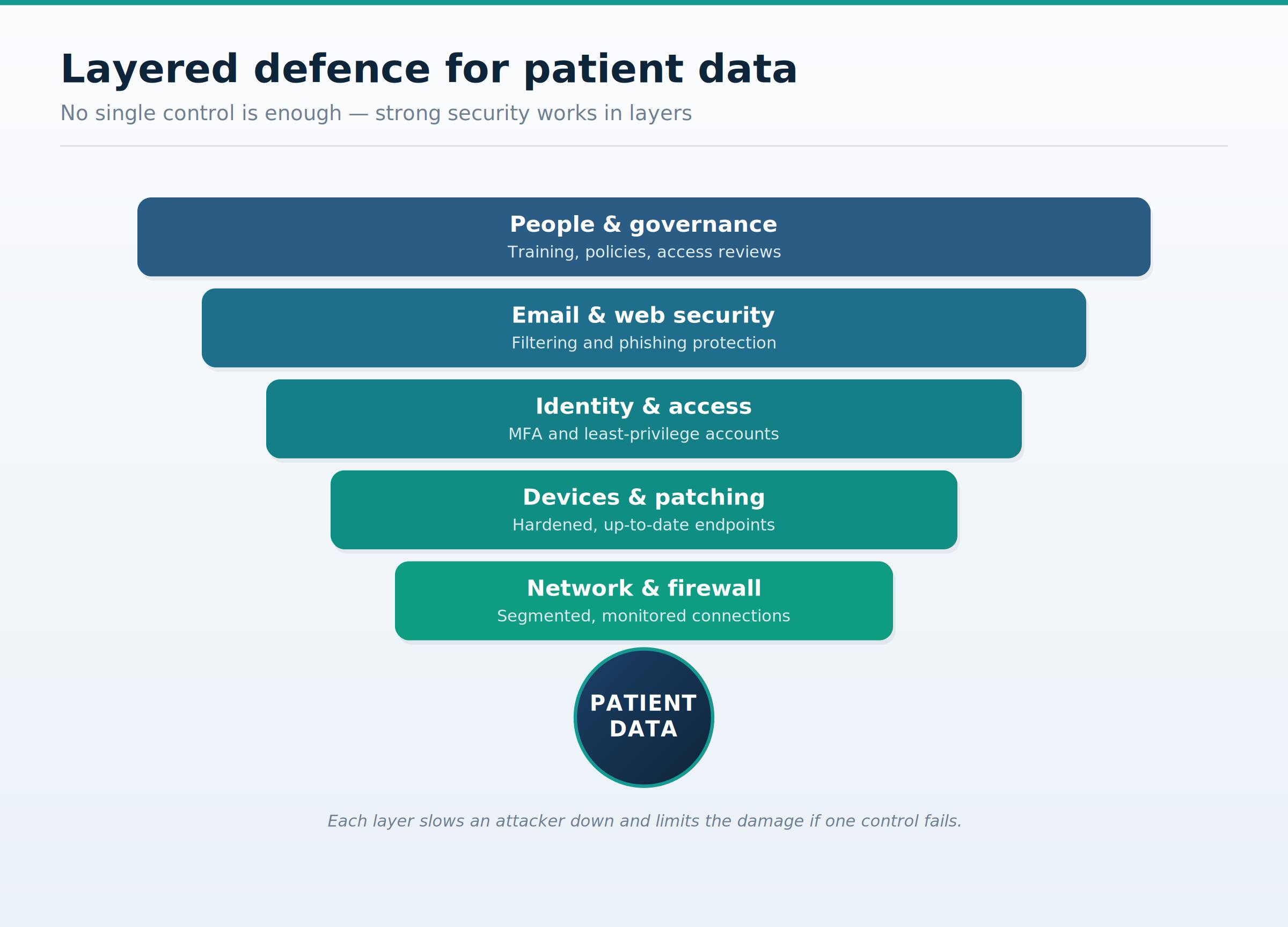
Strong security works in layers, so one failure never exposes everything.
It also helps to think in layers. Rather than relying on a single safeguard, effective practices combine several: limiting access so each staff member can only reach the information they need, encrypting devices, securing email and filtering web traffic, and monitoring systems for unusual activity. If one control fails, the others are still standing, and the attacker is slowed down at every step.
Plan for the worst
Even strong defences can be breached, so every practice should have an incident response plan. Know who to call, how to isolate affected systems and how to meet your notification obligations before anything goes wrong. Combined with tested backups, a clear plan turns a potential crisis into a manageable event and dramatically shortens recovery time.
Common mistakes that leave patient data exposed
A few recurring missteps undermine otherwise well-meaning practices. The most common is treating security as a one-off project, installing antivirus once and assuming the job is done. Threats evolve constantly, so protection has to be maintained and reviewed.
Another is the belief that a small clinic is too small to be a target. Attackers often prefer smaller organisations precisely because their defences tend to be lighter and easier to breach. Shared passwords, no MFA, untested backups and ignoring the security of third-party suppliers round out the list. Each is straightforward to fix once it is on the radar, but each leaves the door open until it is addressed.
Moving from reactive to proactive
The difference between practices that weather an incident and those that are derailed usually comes down to preparation. Proactive cyber security for healthcare means monitoring systems continuously, patching promptly, reviewing access regularly and rehearsing your response, rather than scrambling after the fact.
For many practices, the real challenge is capacity. Clinical teams are busy caring for patients, and few have the time or in-house expertise to manage security to the standard the regulations now expect. This is where an experienced partner makes the difference. With the right managed IT services and cyber security services, a practice can put strong controls in place, keep them current and stay focused on patient care. Providers that specialise in healthcare IT services also understand the specific obligations and clinical software that practices depend on every day.
Protecting patient data is an ongoing commitment
Cyber security in healthcare is no longer optional or purely technical. It protects patient safety, preserves trust and keeps a practice running. The threats are real and growing, but the path forward is well understood: know the risks, meet your obligations under the Privacy Act, implement the Essential Eight, train your team and plan for incidents.
Above all, treat security as something you maintain rather than something you set and forget. If your practice is looking for reliable, proactive support to protect patient data and stay compliant, Stanfield IT can help you build a security approach that fits the way you work.