


IT cost optimisation is the ongoing discipline of reducing wasted technology spend while maintaining or improving the business value that technology delivers. It is not a one-off budget cut. The highest-impact levers are:
- Cloud rightsizing and committed-use discounts on Azure, AWS, and Google Cloud
- SaaS licence rationalisation, including seat audits and shadow IT elimination
- Automated shutdown of non-production environments outside business hours
- Vendor consolidation to reduce duplication and improve negotiating leverage
- Showback and chargeback governance to create cost accountability across teams
Quick wins are achievable within days to weeks. Structural savings from cloud commitments and vendor consolidation typically materialise over 30–90 days. The single caution: cuts made without visibility into usage data risk degrading services that look idle but are not.
Table of Contents
- What is IT cost optimisation, and how does it differ from cost cutting?
- Why does IT cost optimisation matter, and what challenges should you expect?
- A practical, step-by-step IT cost optimisation framework you can follow
- What tactics actually deliver measurable savings?
- Making optimisation repeatable: governance, FinOps, and Australian context
- How long does optimisation take, and what ROI should you expect?
- Operational controls that consistently unlock savings
- Common mistakes that derail optimisation programmes
- How to manage risk when implementing cost optimisation
- How to tailor IT cost optimisation for the Australian market
- How to secure executive and stakeholder buy-in for optimisation
- Which metrics tell you whether optimisation is actually working?
- Key takeaways
- The part most organisations get wrong
- Stanfieldit helps Australian businesses spend less and get more from their IT
- Useful sources and further reading
What is IT cost optimisation, and how does it differ from cost cutting?
IT cost optimisation is the process of ensuring every technology dollar is justified by a measurable business outcome. The goal is not to minimise spend. It is to maximise value per dollar, continuously, as workloads and business needs change.
Cost cutting is different. It is ad hoc, often driven by a budget crisis, and typically targets the largest line items regardless of their business impact. Optimisation, by contrast, is data-driven and value-preserving. You reduce spend on what delivers little, and protect or reinvest in what delivers much.
Two recognised frameworks anchor this discipline. The Technology Business Management (TBM) taxonomy provides a standard cost model for mapping IT spend to towers, services, and business units. FinOps principles, maintained by the FinOps Foundation, extend that model into cloud-native environments with a crawl-walk-run maturity model. Both share the same core principles:
- Visibility: you cannot optimise what you cannot see
- Attribution: costs must be traceable to services, teams, and outcomes
- Rightsizing: resources should match actual demand, not provisioned estimates
- Governance: policies and guardrails prevent cost drift from returning
- Continuous improvement: optimisation is a programme, not a project
DigitalOcean notes that IT spend is expected to grow across most organisations, which makes optimisation a permanent discipline rather than a crisis response. The organisations that manage this well treat their IT budget as a portfolio, not a cost centre.
Why does IT cost optimisation matter, and what challenges should you expect?
The business case for optimisation is straightforward. Reducing waste frees capital for growth initiatives without requiring additional budget approval. Done well, it also improves scalability, because rightsized infrastructure responds more predictably to demand. And it accelerates innovation funding, because money recovered from maintenance and waste can be redirected to product development or security uplift.
The tangible benefits include:
- Reduced cloud and SaaS spend without capability loss
- Improved financial transparency and board-level confidence in IT budgets
- Faster procurement cycles through vendor consolidation
- Better alignment between IT investment and business priorities
The challenges are equally real. Hidden technical debt is the most common trap: systems that appear redundant are often load-bearing in ways that usage logs do not capture. Stakeholder resistance is predictable when teams perceive optimisation as a threat to their tools or headcount. Measurement problems arise when cost allocation is immature and savings cannot be attributed to specific actions.
Pro Tip: When presenting optimisation to executives, frame it as a business narrative, not a spreadsheet exercise. Each saving should answer: what capability is preserved, what risk is reduced, and what growth initiative does the recovered capital fund? Finance leaders respond to that framing far better than a list of percentage reductions.

Optimisation can cause harm when it moves too fast. Terminating a cloud instance that appears idle but supports a nightly batch job, or removing a SaaS licence from a user who accesses the tool quarterly, are common examples. The mitigation is a 30-day observation window before decommissioning any resource, combined with a clear rollback plan.
A practical, step-by-step IT cost optimisation framework you can follow
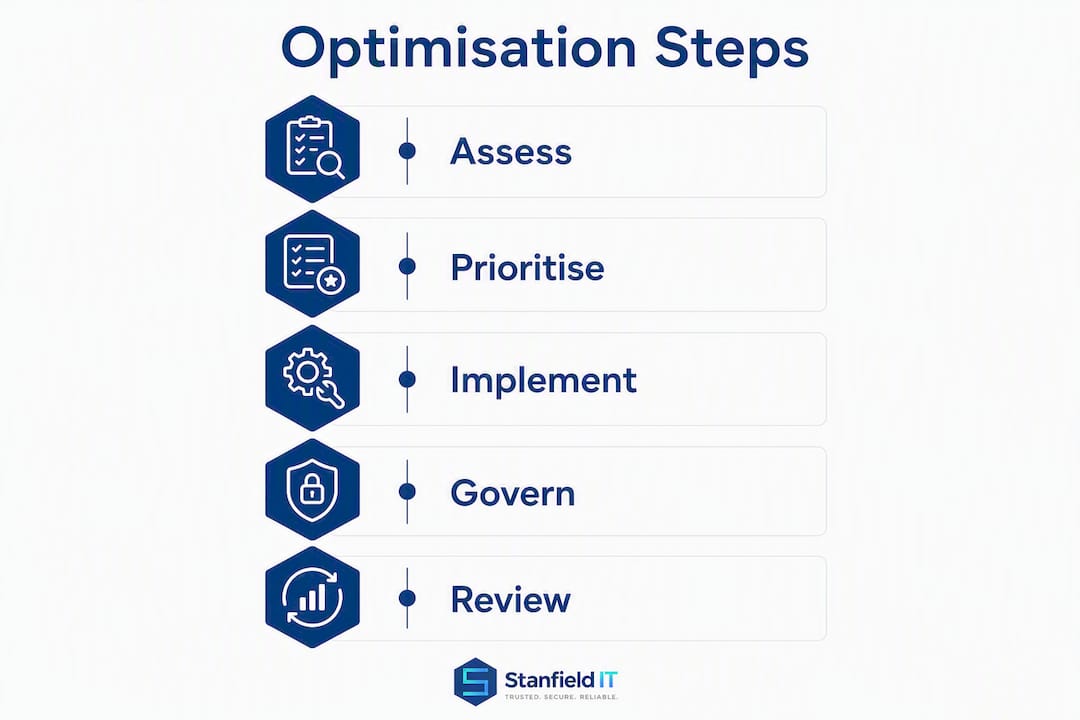
The outcome of a well-run optimisation programme is measurable savings delivered in phases, without service disruption, with governance in place to prevent costs from drifting back. A 90-day cadence, as Shopify’s framework demonstrates, is the right rhythm: quick wins in the first 30 days, structural changes in days 30–90, and governance embedded from day 90 onward.
The seven-step process
- Build a cross-functional team. Appoint an IT lead, a finance sponsor, a procurement owner, and engineering squad representatives. Without finance and procurement at the table, optimisation stalls at the analysis stage.
- Map your IT landscape. Catalogue all cloud accounts, SaaS subscriptions, on-premises systems, and vendor contracts. Include contract end dates and auto-renewal clauses.
- Measure and attribute costs. Apply a TBM-style taxonomy to allocate spend to services, teams, and business capabilities. Start with showback reports before introducing chargeback.
- Identify quick wins. Flag idle cloud resources, unused SaaS seats, duplicate tools, and contracts due for renewal within 90 days.
- Plan structural changes. Assess cloud commitment opportunities, vendor consolidation options, and automation candidates for non-production environments.
- Implement with a rollback plan. Execute changes in priority order, with a 30-day observation window for any decommissioning action.
- Monitor and iterate. Review cost dashboards weekly during the first 90 days, then monthly. Adjust targets as workloads change.
Roles and accountabilities
| Role | Primary accountability |
|---|---|
| IT lead | Programme ownership, technical decisions, risk sign-off |
| Finance sponsor | Budget authority, ROI reporting, executive communication |
| Procurement | Contract management, renewal negotiation, vendor consolidation |
| Engineering squads | Tagging compliance, rightsizing execution, automation build |
| Product owners | Licence demand forecasting, feature-to-cost mapping |
Priority matrix
| Opportunity type | Impact | Effort | Risk | Action |
|---|---|---|---|---|
| Idle cloud resources | High | Low | Low | Terminate within 30 days |
| Unused SaaS seats | High | Low | Low | Reclaim within 30 days |
| Reserved/committed use | High | Medium | Low | Commit after 60 days of data |
| Vendor consolidation | High | High | Medium | Plan for 90-day+ horizon |
| On-premises rationalisation | Medium | High | High | Strategic project, 6–12 months |
Data sources that make this work: cloud billing exports (AWS Cost Explorer, Azure Cost Management), SSO/SAML login data to identify inactive users, licence management platform exports (such as Torii or Zylo for SaaS), and usage logs from your monitoring stack.
The Narrative Group’s three-bucket budget model is a useful complement here. Separating spend into maintenance, improvement, and growth forces leaders to defend the purpose of each dollar rather than simply fighting over totals. It also prevents maintenance costs from quietly consuming the innovation budget over successive financial years.
What tactics actually deliver measurable savings?
SaaS licence audits and seat optimisation
Licence audits consistently surface material waste in organisations of all sizes. The process: export all active licences from your identity provider, cross-reference against SSO login data for the past 90 days, and flag any seat with zero or near-zero activity. Reclaim those seats before the next renewal cycle. For Microsoft 365, this is particularly productive in Australian professional services firms, where licence tiers are often assigned by role seniority rather than actual feature use. A Microsoft 365 licence review can recover meaningful spend within a single billing cycle.
Cloud rightsizing and committed-use discounts
CloudZero identifies rightsizing, automated non-production shutdowns, and committed-use coverage as the three highest-impact cloud tactics. Rightsizing means matching instance types and sizes to actual CPU and memory utilisation, not to peak provisioning assumptions. Committed-use or reserved instances on AWS and Azure deliver significant discounts on compute costs for predictable workloads. The rule of thumb: commit only after 60 days of stable usage data.

Automated shutdown of development and test environments outside business hours is one of the fastest wins available. A dev environment running 24/7 costs roughly three times what it needs to. Scheduling shutdowns via AWS Instance Scheduler or Azure Automation takes a few hours to configure and delivers immediate savings.
Vendor consolidation and zombie app retirement
Duplicate tools for the same function are common after mergers, rapid growth, or decentralised procurement. A consolidation audit maps every tool to its function, identifies overlaps, and produces a rationalisation plan. Zombie apps — tools that are paid for but no longer actively used — can often be terminated with near-zero operational impact. The discovery step is straightforward: pull spend data from your finance system, cross-reference against IT asset management records, and flag anything with no active users in the past 60 days.
Pro Tip: Run your optimisation review on a quarterly cadence. Cloud costs drift upward between reviews as teams provision resources and forget to right-size them. Automation tools like AWS Trusted Advisor, Azure Advisor, and open-source platforms like Infracost can flag drift between quarterly reviews without requiring manual analysis.
Simple AI automation is another lever worth considering. Routine tasks such as patch management, log analysis, and ticket triage can be handled by automation, reducing labour costs and freeing your team for higher-value work. Small businesses are already seeing measurable time savings from straightforward automation implementations that require no specialist AI expertise.
Making optimisation repeatable: governance, FinOps, and Australian context
Governance is what separates a one-time saving from a durable programme. Without it, costs drift back within two to three quarters.
The FinOps maturity model provides a practical path: start with showback (reporting costs to teams without billing them), move to allocation (attributing costs accurately to cost centres), then introduce chargeback (billing teams for their consumption). Starting with showback is critical in Australian organisations where cost allocation models are immature. Teams need to trust the numbers before they will act on them.
Key KPIs to track from day one:
- Cost per service or application
- Waste percentage (spend on idle or underutilised resources as a proportion of total spend)
- Cost per active user or feature
- Cloud utilisation rate (actual vs provisioned capacity)
- Cost-to-revenue ratio for IT-intensive products
For procurement, the Australian context matters. Local government procurement frameworks, particularly for healthcare and professional services, often require specific vendor panel arrangements and data sovereignty compliance under the Australian Privacy Act 1988. Negotiate multi-service bundles at renewal time, and use contract end-date visibility to create competitive tension between vendors. A 90-day lead time before renewal is the minimum needed to run a credible competitive process.
Pro Tip: Separate your IT budget into three buckets: maintenance (keeping the lights on), improvement (lifting existing capability), and growth (new capability). This structure, recommended by the Narrative Group, forces every major expense to answer what business objective it supports and who owns it. It also makes it much harder for maintenance costs to quietly crowd out your innovation spend.
Governance rollout phases:
- Days 0–30: Establish tagging standards, deploy showback dashboards, assign cost owners
- Days 30–90: Introduce allocation models, run first licence and cloud audits, publish savings reports
- Days 90–180: Implement chargeback for major cost centres, embed cost gates in CI/CD pipelines
- Days 180+: Quarterly optimisation reviews, annual vendor renegotiation cycle, continuous automation
IT Financial Management (ITFM) practices, including TBM-aligned allocation models, are the foundation for linking IT spend to business outcomes. Without ITFM, cost attribution is guesswork and savings claims are unverifiable.
How long does optimisation take, and what ROI should you expect?
| Phase | Timeframe | Typical activities | Expected outcome |
|---|---|---|---|
| Quick wins | 0–30 days | Idle resource termination, unused seat reclaim, zombie app retirement | Immediate cost reduction, low risk |
| Structural changes | 30–90 days | Cloud rightsizing, reserved instance commitments, vendor consolidation planning | Material savings, moderate effort |
| Governance and ongoing | 90–365 days | FinOps rollout, chargeback, CI/CD cost gates, quarterly reviews | Durable savings, cost accountability embedded |
Effort and cost vary by organisation size. For an Australian SME, an initial audit typically requires 20–40 hours of internal effort plus any tooling costs. Specialist consultancy for a FinOps governance rollout ranges from a few days of advisory work to a multi-month engagement, depending on complexity. The payback period for quick wins is often measured in weeks, not months, because the savings are immediate and the effort is low.
ROI compounds over time. Quick wins fund the internal effort required for structural changes. Structural changes, particularly cloud commitments and vendor consolidation, deliver ongoing savings that accumulate across each billing cycle. Governance prevents those savings from eroding.
Key considerations for Australian organisations:
- Factor in GST on cloud and SaaS invoices when calculating net savings
- Account for AUD/USD exchange rate exposure on USD-denominated cloud and SaaS contracts
- Check data residency requirements before migrating workloads to lower-cost regions
Engage an external partner, such as Stanfieldit, when internal capacity for the audit and governance build is limited, when the organisation lacks FinOps expertise, or when a neutral third party is needed to facilitate cross-team cost accountability conversations.
Operational controls that consistently unlock savings
The most durable savings come from controls that are automated, not manual. Human-dependent processes drift. Automated controls do not.
Core operational controls to implement:
- Automated resource tagging at provisioning time, enforced by policy (AWS Service Control Policies, Azure Policy)
- Off-hours shutdown schedules for all non-production environments, reviewed quarterly
- Licence lifecycle management: automated deprovisioning when a user offboards or changes role
- Snapshot and backup retention policies: automated deletion of snapshots beyond the defined retention window
- CI/CD cost gates: automated checks that flag infrastructure changes exceeding a cost threshold before deployment
- Egress and API cost monitoring: alerts when data transfer costs exceed baseline by more than 20%
Embedding these controls into delivery pipelines is the key step. A cost gate in a CI/CD pipeline catches expensive infrastructure changes before they reach production. A tagging policy enforced at provisioning time means cost attribution is accurate from day one, not retrofitted after the fact.
Pro Tip: Build a cost review into your sprint retrospective or monthly operations meeting. A 15-minute cost review, using your cloud provider’s native cost dashboard, catches drift early and keeps cost accountability visible to engineering teams without requiring a separate governance process.
From Stanfieldit’s experience working with Australian professional services and healthcare organisations, the controls that deliver the most consistent savings are licence lifecycle automation and off-hours shutdown. Both are low-effort to implement, high-impact in ongoing savings, and easy to verify. Organisations that implement these two controls first typically see measurable results within the first billing cycle.
For IT services outsourcing arrangements, embedding these controls into the managed service agreement ensures they are maintained without relying on internal capacity.
Common mistakes that derail optimisation programmes
Optimisation programmes fail in predictable ways. Recognising the patterns early prevents wasted effort and avoids service degradation.
Common pitfalls:
- One-time cuts disguised as optimisation: terminating resources without a governance model means costs return within two quarters
- Over-committing cloud resources before workload patterns are stable, locking in spend that no longer fits demand
- Poor or inconsistent tagging: without accurate tags, cost attribution is unreliable and savings claims are unverifiable
- Ignoring egress and network charges: data transfer costs are often the fastest-growing line item in cloud bills and the last one audited
- Removing security controls to reduce cost: this is the highest-risk mistake and the one most likely to result in an incident
Red flags that require immediate review:
- Service-level agreement breaches appearing within 30 days of an optimisation action
- Unplanned outages or performance degradation in systems that were recently rightsized
- A sudden increase in support tickets or incidents following a licence reclaim exercise
- Savings reports that cannot be reconciled against actual billing data
When a red flag appears, the remediation sequence is: pause further optimisation actions, restore the affected resource or licence, investigate the root cause, and update the observation window policy before proceeding. A disaster recovery plan that includes rollback procedures for optimisation actions is a practical safeguard.
Optimisation that compromises cyber security services or removes security tooling to reduce cost is never acceptable. Security controls are not a discretionary expense.
How to manage risk when implementing cost optimisation
Risk management in optimisation is not complex, but it requires discipline. The core principle is that no resource should be decommissioned without a defined observation period and a documented rollback plan.
A practical risk framework for Australian IT managers:
Before any change:
- Document the current state (resource type, cost, usage metrics, dependencies)
- Identify the business process or team that depends on the resource
- Define the rollback procedure and the person responsible for executing it
- Set a 30-day observation window for any decommissioning action
During implementation:
- Stage changes in non-production environments first where possible
- Communicate planned changes to affected teams at least five business days in advance
- Monitor service-level metrics daily for the first two weeks after any change
After implementation:
- Validate that savings appear in the next billing cycle
- Confirm that no service-level metrics have degraded
- Document the outcome and update the risk register
For healthcare organisations in Australia, additional care is required. Clinical systems, patient data platforms, and any system subject to My Health Record obligations under the My Health Records Act 2012 require formal change management approval before any optimisation action. The risk of a clinical workflow disruption far outweighs any cost saving.
Vendor lock-in is a related risk. Committing to reserved instances or long-term SaaS contracts reduces flexibility. The mitigation is to commit only on workloads with 12 months or more of stable usage history, and to maintain a proportion of on-demand capacity for variable workloads.
How to tailor IT cost optimisation for the Australian market
The Australian market has specific characteristics that shape how optimisation programmes should be designed and executed.
Data sovereignty and privacy: The Australian Privacy Act 1988 and the Notifiable Data Breaches scheme require that personal information is handled and stored in accordance with the Australian Privacy Principles. For cloud workloads, this often means restricting data residency to Australian regions (AWS Sydney, Azure Australia East/Southeast, Google Cloud Sydney). Moving workloads to cheaper offshore regions to reduce cost may breach these obligations. Always confirm data classification before optimising storage or compute placement.
AUD/USD exposure: Most major cloud and SaaS contracts are denominated in USD. As the AUD fluctuates, the effective AUD cost of these contracts changes without any change in consumption. Hedging strategies or AUD-denominated contracts (where available) reduce this exposure. Factor exchange rate risk into your ROI calculations.
Local procurement frameworks: Australian government and healthcare organisations often operate under panel arrangements or standing offer agreements. Optimisation within these frameworks requires working through approved vendors and may limit the ability to switch providers mid-contract. Understand your procurement constraints before committing to a consolidation strategy.
Essential Eight compliance: The Australian Cyber Security Centre’s Essential Eight framework is increasingly a baseline requirement for Australian organisations, particularly those in government supply chains or healthcare. Optimisation must not remove or degrade controls that support Essential Eight maturity. Patch management, application control, and multi-factor authentication are non-negotiable regardless of cost pressure.
Superannuation and payroll system costs: For Australian businesses, HR and payroll systems carry specific compliance obligations under the Fair Work Act 2009 and Single Touch Payroll requirements. These systems are not candidates for aggressive optimisation without careful compliance review.
How to secure executive and stakeholder buy-in for optimisation
The most technically sound optimisation programme will stall without executive support and cross-team cooperation. Securing that support requires a specific communication approach.
Lead with business outcomes, not IT metrics. Executives respond to statements like “this programme will recover $X in annual spend that can be redirected to the product roadmap” rather than “we will reduce our cloud utilisation rate by 15%.” Translate every technical saving into a business outcome.
Use a business narrative structure for each major initiative. For each optimisation initiative, answer five questions: what business objective does this support, what risk does it mitigate, which budget category does it sit in (maintenance, improvement, or growth), how will success be measured, and who owns the outcome. This structure, drawn from sound IT budgeting practice, makes it straightforward for finance sponsors to approve and defend the programme.
Involve stakeholders early. Teams that feel optimisation is being done to them, rather than with them, will resist. Involve engineering leads and product owners in the opportunity identification phase. Their domain knowledge will surface risks that a top-down audit will miss, and their participation creates shared ownership of the outcome.
Report savings in business terms. A monthly savings report that shows recovered spend, reinvestment decisions, and service-level outcomes builds credibility with executives and sustains momentum. Avoid reporting only cost metrics; include capability and service-quality indicators to demonstrate that optimisation is not degrading the business.
For smaller organisations, IT support for small business models that include regular cost reviews as part of the managed service agreement make stakeholder communication easier, because the reporting is built into the relationship rather than requiring a separate governance effort.
Which metrics tell you whether optimisation is actually working?
Measuring the effectiveness of an IT cost optimisation programme requires a mix of financial, operational, and service-quality metrics. Financial metrics alone are insufficient: a programme that reduces cost by degrading service has not succeeded.
Financial metrics:
- Total IT spend as a percentage of revenue (track monthly, compare to industry benchmarks)
- Cost per active user for each major SaaS platform
- Cloud waste percentage (idle and underutilised spend as a proportion of total cloud spend)
- Savings realised versus savings targeted (track monthly against the programme plan)
- Cost avoidance: spend that would have occurred without optimisation actions
Operational metrics:
- Cloud resource utilisation rate (CPU, memory, storage) by environment
- Licence utilisation rate: active users as a percentage of licences purchased
- Time to provision and decommission resources (a proxy for governance maturity)
- Number of untagged resources (should trend toward zero)
Service-quality metrics:
- Mean time to resolve (MTTR) for incidents, tracked before and after optimisation actions
- Service-level agreement compliance rate
- End-user satisfaction scores for IT services
Review these metrics monthly during the first 90 days of a programme, then quarterly once governance is embedded. A dashboard that combines financial and service-quality metrics in a single view is the most effective tool for executive reporting, because it demonstrates that savings are not coming at the expense of capability.
Key takeaways
IT cost optimisation delivers durable savings only when it combines visibility, attribution, structured governance, and continuous review — not one-off cuts.
| Point | Details |
|---|---|
| Start with visibility | Run a licence and cloud audit in the first 30 days before making any changes. |
| Use a 90-day cadence | Quick wins first, structural changes next, governance embedded by day 90. |
| Govern continuously | Showback before chargeback; automated tagging and shutdown controls prevent cost drift. |
| Measure both cost and service quality | Track waste percentage and MTTR together to confirm savings are not degrading capability. |
| Stanfieldit accelerates the process | Stanfieldit provides audit, FinOps governance, managed cloud optimisation, and licence rationalisation for Australian SMEs. |
The part most organisations get wrong
Most IT cost optimisation programmes I see stall at the same point: after the quick wins. The idle resources are terminated, a few SaaS licences are reclaimed, and the savings report looks good for one quarter. Then costs drift back, the programme loses momentum, and the organisation is back where it started within two billing cycles.
The reason is almost always the same. The programme was treated as a project with an end date, not a discipline with a governance model. Quick wins are easy to find and easy to claim. Durable savings require tagging standards, cost owners, quarterly reviews, and procurement discipline. Those things are less exciting to report, but they are the only thing that makes the savings stick.
The other pattern worth naming: organisations that focus exclusively on cloud costs and ignore SaaS. Cloud optimisation is well-understood and well-tooled. SaaS licence waste is often larger in absolute dollar terms for Australian professional services and healthcare organisations, and it is almost always undermanaged. A thorough licence audit, cross-referenced against SSO login data, is frequently the highest-ROI action available and the one most often skipped.
The organisations that run effective optimisation programmes treat cost as a product metric, not a finance function. Engineering teams own their cloud spend. Product owners forecast licence demand. Finance provides the governance model. That shared ownership is what makes optimisation durable.
Stanfieldit helps Australian businesses spend less and get more from their IT
If your organisation has identified the need to reduce IT costs but lacks the internal capacity or FinOps expertise to run a structured programme, Stanfieldit provides exactly that capability for Australian SMEs and professional services organisations.

Stanfieldit’s IT cost optimisation services include a structured licence and cloud audit, FinOps governance rollout, managed cloud optimisation across Microsoft 365, Azure, and AWS, and ongoing licence rationalisation as part of a managed IT agreement. Rather than a one-time engagement that delivers a report and leaves, Stanfieldit embeds cost accountability into your ongoing IT management, so savings are maintained rather than eroded.
The starting point is a no-obligation IT assessment that maps your current spend, identifies the highest-impact opportunities, and gives you a clear picture of what a 90-day programme would deliver. Book your IT assessment with Stanfieldit and get a concrete savings estimate within two weeks.
Useful sources and further reading
The following sources informed this guide and are recommended for further reading on specific topics:
- DigitalOcean: 11 IT cost optimisation strategies for scalable savings — practical overview of licence audits, cloud tactics, and the case for value-focused optimisation over blunt cuts.
- CloudZero: IT cost reduction strategies — a CTO and CFO guide — detailed guidance on cloud rightsizing, committed-use discounts, and automation tactics with a finance-leader perspective.
- CloudZero: IT cost optimisation — strategies and framework — the five-stage optimisation framework and a clear definition of what the discipline means in a cloud-first environment.
- Shopify: How to reduce IT costs without slowing innovation — a 90-day framework — the 90-day quick-win-to-governance cadence that underpins the timeline guidance in this article.
- CostPerform: What is IT Financial Management (ITFM)? — comprehensive guide to ITFM, allocation models, showback and chargeback, and TBM taxonomy for linking IT spend to business outcomes.
- Narrative Group: IT budget planning for mid-sized companies — the three-bucket budget model (maintenance, improvement, growth) and financial-first budgeting principles for IT leaders.
- Stanfieldit: IT services outsourcing — guidance on outsourcing models and how managed service agreements can embed cost controls into ongoing IT delivery.
For Australian regulatory context, consult the Office of the Australian Information Commissioner for Privacy Act obligations, the Australian Cyber Security Centre for Essential Eight guidance, and the Australian Taxation Office for GST treatment of cloud and SaaS services.