


Cyber Security Strategy: A Comprehensive Framework for Australian Businesses
Most business owners don’t lie awake thinking about firewalls and encryption. They think about their customers, their staff, and the day-to-day pressure of keeping everything running. Yet a single security incident can undo years of that hard work in an afternoon. A ransomware attack, a compromised email account, or a lost laptop can halt operations, expose sensitive data, and damage the trust you’ve spent years building.
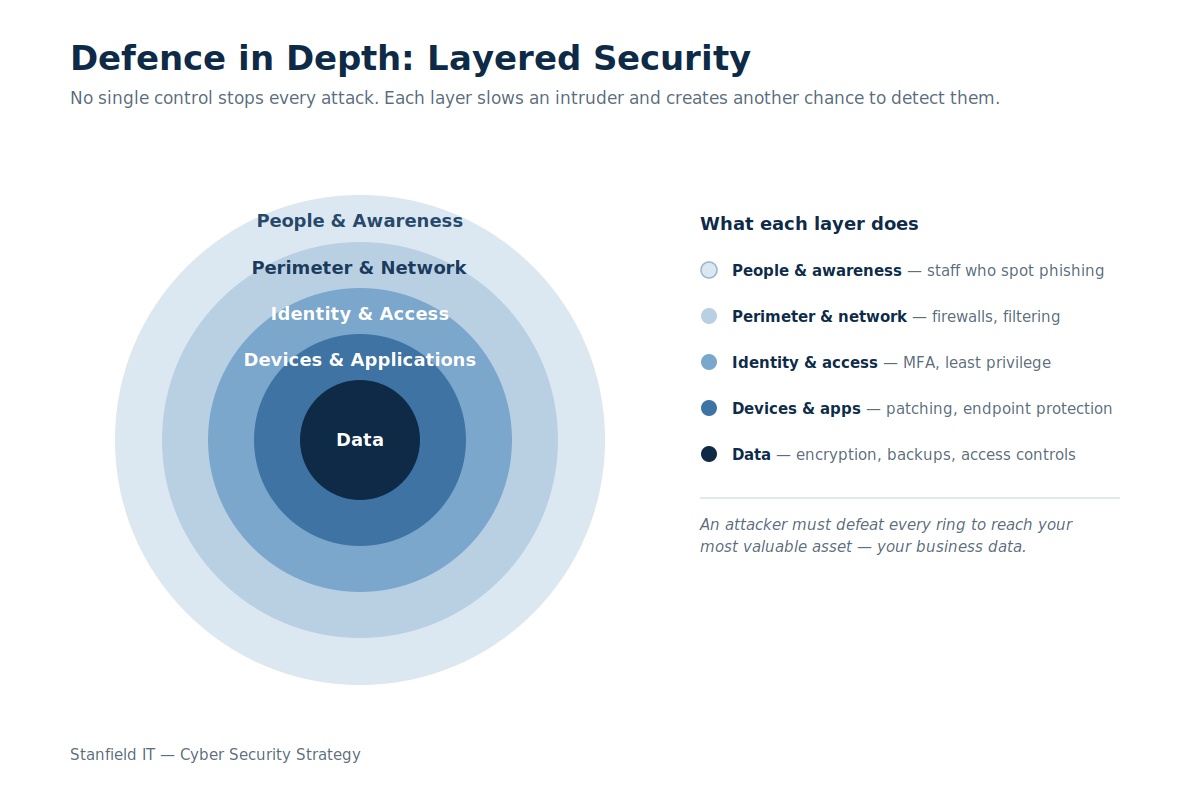
That’s why a clear cyber security strategy matters so much. It isn’t about buying the most expensive software or locking everything down so tightly that nobody can get their job done. It’s about understanding what you need to protect, deciding what to do first, and putting sensible, layered defences in place that hold up as your business grows and the threats around it change.
This guide walks through what a comprehensive framework looks like in plain terms: why it matters, the structure that holds it together, the national context shaping expectations in Australia, and the practical steps you can take to move from feeling exposed to feeling genuinely prepared.
Why Every Business Needs a Cyber Security Strategy
There’s a common myth that cyber criminals only go after large corporations and banks. The reality is the opposite. Small and medium businesses are frequently targeted precisely because attackers expect them to have weaker defences and fewer dedicated security staff. To an automated attack scanning thousands of systems at once, your business looks exactly like everyone else’s: a possible way in.
Without a deliberate plan, security tends to grow by accident — a bit of antivirus here, a password policy there, a backup someone set up years ago and hasn’t checked since. Each piece might be fine on its own, but together they leave gaps nobody is watching. A proper cyber security strategy replaces that patchwork with a coordinated approach where every control has a purpose and someone is accountable for keeping it working. The benefits go well beyond avoiding disaster: a considered strategy reduces downtime, protects your reputation, helps you meet customer and insurance requirements, and gives your team the confidence to work without second-guessing every email or link.
The Difference Between Strategy and Tactics
It’s worth pausing on an important distinction. Tactics are the individual tools and responses you use to deal with immediate threats: blocking a suspicious sender, patching a vulnerability, resetting a password. Strategy is the bigger picture that decides which tactics you need, how they fit together, and how they support your business over the long term. Plenty of organisations are busy with tactics while having no real strategy at all, reacting to each problem as it appears and never quite getting ahead of the next one.
A strategic approach flips that around. Instead of only fighting today’s fire, you build a sustainable security posture that anticipates tomorrow’s risks. Part of that shift means accepting a hard truth: prevention alone is never enough. No matter how strong your defences, you have to assume that something will eventually get through. This “assume breach” mindset simply means designing your systems so that when an incident happens, you can detect it quickly, contain it, and recover with minimal damage. Hoping nothing ever goes wrong is not a plan.
A Framework for Building Your Cyber Security Strategy
A good way to make sense of cyber security is to think of it as a continuous cycle made up of five connected stages. This model, drawn from widely used security frameworks, gives you a simple structure to organise your thinking and make sure nothing important falls through the cracks.
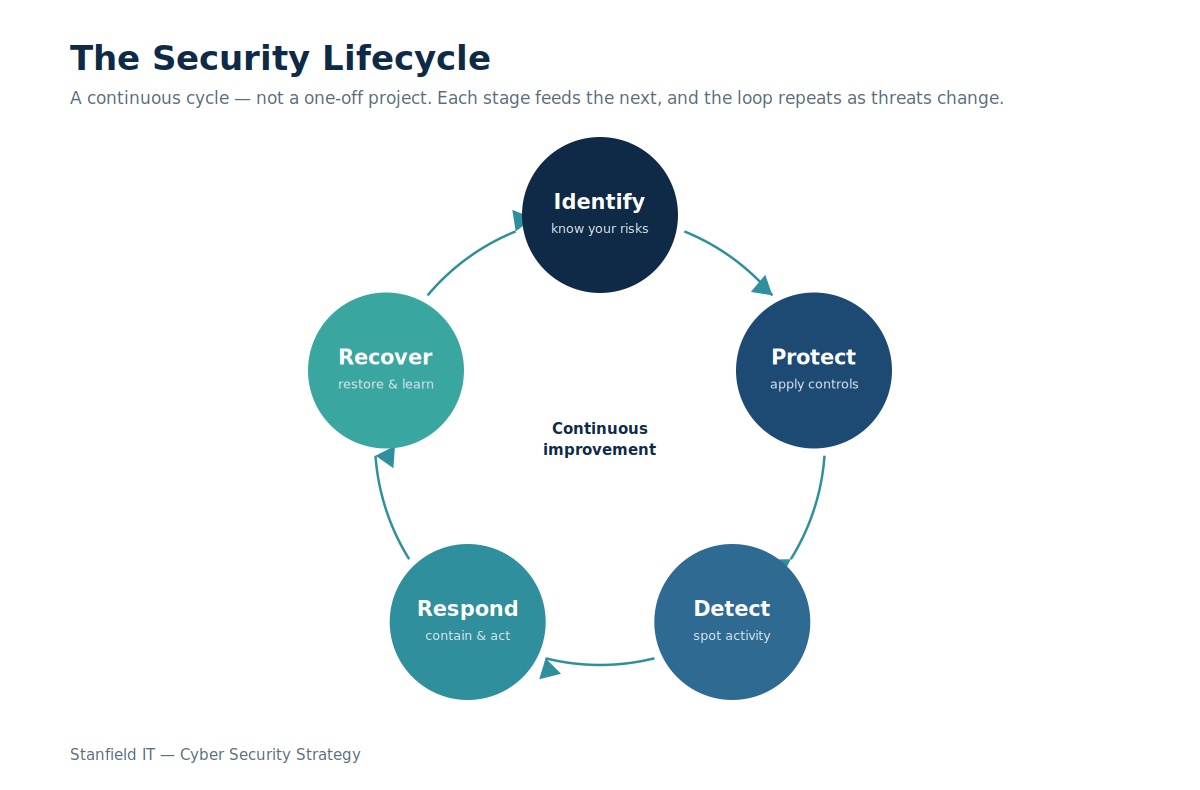
The five stages work like this:
- Identify — Understand what you have and what could go wrong. This means knowing your important data, systems, and devices, and being honest about where your risks and weak spots lie.
- Protect — Put the right safeguards in place. This covers the practical controls that prevent or limit attacks, from access management to staff training.
- Detect — Notice when something is wrong. The faster you spot unusual activity, the less damage it can do.
- Respond — Act decisively when an incident occurs. A clear plan for who does what, and in what order, turns a crisis into a managed event.
- Recover — Restore normal operations and learn from what happened. Good recovery gets you back on your feet quickly and feeds lessons back into the cycle.
What makes this a framework rather than a checklist is that the stages never really finish. Once you’ve recovered from an incident or completed a review, you return to identifying new risks, and the cycle begins again. Threats evolve, your business changes, and your strategy has to keep pace.
The first two stages, identify and protect, are about getting ahead of trouble: knowing your important data and devices, being honest about your weak spots, and putting sensible safeguards in place where they reduce the most risk. The final three are about resilience. Detection gives you early warning, response gives you a clear plan of who does what, and recovery gets you operating again. A tested backup and recovery plan sits right at the heart of this, because the ability to restore clean data is often the difference between a bad day and a business-ending one.
The Australian Context: Six Cyber Shields
If you operate in Australia, it helps to understand the national direction shaping how cyber security is approached across the country. The 2023–2030 Australian Cyber Security Strategy sets out the government’s plan to make Australia a world leader in cyber security by 2030, backed by significant investment and a clear message that business resilience is now a national priority.
The strategy is organised around six “cyber shields,” each adding a layer of defence for citizens and businesses. They’re being rolled out in stages, and as of 2026 the focus is shifting toward lifting cyber maturity right across the economy rather than only patching the most urgent gaps.
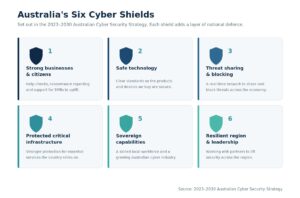
The six shields cover strong businesses and citizens, safe technology, world-class threat sharing and blocking, protected critical infrastructure, sovereign capabilities, and a resilient region with global leadership. The first shield is especially relevant to small and medium businesses, because it responds directly to a common concern: that smaller organisations lack the time, money, and expertise to lift their own security.
The practical takeaway is this. Government initiatives provide a helpful backdrop and set expectations, but they can’t protect your business for you. National shields don’t configure your email security or train your staff. The responsibility for your own defences still sits with you, which is exactly why having your own cyber security strategy is so important.
Moving Beyond the Old “Castle and Moat” Approach
For a long time, security was built like a castle: strong walls around your network, with anything inside those walls treated as trusted. The trouble is that the modern workplace has no clear walls anymore. Staff work from home, on the road, and across multiple devices, and data lives in cloud services rather than a single office server. The old perimeter has effectively dissolved.
This is where the idea of “zero trust” comes in. It sounds severe, but the principle is sensible: never automatically trust a request just because it appears to come from inside your network. Instead, verify every request based on who is making it, what device they’re using, and whether it makes sense in context. The motto is often summed up as “never trust, always verify.”
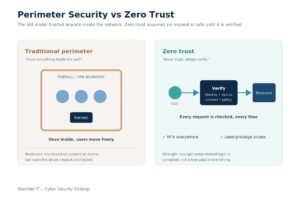
In everyday terms, zero trust means that even if an attacker steals one set of login details, they don’t automatically get the keys to everything. Each request is checked, access is limited to what each person actually needs, and a single compromised account is contained rather than catastrophic. You don’t have to overhaul everything overnight to benefit from this thinking; even small steps in this direction meaningfully reduce your risk.
The Practical Controls That Make the Biggest Difference
Strategy becomes real when it turns into specific actions. While every business is different, a handful of controls consistently deliver the greatest protection for the effort involved. If you do nothing else, these are the places to start.
Multi-factor authentication (MFA). Requiring a second form of verification beyond a password is one of the single most effective steps you can take. It blocks the vast majority of attacks that rely on stolen or guessed passwords. Rolling out identity and access management controls like MFA across your important systems should be near the top of any list.
Regular patching and updates. Many breaches exploit known weaknesses that already have fixes available. Keeping operating systems, applications, and devices up to date closes those doors before attackers can walk through them.
Reliable, tested backups. Backups are your safety net against ransomware, hardware failure, and human error. The key word is tested — a backup you’ve never tried to restore is a guess, not a guarantee.
Email and phishing protection. Email remains the most common way attacks begin. Strong filtering combined with staff who know what to look for stops a large share of threats before they cause harm.
Staff awareness and training. Your people are your front line. Regular, practical security awareness training helps everyone recognise suspicious emails, dodgy links, and social engineering attempts, turning a common weak point into a genuine strength.
Notice that not one of these is about buying a single expensive product. Good security is mostly about doing sensible things consistently, which is reassuring news for any business owner worried about cost.
Common Mistakes to Avoid
Even well-meaning businesses tend to trip over the same handful of issues. The first is treating security as a one-off project — investing heavily, ticking the box, then leaving everything untouched for years while the threat landscape moves on. Security is an ongoing rhythm, not a finish line.
The second is focusing only on technology while ignoring people and processes. The best tools in the world won’t help if staff aren’t trained or nobody knows who to call during an incident. The third is assuming you’re too small to be a target, when smaller businesses are often more attractive to attackers, not less. And the fourth is never testing your defences or your recovery. It’s far better to find a gap during a planned review than during a real crisis. Testing backups, rehearsing your response plan, and reviewing your controls regularly are what separate a strategy on paper from one that actually works.
How to Get Started: A Simple Roadmap
If all of this feels like a lot, the good news is you don’t have to do everything at once. A cyber security strategy is built in stages, and steady progress beats trying to boil the ocean. The most effective approach follows a simple, repeatable path.
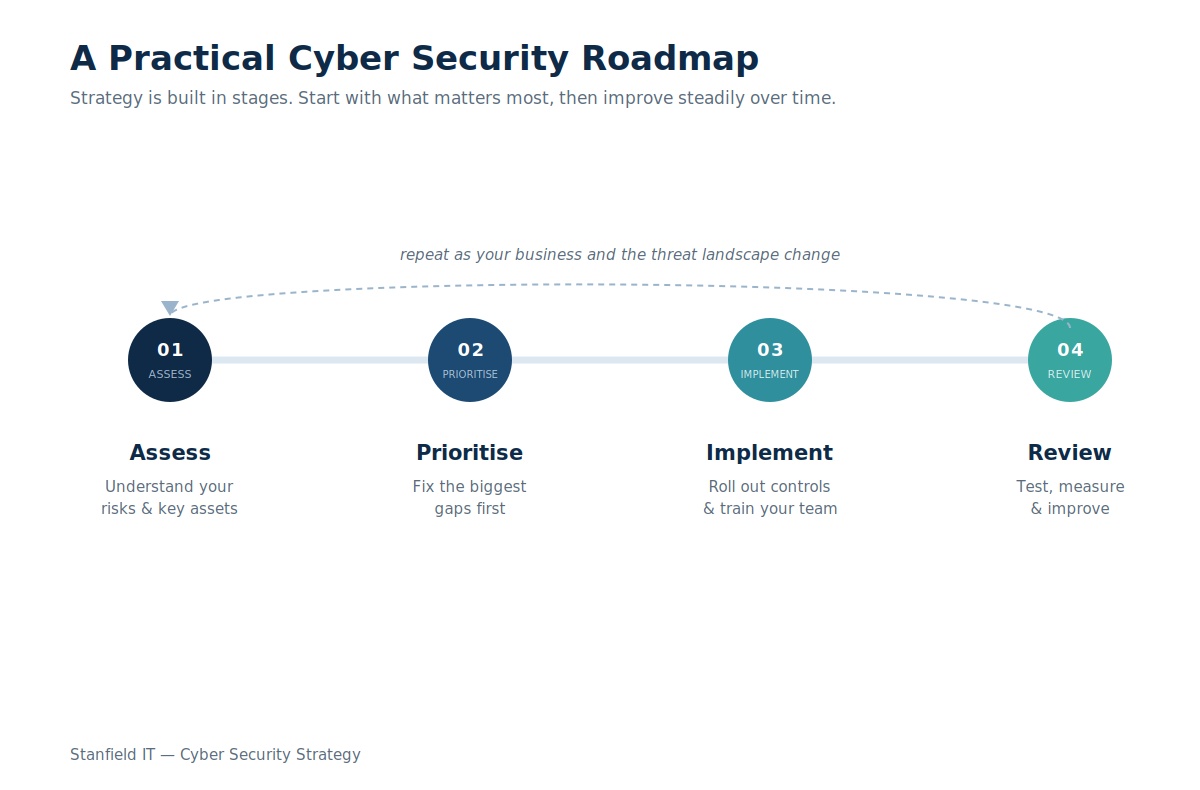
Start by assessing where you stand: what you need to protect and where your biggest risks lie. Then prioritise, tackling the most serious gaps first rather than getting distracted by minor issues. Next, implement the controls that matter most and bring your team along through training and clear communication. Finally, review what you’ve done — test it, measure it, and improve it — before cycling back to reassess as your business and the threats around it evolve.
For many businesses, the hardest part is simply knowing where to begin and having the capacity to keep it going. That’s where a structured assessment from an experienced partner can save a lot of time and uncertainty, giving you a clear picture of your current position and a prioritised plan for what to do next. If you’d like a broader view of how this fits alongside your wider technology setup, our overview of cyber security services explains how the pieces connect.
Bringing It All Together
A comprehensive cyber security strategy doesn’t have to be complicated or intimidating. At its core, it’s about understanding what matters, layering sensible defences, planning for the incidents that prevention can’t stop, and treating the whole thing as a continuous cycle rather than a one-time fix. The businesses that handle cyber threats best aren’t the ones with the biggest budgets. They’re the ones that took the time to plan, focused their effort where it counts, and kept improving over time. Being proactive costs far less than reacting to a breach, and it lets you focus on running and growing your business with genuine peace of mind.
If your business is looking for reliable IT support and a practical, proactive approach to cyber security, Stanfield IT can help. Our Australia-based team works with growing businesses to assess risk, strengthen defences, and build security foundations that hold up as you grow — explained in plain English, without the jargon. Get in touch for a friendly conversation about where your business stands and where to go next.