


What is AI automation and why does it matter for Australian businesses?
AI automation combines artificial intelligence with robotic process automation (RPA) to replace manual, repetitive tasks with intelligent systems that run continuously without human intervention. For Australian businesses, this means processes that once required dedicated staff can now operate around the clock with greater accuracy and consistency.
The core capabilities worth understanding:
- 24/7 operation with no downtime or fatigue
- RPA for data entry, invoice processing, and compliance tasks
- AI chatbots for customer service and lead qualification
- Intelligent document processing for contracts and reporting
- Workflow automation connecting your CRM, accounting, and cloud platforms
The critical distinction in 2026 is between genuine agentic AI and repackaged generative AI. True agentic orchestration uses a process reasoning engine to plan, decide, and act across systems autonomously. Most products on the market do not do this. Australian businesses that understand this difference will make far better purchasing decisions.
How does the AI automation market in Australia actually look right now?

The Australian market reflects a global pattern: over 90% of solutions marketed as “agentic” are simply generative AI layered over legacy systems. Gartner identifies only around 130 vendors globally that deliver genuine agent-driven orchestration.
| Technology type | What it does | Reliability for business |
|---|---|---|
| True agentic AI (APA) | Reasons across processes, acts autonomously | High, with governance controls |
| Repackaged generative AI | Generates text or responses, limited action | Variable, often unpredictable |
| Standard RPA | Automates rule-based tasks | High for structured workflows |
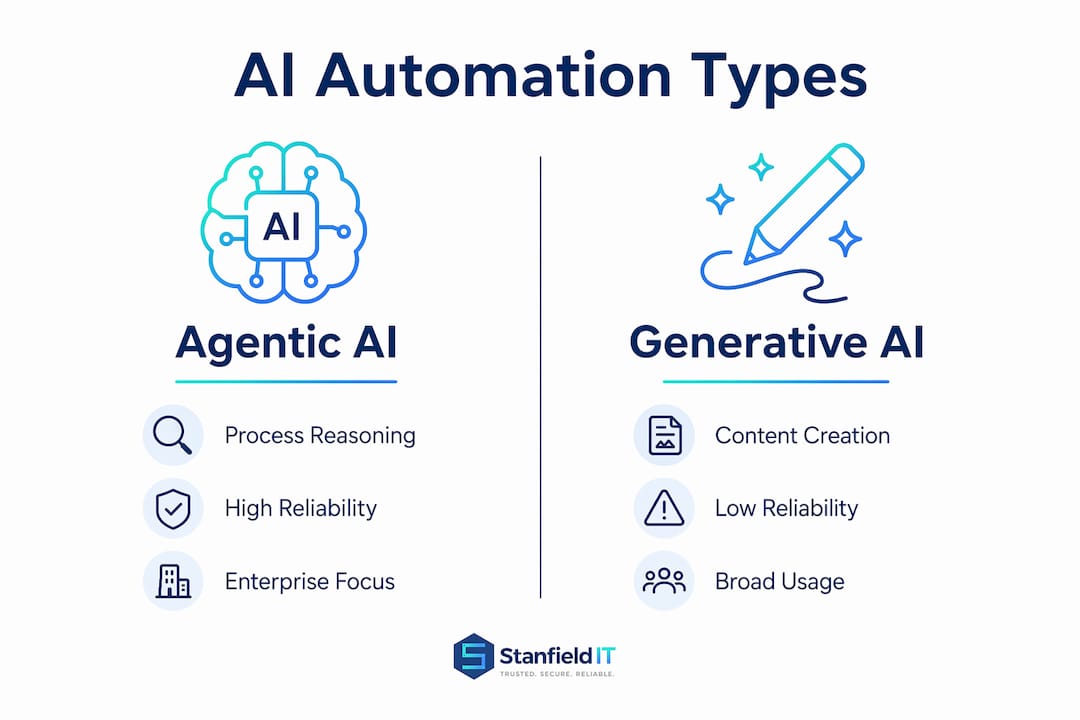
Gartner also warns that a majority of agentic AI projects face cancellation due to superficial implementation. For Australian businesses, this makes vendor scrutiny and local expertise non-negotiable.
Where can AI automation improve your operations right now?
Australian businesses across multiple sectors are already seeing significant efficiency gains through well-implemented automation. The applications are practical and sector-specific:
- Healthcare: patient record processing, appointment scheduling, AHPRA compliance documentation
- Finance: automated reconciliation, fraud detection alerts, regulatory reporting
- Manufacturing: quality control workflows, supply chain monitoring, predictive maintenance triggers
- Retail: inventory management, customer service chatbots, returns processing
- Professional services: contract review, billing automation, client onboarding
- Government: document processing, citizen inquiry handling, compliance tracking
The 24/7 availability of these systems means your business continues operating outside business hours without additional staffing costs.
What challenges should you prepare for when adopting AI automation?
- Technology complexity. Genuine agentic platforms require careful configuration. Rushing deployment without a process reasoning engine leads to brittle automations.
- Change management. Staff resistance is common. Early communication about role changes reduces friction significantly.
- Data privacy. Australian Privacy Act obligations apply to any system processing personal information. Governance frameworks must be built in from day one.
- Regulatory compliance. Sector-specific rules, particularly in healthcare and finance, require automation solutions designed with local compliance in mind.
- Workforce impact. Roles shift rather than disappear. Upskilling and transition planning protect productivity during rollout.
Pro Tip: Run a pilot project on a single, well-defined process before committing to enterprise-wide deployment. A contained pilot surfaces integration issues and builds internal confidence without large-scale risk.
How do you choose the right AI automation partner in Australia?
Selecting the right partner matters as much as selecting the right technology. Key criteria:
- Genuine agentic capability: ask vendors to demonstrate their process reasoning engine, not just a chatbot interface
- Local compliance knowledge: your partner must understand the Australian Privacy Act, sector-specific regulations, and the Australian Government’s AI Ethics Framework
- Integration depth: confirm compatibility with your existing systems, whether that is Microsoft 365, Xero, Salesforce, or industry-specific platforms
- Transparent pricing and ROI projections: avoid vendors who cannot provide clear cost-to-benefit modelling
- Ongoing local support: face-to-face consultation from an Australian-based team ensures accountability and faster resolution
Stanfieldit provides managed IT and AI automation services tailored specifically to Australian SMEs, with deep experience in cyber security, compliance, and cloud integration.
Pro Tip: Ask any vendor claiming “agentic AI” to show you the process reasoning engine in action on a real workflow. If they cannot, the product is likely generative AI with a new label.
What does AI automation actually cost, and how long does it take?
| Business size | Typical cost | Implementation time | Expected ROI |
|---|---|---|---|
| Small business | $15,000 | 3–4 months | Within 12 months |
| Medium enterprise | $60,000 | 5–7 months | Within 12 months |
| Large-scale transformation | $150,000+ | 7–9 months | Within 12 months |
Most clients achieve a 150–300% return on investment within 12 months. Workforce transition costs, including training and change communication, should be factored into your total budget from the outset.
Understanding AI-driven automation for IT governance and reliability is particularly relevant when scoping larger deployments.
What regulations and ethical frameworks govern AI automation in Australia?
Australia does not yet have a single binding AI law, but several frameworks directly affect how you deploy automation:
The Australian Privacy Act 1988 governs any automated system processing personal data. The Australian Government’s AI Ethics Framework sets eight voluntary principles covering fairness, accountability, transparency, and human oversight. Sector regulators including APRA, AHPRA, and ASIC each publish additional guidance relevant to their industries.
The federal government’s ongoing work on mandatory AI guardrails, particularly for high-risk applications, signals that compliance requirements will tighten. Building governance into your automation architecture now is far less costly than retrofitting it later.
AI automation in practice: Australian industry examples
Healthcare: Hospital networks have deployed intelligent document processing to handle patient referrals and discharge summaries, reducing administrative handling time and improving clinician availability.
Finance: Australian accounting firms use RPA to automate BAS preparation and reconciliation, cutting processing time and reducing manual errors during peak periods.
Retail: E-commerce operators use AI chatbots integrated with inventory systems to handle order queries and returns 24/7, freeing customer service teams for complex escalations.
Professional services: Law firms and consultancies apply contract review automation to flag non-standard clauses, accelerating due diligence without replacing legal judgement.
Manufacturing: Western Australian industrial operators use automation platforms to monitor equipment performance and trigger maintenance workflows before failures occur.
Each of these examples shares a common thread: the automation handles the high-volume, rule-based work, while people focus on decisions that require context and judgement. Stanfieldit helps Australian businesses across these sectors design and implement automation solutions that fit their existing IT environment and compliance obligations.
Stanfieldit works with Australian SMEs to implement AI automation that is practical, compliant, and built for long-term reliability. If you are ready to identify where automation can deliver real returns in your business, talk to our team today.

Key takeaways
Australian businesses that invest in genuine agentic AI automation, backed by local expertise and sound governance, consistently achieve efficiency gains and return on investment within 12 months.
| Point | Details |
|---|---|
| Agentic AI vs generative AI | Over 90% of “agentic” products are repackaged generative AI; only vendors with a process reasoning engine deliver true automation. |
| Efficiency gains | Well-implemented AI automation delivers significant operational efficiency improvements across sectors. |
| Cost and timeline | Projects range from $15,000 for small solutions to over $150,000 for large transformations, taking 3–9 months to deploy. |
| ROI expectation | Most Australian businesses achieve 150–300% return on investment within 12 months of implementation. |
| Compliance is built-in | The Australian Privacy Act and sector-specific regulations require governance frameworks from day one, not as an afterthought. |