


AI is becoming part of everyday financial services. It can help teams detect fraud, review large volumes of data, improve customer service, support compliance processes and make internal operations more efficient. That opportunity is exciting, but it also introduces new security, privacy and operational challenges.
The important point is that AI should not be treated as a separate technology experiment that sits outside normal business controls. AI systems connect to data, people, vendors, cloud platforms, customer workflows and decisions. If those connections are not properly managed, AI can create new pathways for data exposure, fraud, poor decisions and business disruption.
Managing AI cyber security risks is about finding the right balance. Finance businesses do not need to avoid AI altogether, but they do need clear rules, strong oversight and practical security controls before AI tools become deeply embedded in daily work. The safest approach is to make AI part of your existing cyber security, risk management and governance programs early.
Why AI Cyber Security Risks Matter in Finance
Finance businesses are trusted with highly sensitive information. Customer identities, transaction records, lending data, investment information, payroll details and commercial records all need to be protected. When AI tools are introduced, that information can move through new systems, prompts, APIs, automation workflows and third-party platforms.
This matters because the finance industry is already a high-value target. Attackers understand that financial organisations rely on accuracy, trust and uptime. AI can improve defence, but it can also give attackers better tools. Phishing can become more convincing. Deepfake voice or video impersonation can make payment fraud more believable. Malicious prompts can be designed to manipulate AI tools connected to internal systems.
Regulators are also paying closer attention to resilience, third-party risk and responsible AI use. APRA’s CPS 230 requires APRA-regulated entities to manage operational risk, maintain critical operations through disruptions and manage material service provider risk; ASIC has also warned that some licensees are adopting AI faster than their governance arrangements are being updated.
A practical AI strategy should answer simple business questions. What AI tools are being used? What data can they access? Who approved them? What decisions do they influence? What happens if they produce a harmful, biased or insecure result? If those questions are difficult to answer, the organisation may already have an AI governance gap.
The AI Cyber Security Risks Finance Teams Need to Understand
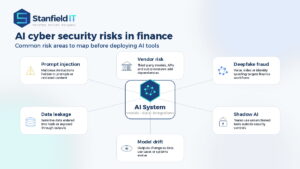
AI does not replace traditional cyber security risks. It adds another layer to them. A finance business still needs strong identity management, secure devices, reliable backups, network protection, email security and staff awareness. AI introduces additional issues that need to be understood in plain language.
One of the most common concerns is data leakage. Staff may paste customer information, reports, contracts, spreadsheets or internal notes into a public AI tool without realising how that data may be stored or used. Even when the tool is legitimate, the business may lose control over where sensitive information goes.
Prompt injection is another AI-specific risk. This occurs when a malicious instruction is entered directly into an AI system, or hidden inside content the AI system reads, so the tool behaves in an unintended way. NIST’s generative AI profile identifies prompt injection and data poisoning as cyber security risks that can affect AI systems and connected environments.
Model poisoning and poor data quality can also affect outcomes. If an AI model is trained or influenced by inaccurate, manipulated or incomplete data, it may produce results that look confident but are wrong. For finance teams, that could affect fraud detection, compliance review, customer segmentation or internal reporting.
There is also the issue of shadow AI. This happens when staff use unapproved AI tools because they are fast and convenient. The intention may be harmless, but the result is risky. The business loses visibility over data, access, retention, audit trails and vendor security.
Deepfake and impersonation risk is rising as well. Finance teams already deal with payment redirection scams, business email compromise and social engineering. AI-generated voice, video and messages can make those scams harder to detect, especially when staff are under time pressure.
The most effective response is not panic. It is visibility. Once you know which AI tools are being used, what data they touch and which business processes they influence, you can apply appropriate controls.
Build Governance Around AI Cyber Security Risks
Good AI security starts with governance. That does not mean creating heavy paperwork for the sake of it. It means making sure the right people are involved before AI tools are approved, deployed or connected to sensitive systems.
A useful first step is to create an AI use case register. This should record each approved AI tool or workflow, who owns it, what it is used for, what data it can access, whether a third-party vendor is involved, and what controls apply. For many finance businesses, simply creating this register reveals tools or workflows that were previously unmanaged.
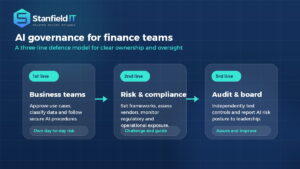
Responsibility should also be clear. Business teams are often the first line of defence because they understand how the tool is used day to day. Risk, compliance, privacy and IT teams should provide oversight, challenge and support. Senior leaders and boards need reporting that explains AI risk in business terms, not just technical language.
Governance should also define risk appetite. Some AI use cases may be low risk, such as summarising public information or drafting internal training material. Others may be high risk, such as processing customer data, influencing lending decisions, reviewing financial advice or automating security responses. High-risk use cases need stronger controls, more testing and clearer approval pathways.
This is where managed IT and cyber security support can make a real difference. A structured approach helps ensure AI is assessed alongside existing systems, policies and compliance requirements, rather than being introduced as an isolated project. Stanfield IT’s <a href=”/cyber-security-services/”>Cyber Security Services</a> are designed to help businesses reduce risk, strengthen controls and build a more resilient security posture.
Protect Data, Identity and Access
AI security depends heavily on data security. Before staff use AI tools, the business should define what data is allowed, restricted or prohibited. Customer records, financial account information, authentication details, confidential contracts and regulated data should never be entered into tools unless the platform has been formally approved for that purpose.
Data classification makes this easier. Instead of expecting every employee to make a judgement from scratch, clear labels and rules can guide behaviour. For example, public marketing copy may be permitted in an approved AI tool, while client financial records may be restricted to internal systems only.
Identity controls are just as important. AI tools should not have broad access by default. Access should be based on role, need and business purpose. Multi-factor authentication, conditional access, single sign-on, privileged access controls and regular account reviews all help limit the impact if an account is compromised.
Finance businesses should also consider how AI interacts with documents, emails and internal systems. If an AI assistant can search a large document library, it may surface information a user should not normally see. Permissions, data loss prevention rules and audit logs need to be checked before these tools are widely rolled out.
Staff training is essential, but it should be practical. Employees do not need a technical lecture on machine learning. They need to understand what information they can enter into AI tools, how to spot suspicious AI-generated content, when to escalate concerns, and why shortcuts can create risk for customers and the business.
Strengthen Vendor and AI Supply Chain Management
Many finance businesses will use AI through third-party vendors rather than building their own models. That makes vendor management a critical part of AI cyber security. The business needs to understand not only the main provider, but also any sub-processors, hosting platforms, data providers, model providers and support partners involved behind the scenes.
Vendor due diligence should include specific questions about AI. How is customer data handled? Is data used to train models? Where is data stored? How long is it retained? Can data be deleted? What logging is available? How are models tested, updated and monitored? What happens if the vendor changes the model, the hosting environment or the terms of service?
Contracts should reflect the level of risk. A low-risk productivity tool may need a simpler review, while an AI platform connected to customer data, financial workflows or security monitoring should receive deeper assessment. This may include reviewing certifications, penetration testing, incident response processes, business continuity arrangements and notification obligations.
Concentration risk should also be considered. If several critical workflows depend on one AI provider or one cloud platform, an outage, breach or sudden service change could have a larger operational impact than expected. The U.S. Treasury has highlighted financial-sector AI challenges including third-party providers, data supply chain mapping, explainability and digital identity.
For smaller and medium-sized businesses, this can feel like a lot to manage. The goal is not to slow innovation unnecessarily. It is to make sure the business knows who it is relying on and what would happen if that provider failed, changed or exposed sensitive information.
Monitor, Test and Respond Before Incidents Escalate
AI systems need ongoing monitoring. A tool that was safe when first approved may become riskier over time as features change, integrations expand, staff usage grows or new threats emerge. Regular review helps ensure the original risk assessment remains accurate.
Monitoring should include usage logs, access changes, unusual prompts, unexpected outputs, data loss alerts and vendor notifications. Where AI tools are connected to business systems, monitoring should also include the systems around them, such as identity platforms, email, cloud storage, endpoint security and network activity.
Testing is equally important. Finance businesses should test how AI tools behave when presented with sensitive data, suspicious prompts, misleading instructions or unusual user behaviour. This does not need to be complicated at first. Even basic scenario testing can reveal whether controls are working or whether staff need clearer guidance.
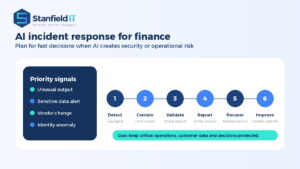
Incident response plans should also be updated for AI. If an AI tool exposes customer data, produces harmful advice, acts on a malicious prompt or is affected by a vendor breach, the business needs to know who will investigate, who will make decisions, who will communicate with stakeholders and how systems will be contained.
Business continuity planning should include AI-supported processes. If a critical AI tool becomes unavailable, can staff continue manually? Are there fallback procedures? Are important records stored somewhere accessible? Stanfield IT’s <a href=”/business-continuity-planning/”>Business Continuity Planning</a> services can help organisations prepare for disruption before it affects customers.
A Practical Action Plan for Safer AI Adoption
The safest way to manage AI is to start with practical steps that improve visibility and control. Finance businesses do not need to solve every AI risk in one project, but they do need a clear path forward.
A strong starting point includes:
- Create an approved AI tool and use case register.
- Define what data can and cannot be used with AI systems.
- Review access controls for AI-connected tools and data sources.
- Update vendor due diligence to include AI-specific questions.
- Train staff on safe AI use, deepfake risk and escalation steps.
- Test AI tools before connecting them to sensitive workflows.
- Add AI scenarios to incident response and continuity planning.
- Review AI controls regularly as tools and risks change.
The key is to keep AI governance connected to the rest of your technology environment. AI should sit alongside cyber security, privacy, compliance, cloud management, identity protection and operational resilience. When those areas work together, the business is in a much stronger position to use AI safely.
How Stanfield IT Can Help
AI can help finance businesses work faster, detect threats earlier and improve customer experiences. But it needs the right guardrails. Without clear oversight, AI can quietly create data, vendor, identity and operational risks that are difficult to unwind later.
Stanfield IT helps businesses improve security, reliability and IT performance with practical advice and proactive support. From cyber security and managed IT to cloud services, vendor risk and business continuity planning, our team can help you assess your current environment and build sensible controls around AI adoption.
If your finance business is reviewing AI tools, concerned about shadow AI, or looking to strengthen cyber security before moving further, Stanfield IT can help you take the next step with confidence.