


Business continuity and disaster recovery planning is the integrated process of preparing an organisation to maintain critical operations during a disruption and rapidly restore IT systems afterwards. Known formally under ISO 22301 and NIST SP 800-34, these disciplines are distinct but inseparable. Business continuity (BC) is enterprise-wide, covering people, processes, and revenue protection. Disaster recovery (DR) is a subset focused on restoring IT infrastructure and data. Treating them as separate programmes creates dangerous gaps. Professionals who align both under a single resilience strategy consistently achieve faster recovery and clearer governance.
What are the key components of a business continuity and disaster recovery plan?
A business continuity plan covers the full enterprise, while a disaster recovery plan addresses IT restoration specifically. Understanding what belongs in each is the starting point for any resilience programme.
Business continuity plan components
A sound BC plan includes these core elements:
- Business Impact Analysis (BIA): Identifies critical functions, acceptable downtime, and revenue exposure.
- Risk assessment: Catalogues threats from natural disasters, cyber incidents, supply chain failures, and infrastructure outages.
- Governance and ownership: Assigns executive sponsors, BC managers, and department leads with clear accountability.
- Continuity strategies: Covers manual workarounds, alternate work sites, cross-trained staff, and supplier contingencies.
- Communication plans: Defines internal escalation trees and external stakeholder messaging.
- Testing and review schedule: Sets frequency and type of exercises to validate plan effectiveness.
Disaster recovery plan components
A DR plan operates within the BC framework and focuses on IT restoration. Key elements include a full system and application inventory, recovery procedures for each critical system, backup strategies covering on-site and cloud replication, defined recovery time objectives (RTO) and recovery point objectives (RPO), and regular DR tests to validate technical procedures.

The critical distinction is ownership. Business continuity focuses on revenue protection and limiting customer impact, with leadership sitting in operations or risk management. Disaster recovery focuses on IT restoration mechanisms, with ownership in IT or infrastructure teams. Both must coordinate under a unified governance structure to avoid misaligned expectations.
How do RTO, RPO, and MTPD shape planning priorities?
These three metrics are the quantitative backbone of any business continuity disaster recovery plan. Getting them right determines whether your recovery targets are achievable or aspirational.
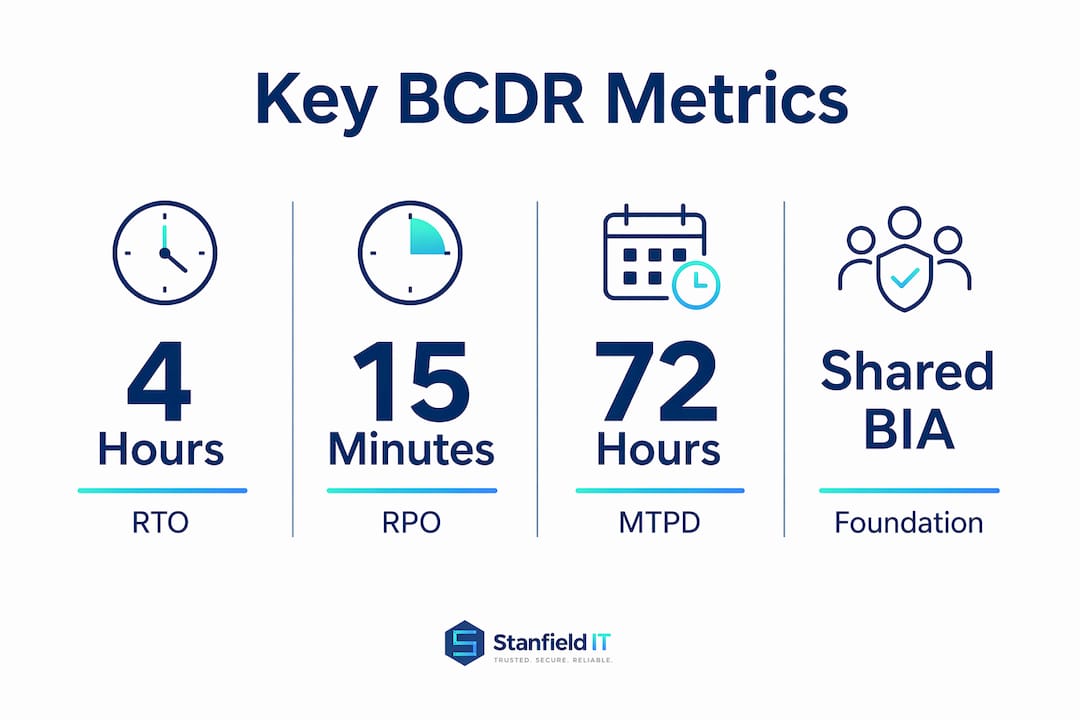
| Metric | Definition | Example |
|---|---|---|
| RTO | Maximum allowable downtime before business impact becomes unacceptable | 4 hours for a payments system |
| RPO | Maximum acceptable data loss measured in time | 1 hour of transaction data |
| MTPD | Maximum tolerable period of disruption before the organisation cannot recover | 24 hours for core operations |
The BIA defines RTO and RPO, and both must sit comfortably within the MTPD to maintain a safety margin. This relationship matters because an RTO set at 20 hours against an MTPD of 24 hours leaves almost no buffer for complications during a real incident.
A common pitfall is setting RTO and RPO based on what IT can technically deliver rather than what the business can actually tolerate. The BIA must drive these numbers, not the infrastructure team’s comfort level. Misaligned metrics produce recovery plans that satisfy IT but fail the business at the worst possible moment.
Pro Tip: Run your RTO and RPO figures past your CFO and operations lead before finalising them. If they cannot explain what those numbers mean for revenue and customers, the metrics are not yet fit for governance.
What are best practices for integrating BC and DR into one resilience strategy?
BC and DR are integrated elements of a single resilience strategy, not parallel programmes. ISO 22301 mandates that BC strategies explicitly include DR for IT dependencies. The practical implication is that your governance, planning, and testing must treat them as one.
Use a shared BIA
A mature programme uses one shared BIA to drive both BC and DR priorities simultaneously. Separate BIAs for BC and IT teams routinely produce conflicting recovery expectations. A single BIA eliminates that misalignment by anchoring every recovery target to the same business impact data.
Anchor planning to business services
Anchoring BCDR planning in important business services produces better outcomes than planning around organisational units or individual hardware. A payments processing service, for example, spans multiple teams, systems, and vendors. Planning at the service level forces you to map all dependencies and define minimum viable output, which is far more useful during an actual incident.
Build a unified governance structure
Integrated planning requires:
- A single incident command structure covering both operational and IT recovery.
- Cross-functional exercises that include operations, IT, HR, communications, and senior leadership.
- Vendor and third-party dependency registers reviewed at least annually.
- Manual workaround procedures documented for every critical service, not just IT systems.
- A communication plan that covers staff, customers, regulators, and media.
Pro Tip: Schedule at least one cross-functional exercise per year that deliberately excludes IT systems. This forces teams to practise manual workarounds and exposes gaps that purely technical DR tests will never reveal.
Organisations in Manly and across Australia increasingly face regulatory pressure to demonstrate integrated resilience. The Australian Prudential Regulation Authority (APRA) and the Australian Securities and Investments Commission (ASIC) both expect regulated entities to show that BC and DR are coordinated, tested, and governed at board level. Aligning your programme to ISO 22301 provides a recognised framework that satisfies most regulatory expectations.
How should you test and continuously improve your plans?
Testing is where resilience programmes either prove their value or expose their weaknesses. Organisations should conduct multiple tests annually, using a range of exercise types to build genuine readiness.
- Tabletop exercises: Facilitated discussions where teams walk through a scenario without activating systems. These are low cost, high value, and ideal for testing decision-making and communication.
- Functional tests: Activate specific components of the plan, such as failing over a single system or testing the communication tree. These validate technical procedures without full disruption.
- Full-scale simulations: End-to-end exercises that activate the entire plan, including IT failover, alternate work sites, and external communications. These are resource-intensive but reveal integration gaps that smaller tests miss.
- After-action reviews: Structured debrief sessions held within 48 hours of any exercise or real incident. Document findings, assign owners, and set deadlines for remediation.
- Plan review cycle: Review the full BC and DR plan at least annually, and after any significant organisational change, technology migration, or real incident.
Success should be measured in business service outcomes rather than IT metrics alone. A dashboard showing “payments processing restored within RTO” communicates more to a board than a page of RTO and RPO figures. Translating technical recovery data into business impact language is one of the most underrated skills in resilience management.
Regulatory expectations in Australia require documented evidence of testing. APRA CPS 232 and related standards expect regulated entities to demonstrate that plans are tested, reviewed, and updated. Keeping clear records of every exercise, finding, and remediation action protects your organisation during audits and builds credibility with senior leadership.
What are the most common mistakes in BC and DR planning?
Most resilience programmes fail not because of poor intentions but because of predictable, avoidable mistakes. Recognising these patterns early saves significant time and credibility.
- Treating BC and DR as IT projects. The greatest mistake is treating BC as IT-only, which misses the full scope of revenue protection and operational continuity. BC belongs to the whole enterprise.
- Running separate BC and DR programmes. Separate planning often results in conflicting recovery expectations from business and IT teams. A unified programme with a shared BIA prevents this.
- Neglecting non-IT continuity. Combining BCP and DRP into one document risks focusing only on IT recovery. Manual workarounds, communication trees, and third-party dependencies must be explicitly included.
- Unclear roles and ownership. Plans that list responsibilities without named individuals and deputies fail during real incidents when people are unavailable or unsure of their authority.
- Using metrics senior leadership cannot interpret. Presenting RTO and RPO data to a board without translating it into revenue impact, customer impact, or regulatory exposure produces disengagement and underfunding.
Small organisations face a particular version of this problem. Small organisations often combine BCP and DRP into single documents but risk focusing mainly on IT restoration, neglecting the operational continuity elements that protect revenue and customer relationships. The solution is not a longer document. It is a more deliberate structure that explicitly addresses both dimensions.
Key takeaways
Effective business continuity and disaster recovery planning requires a shared BIA, unified governance, service-based recovery targets, and regular cross-functional testing to protect both operations and IT systems.
| Point | Details |
|---|---|
| BC and DR are distinct but inseparable | BC covers enterprise operations; DR covers IT restoration. Both must be governed together. |
| Shared BIA drives alignment | One BIA for both BC and DR eliminates conflicting recovery targets between business and IT teams. |
| RTO and RPO must fit within MTPD | Set recovery metrics based on business tolerance, not IT capability, to maintain a safety margin. |
| Test with variety and frequency | Use tabletop, functional, and full-scale exercises annually to expose gaps before a real incident does. |
| Measure in business outcomes | Translate technical recovery metrics into revenue and customer impact for board-level governance. |
Why integrated planning is the only approach that actually works
The programmes I see fail most often share one trait: they were built by IT teams for IT teams. The BC plan exists as a separate document that nobody in operations has read, and the DR plan is a technical runbook that the board has never seen. When an actual incident hits, the two teams pull in different directions because their recovery targets were never reconciled.
The shift that changes everything is anchoring the entire programme to important business services rather than systems or departments. When you plan at the service level, every dependency becomes visible. The payments team, the IT infrastructure team, and the third-party processor all appear on the same map. That shared visibility is what makes coordinated recovery possible.
Board-level impact dashboards that translate technical metrics into business outcomes are not a luxury. They are the mechanism by which resilience programmes get funded, resourced, and taken seriously. If your board cannot see the connection between your RTO targets and revenue exposure, your programme will always be underprioritised.
The other thing I would push back on is the idea that testing is a compliance exercise. The organisations that recover fastest are the ones that test regularly, debrief honestly, and fix what they find. Regular combined exercises and single incident command structures improve real-world readiness in ways that no amount of documentation can replicate. Test hard, debrief harder, and your plan will earn its place when it matters most.
— Nathan
How Stanfieldit supports your resilience programme
Building a resilience programme that genuinely integrates BC and DR requires the right IT infrastructure, clear recovery architecture, and a managed services partner who understands both dimensions.

Stanfieldit works with Australian businesses to align IT infrastructure and recovery with their BC and DR objectives. From proactive monitoring and cloud backup strategies to cyber security and managed IT services, Stanfieldit provides the technical foundation that makes recovery targets achievable. Whether you are building a programme from scratch or strengthening an existing one, Stanfieldit’s team brings practical experience in aligning IT capability with business continuity outcomes. Explore how managed IT services can support your organisation’s resilience goals.
FAQ
What is the difference between business continuity and disaster recovery?
Business continuity is enterprise-wide and covers maintaining operations, revenue, and customer service during a disruption. Disaster recovery is a subset that focuses specifically on restoring IT systems and data.
What does RTO mean in a disaster recovery plan?
RTO is the Recovery Time Objective, the maximum allowable downtime for a system or service before the business impact becomes unacceptable. It is defined through the Business Impact Analysis and must sit within the MTPD.
How often should a business continuity plan be tested?
Organisations should conduct multiple tests annually, including tabletop exercises, functional tests, and at least one full-scale simulation. Plans should also be reviewed after any significant organisational change or real incident.
What is a shared BIA and why does it matter?
A shared BIA is a single Business Impact Analysis used to drive both BC and DR planning priorities. It eliminates the conflicting recovery expectations that arise when business and IT teams conduct separate analyses.
What standards govern business continuity and disaster recovery planning in Australia?
ISO 22301 is the primary international standard for business continuity management. NIST SP 800-34 provides guidance for IT contingency planning. Australian regulated entities must also comply with APRA CPS 232 and related ASIC requirements.