

Not long ago, artificial intelligence felt like something reserved for big tech companies with deep pockets and dedicated data teams. That has changed remarkably quickly. Today, a small accounting firm, a busy medical practice or a growing trades business can open a tool like Claude, type a request in plain English, and have a first draft, a summary or an analysis back in seconds.
This shift is exactly why AI automation for business has become one of the most talked-about topics for small and medium businesses across Australia. Used well, it can take hours of repetitive work off your team’s plate, reduce errors and free people up to focus on the work that actually grows the business. Used carelessly, it can quietly expose your most sensitive data and create risks you won’t notice until something goes wrong.
The good news is that you don’t have to choose between the two. With the right approach, you can capture the benefits of AI and keep your business secure — provided you build that security in from the very beginning rather than bolting it on later. This article walks through what’s now possible, where the risks sit, and how to adopt AI in a way that’s both productive and safe.
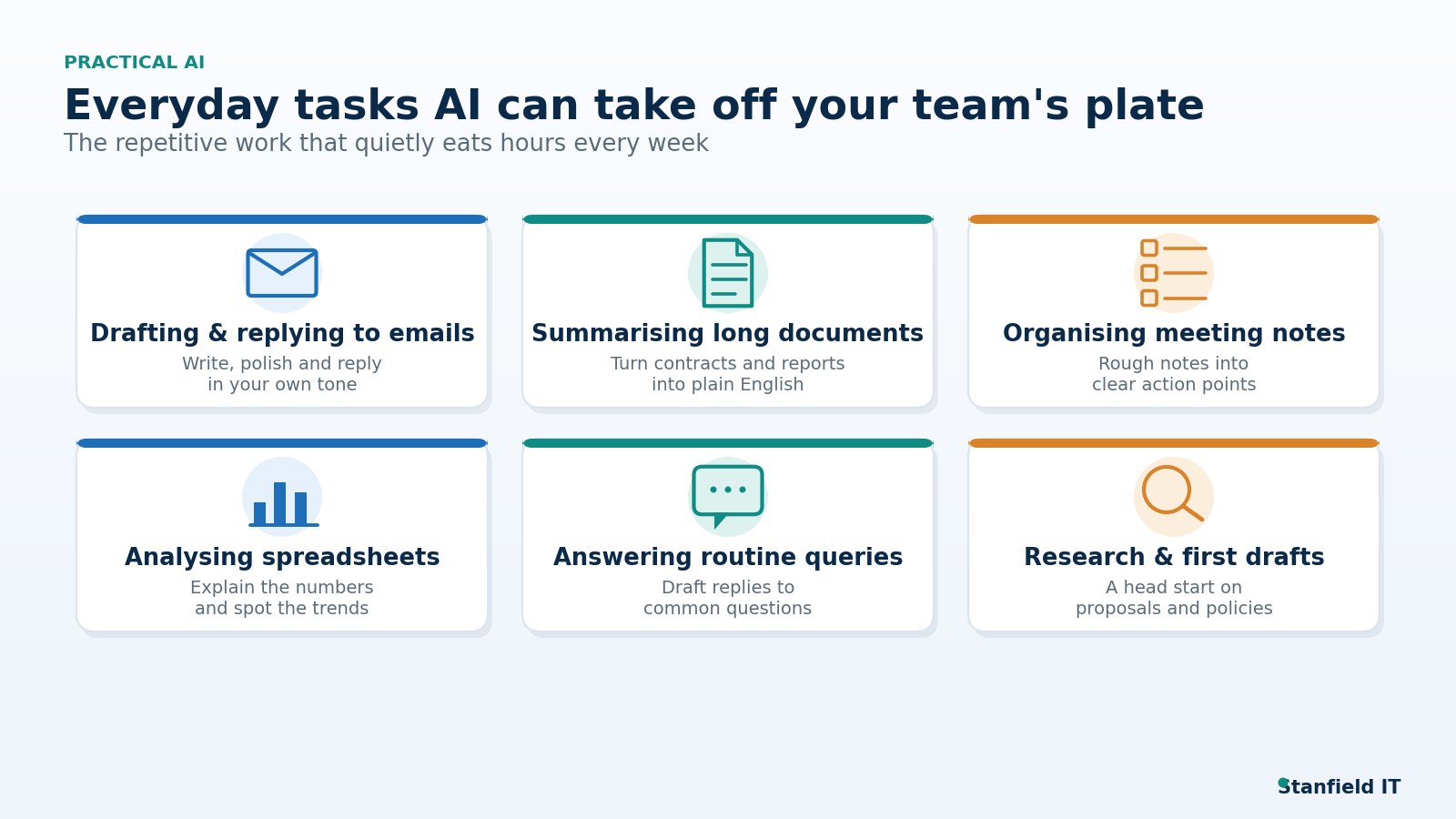
AI is especially good at the small, repetitive tasks that quietly eat into your team’s week.
Why AI Automation for Business Has Become Impossible to Ignore
The pace of adoption tells the story of why AI automation for business has taken off so quickly. Industry surveys through 2025 found that the share of small businesses using AI jumped from around 39% to roughly 55% in a single year, and the vast majority of those that have adopted it report real, measurable gains. More than 80% of small businesses using AI say it has improved their productivity, with a meaningful slice reporting time savings of more than 20%.
There are a few reasons this is happening now rather than five years ago. Modern AI assistants understand natural language, so there’s no technical skill required to use them. They’re available through everyday apps your team already knows. And the cost of entry is low, which means even a small business can experiment without a large upfront investment.
For an owner or operations manager, the appeal is simple. Every business has a long tail of routine tasks — drafting the same kinds of emails, summarising reports, pulling figures out of spreadsheets, writing up meeting notes, answering common customer questions. These jobs are necessary but rarely the best use of skilled people’s time. AI is very good at exactly this kind of work, which is why it has moved so quickly from novelty to everyday tool.
The reasonable concern, of course, is that moving fast can mean moving carelessly. So before looking at how to do this safely, it helps to understand what AI can realistically do for your team.
What AI Can Actually Do for Your Team Day to Day
It’s easy to get lost in the hype, so let’s keep this grounded. The most valuable uses of AI for most businesses aren’t dramatic. They’re the small, repeated tasks that add up to hours every week.
A tool like Claude can draft and refine emails, turn a long document or contract into a plain-English summary, take rough meeting notes and organise them into clear action points, analyse a spreadsheet and explain what the numbers mean, and produce a solid first draft of a proposal, policy or report that a person then reviews and finishes. Newer tools take this further. Claude Cowork is designed to help non-technical teams hand off whole pieces of knowledge work, while assistants built into everyday apps can now help directly inside spreadsheets and presentations.
The key point is that AI works best as a capable assistant, not an autopilot. It handles the first 80% of a task quickly, and your team applies the judgement, accuracy and context that only a person can. A marketing coordinator might use it to draft a month of social posts in an hour instead of a day. A bookkeeper might use it to explain an unusual variance in the accounts. An office manager might use it to turn a messy email thread into a clear summary for the team.
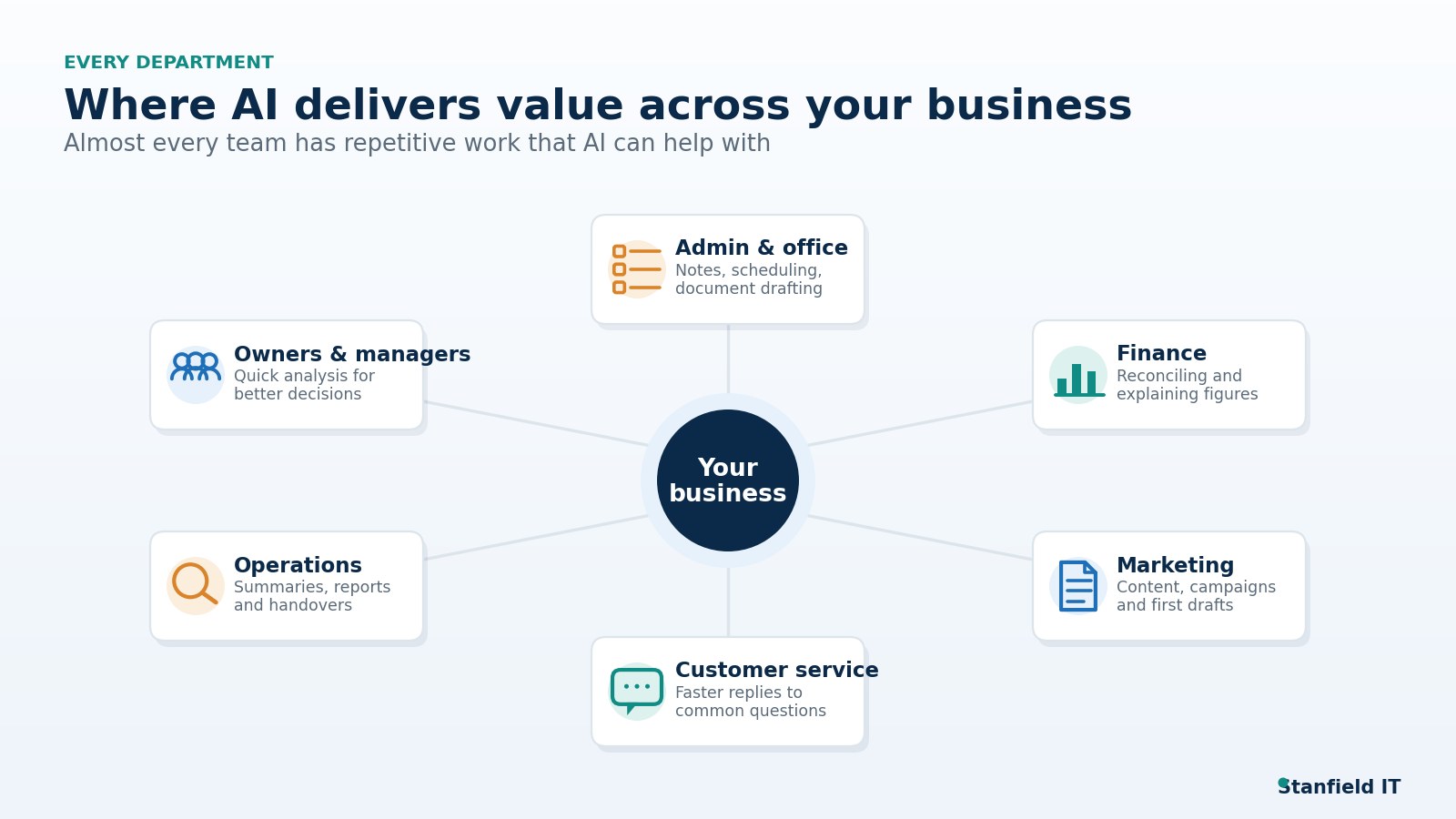
Across a typical business, almost every team has repetitive work that AI can help with.
Across a typical business, the opportunities show up in nearly every department. Admin, finance, marketing, customer service and operations all have repetitive work that AI can lighten. The challenge isn’t finding a use case. It’s making sure that as these tools spread through your business, they don’t quietly take your data somewhere you didn’t intend.
The Risks That Come With Moving Fast
Here’s where many businesses get caught out. The same qualities that make AI tools so easy to adopt — they’re free or cheap, instant, and accessible to anyone — also make them easy to misuse without anyone realising.
The biggest risk is something the industry now calls shadow AI: staff using AI tools the business hasn’t approved or secured. It usually starts with good intentions. An employee pastes a customer list into a free chatbot to write personalised emails, or drops a financial report into an online summariser to save time. In that moment, your data has left your control and landed on someone else’s servers, where you have no idea how it’s stored, who can see it, or whether it will be used to train a model.
This is far more common than most owners assume. Research in 2025 found that around 56% of employees use AI tools their employer hasn’t approved, while only a fraction use tools the business actually governs. Smaller businesses are especially exposed, partly because they rarely have the time or in-house expertise to set rules before people start experimenting.
The consequences are real and measurable. IBM’s research into data breaches found that incidents involving shadow AI cost organisations roughly US$670,000 more on average than other breaches, and the overwhelming majority of affected organisations had no proper controls over AI access when the breach occurred. It’s little wonder that, in the World Economic Forum’s 2026 outlook, chief executives ranked data leaks through generative AI as their single biggest security concern.
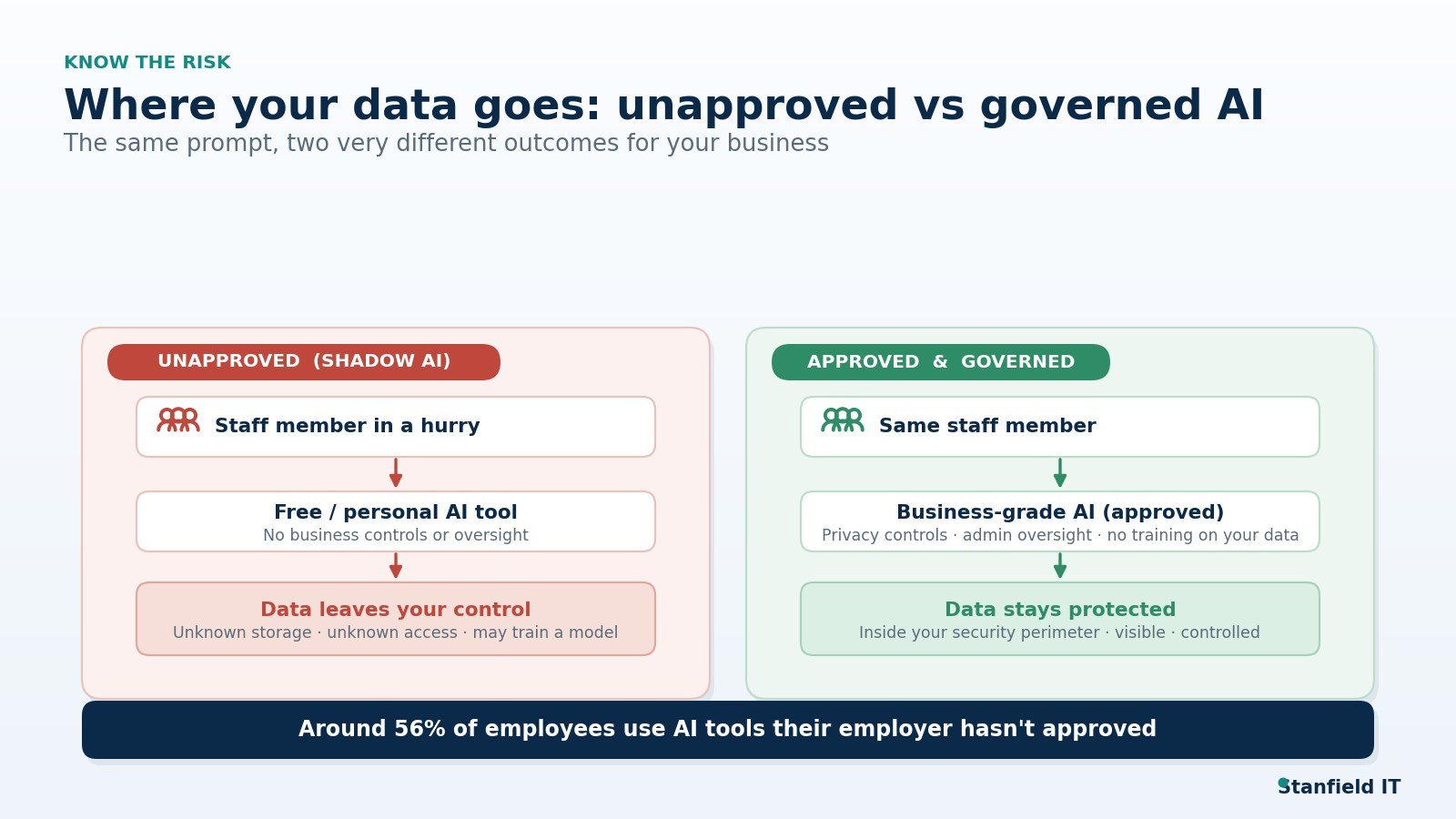
The same prompt can have very different outcomes depending on whether the tool is approved and governed.
The risks aren’t only about data leaking out. AI can also produce confident answers that are simply wrong, so relying on its output for important decisions without checking is its own kind of hazard. And because some AI features are now built into browser extensions and apps you already use, the exposure can hide in plain sight. None of this is a reason to avoid AI. It’s a reason to adopt it deliberately.
Why Security Has to Come First, Not as an Afterthought
There’s a pattern that plays out again and again with new technology. A business rushes to adopt it because everyone else is, gets value from it, and only thinks about security after something goes wrong. By then, the cleanup — lost data, regulatory headaches, damaged trust with customers — costs far more than getting it right would have.
AI is following the same pattern, only faster. One striking finding from 2026 research is that while around 80% of organisations worry about data leaking through AI, roughly 60% still have no specific plan to deal with it. That gap between concern and action is exactly where problems take root.
Building security in from the start is not about slowing your team down or wrapping AI in so much red tape that no one uses it. It’s the opposite. When people know which tools are approved and what they can safely do, they use AI with confidence instead of quietly going around IT. Clear guardrails actually speed adoption up, because they remove the uncertainty that makes cautious staff hesitate and reckless staff dangerous.
This is the balance worth getting right: enough freedom to capture the productivity gains, and enough control to keep your data and your reputation safe. The businesses that win with AI aren’t the ones that move fastest, or the ones that lock everything down — they’re the ones that do both at once.
Building a Secure Foundation for AI Automation for Business
So what does a sensible, secure approach actually look like? It doesn’t require a huge budget or a dedicated AI team. For most businesses, it comes down to six practical steps that build on the same security fundamentals you should already have in place.
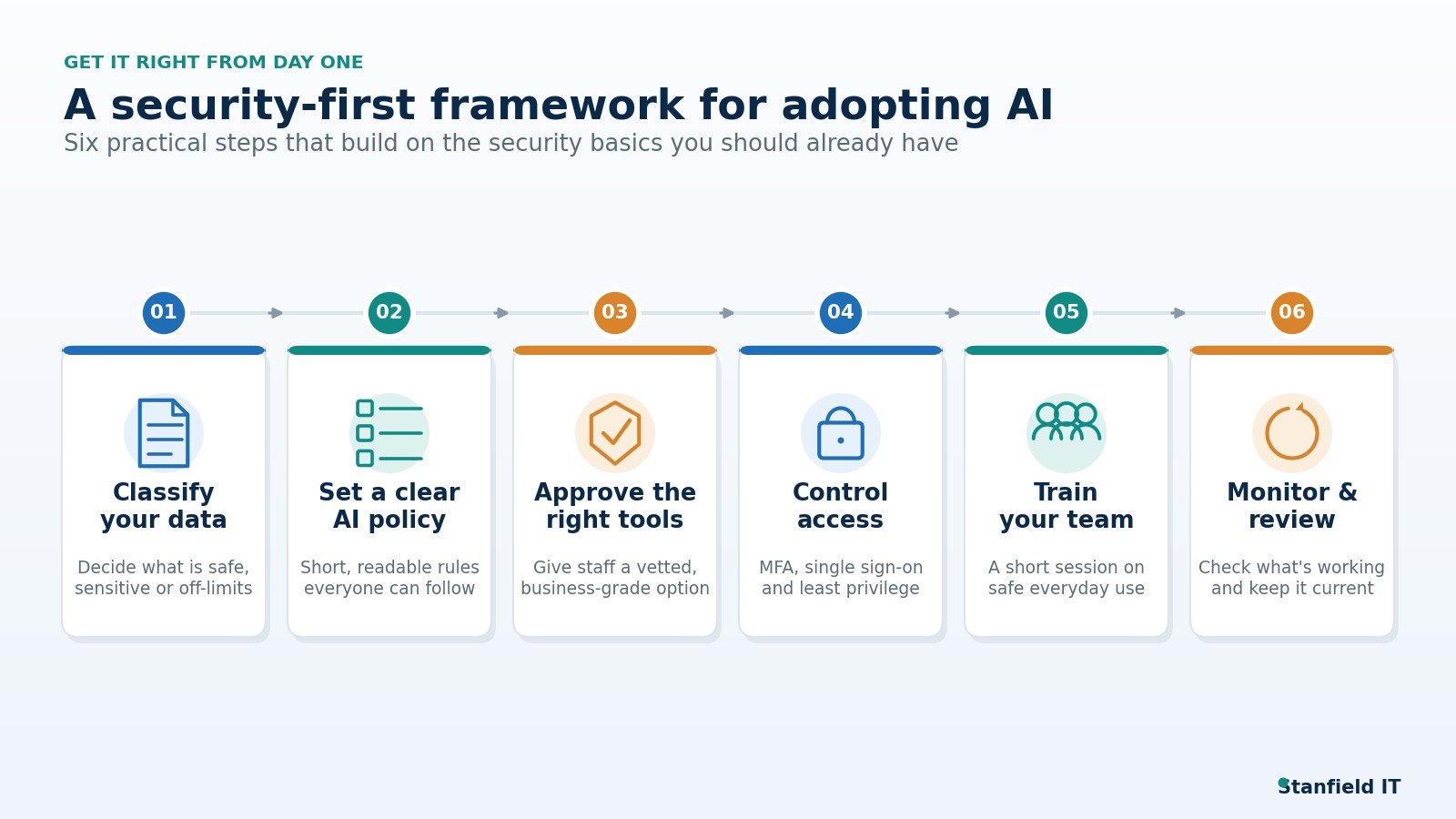
A practical, security-first sequence for adopting AI without leaving gaps.
Start by classifying your data. Before anyone uses AI, decide what information is fine to use, what needs caution, and what should never go near a public tool. Customer records, financial details, login credentials, health information and confidential contracts sit firmly in the “never” category unless you’re using a properly approved, secured platform. Clear labels take the guesswork away from staff and replace dozens of individual judgement calls with a simple rule.
A short reference like the one below makes this real for your team.
Set a clear AI policy. A short, readable document beats a thirty-page manual no one opens. It should explain which tools are approved, what data can and can’t be used, and who to ask when someone’s unsure.
Approve the right tools. Rather than banning AI and pushing people towards shadow tools, give them a vetted option. Business-grade AI platforms offer stronger privacy commitments — including not training on your data — along with the administrative controls that free consumer tools simply don’t have.
Control access. The same fundamentals that protect the rest of your systems apply here. Single sign-on, multi-factor authentication and giving people access only to what they need are core parts of frameworks like the Essential Eight, and they shouldn’t stop at your AI tools.
Train your team. Most AI mishaps come from people not knowing better, not from bad intent. A short, practical session on what’s safe and what isn’t prevents the majority of problems before they happen.
Monitor and review. AI tools, and the way your team uses them, will keep changing. It’s worth checking in periodically to see what’s working, what’s been adopted, and whether your policy still fits.
None of these steps is complicated on its own. The difficulty is finding the time and knowing how the pieces fit together with your wider security setup, which is exactly the sort of thing a good IT partner handles as part of managed IT services.
The Real Benefits When You Get the Balance Right
When AI is adopted thoughtfully, the payoff goes well beyond saving a few minutes on emails.
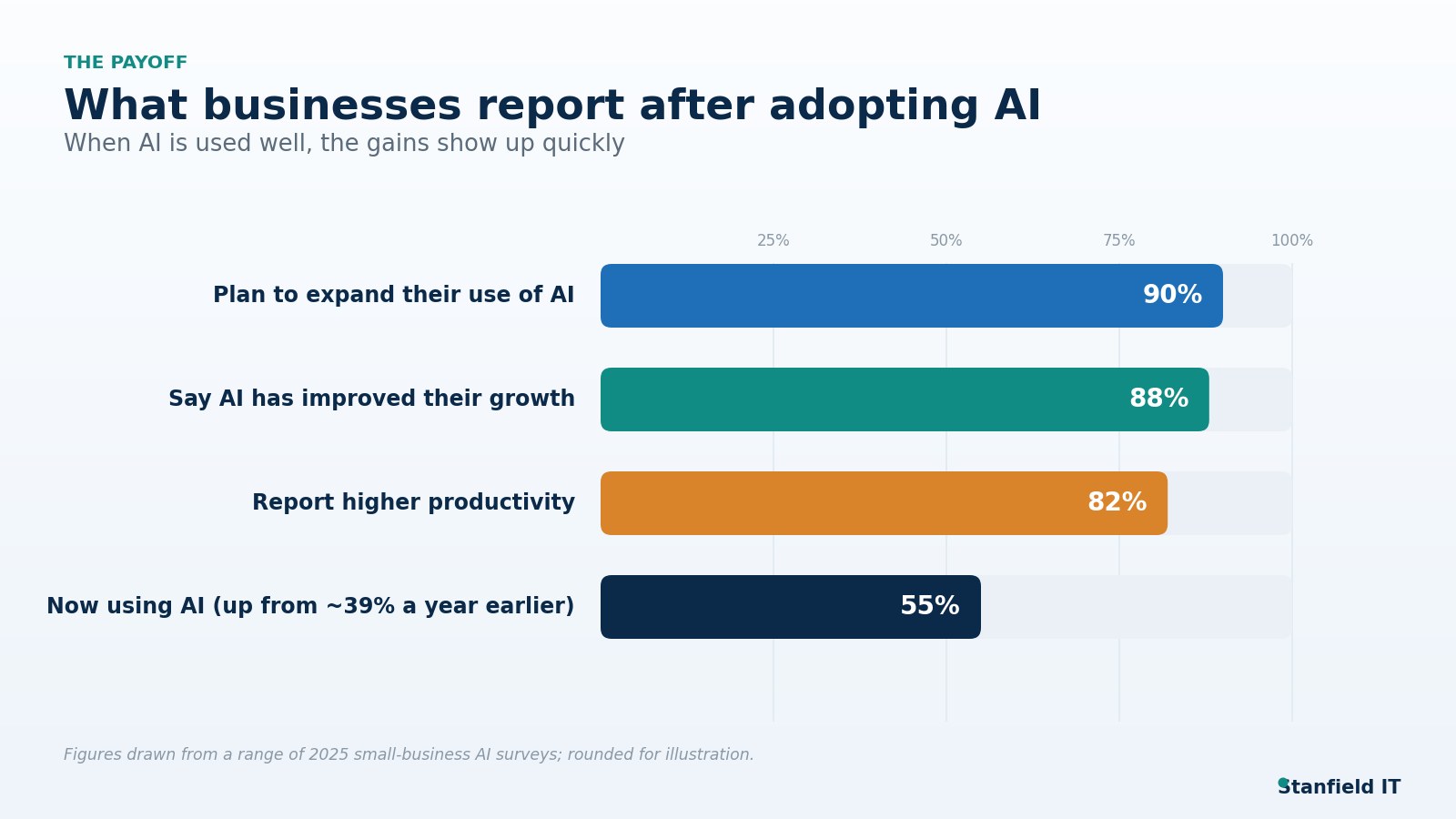
Businesses that adopt AI sensibly tend to see gains quickly — and most plan to do more.
The most obvious benefit is reclaimed time. Hours that used to go into routine drafting, summarising and data entry can be redirected to higher-value work: winning clients, improving service, and solving the problems that actually need a person. Surveys consistently show that businesses using AI report not just faster work but better decisions, because people spend less time wrangling information and more time acting on it.
There’s a clear cost benefit too. For many small businesses, AI handles work that would otherwise mean hiring or outsourcing, which lets a lean team do more without growing headcount. It also improves consistency, with drafts, responses and reports coming out to a reliable, professional standard every time.
Perhaps the most underrated benefit is morale. Few people enjoy repetitive admin. Handing the tedious parts of a job to AI lets your team spend more of their day on work that’s genuinely engaging, which tends to show up in both retention and quality.
And when security is built in from the start, all of this comes without the constant background worry about where your data might be ending up. That peace of mind is worth as much as the productivity gains themselves.
Common Mistakes Businesses Make With AI
A few avoidable missteps come up time and again. The first is doing nothing because it all feels overwhelming. Adoption barriers are usually about uncertainty rather than cost, and waiting too long simply means watching competitors pull ahead. The second is the opposite: rolling out AI with no rules at all, which is precisely how shadow AI and data leaks take hold.
Other common mistakes include trusting AI output without checking it, assuming free consumer tools are safe for business data, and treating AI security as something separate from the rest of your IT rather than part of the same picture. Each of these is easy to avoid once you’re aware of it, and far cheaper to prevent than to fix.
How to Get Started the Right Way
You don’t need to transform everything overnight. The most successful approach to AI automation for business is usually a measured one. Pick one or two genuine pain points, choose an approved tool, set simple ground rules, and let a small group try it before rolling it out more widely.
Pair that experimentation with the security basics — data classification, a short policy, proper access controls and a quick training session — and you’ll capture the upside while keeping the risks in check. As your confidence grows, you can expand into more areas knowing the foundations are solid.
If you’d rather not navigate this alone, this is precisely where an experienced partner adds value. Getting the security foundations right, and keeping them aligned with frameworks like the Essential Eight, is the core of strong cyber security services, and it’s far easier to build those guardrails before AI is everywhere in your business than to retrofit them afterwards.
Bringing It All Together
AI automation for business has moved from a future possibility to a present-day advantage, and the businesses adopting it sensibly are already seeing more time, lower costs and happier teams. But speed without security is a false economy. The risks — shadow AI, data leakage and over-reliance on unchecked output — are real, and they’re cheapest to address before they ever become problems.
The right path isn’t to rush in or to hold back. It’s to embrace AI deliberately: capture the productivity, classify your data, approve the right tools, control access and bring your team along with you. Get that balance right from the beginning, and AI becomes one of the most valuable, lowest-risk investments your business can make.
If your business wants to make the most of AI while keeping your data and systems secure, Stanfield IT can help you adopt the right tools, build sensible controls and get the foundations right from day one.